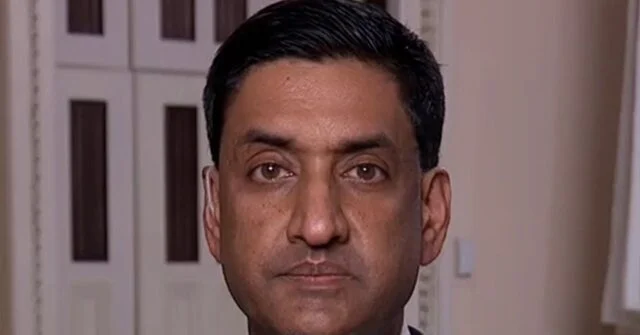
Khanna: Call to Arrest Netanyahu ‘Not Talking About Americans Who Are Subject to Our Own Law’
On Tuesday, during an appearance on CBS’s "The Takeout," Representative Ro Khanna (D-CA) articulated a firm stance on international accountability, asserting that individuals subject to arrest warrants from the International Criminal Court (ICC) should not be permitted entry into U.S. jurisdiction. Khanna specifically named Russian President Vladimir Putin and Israeli Prime Minister Benjamin Netanyahu as figures to whom this principle should be consistently applied, while clarifying that such measures would not extend to American citizens due to the absence of corresponding U.S. arrest warrants. This declaration has reignited discussions regarding the United States’ complex relationship with the ICC, the enforcement of international law, and the delicate balance between national sovereignty and global justice.
Khanna’s statement underscored a belief in the consistent application of international legal principles. "We should not allow people in our jurisdiction who have an arrest warrant by the ICC," he stated, adding, "My view on Netanyahu is the same as my view on Putin, if you have a warrant for your arrest by the ICC, and you’re coming here — not to the U.N., because the U.N. has its own rules — but you’re coming to the United States, then you should be arrested." He emphasized that this policy would not pose a threat to Americans, clarifying, "They don’t have any American arrest warrants. This is not talking about Americans who are subject to our own law. But that seems to be a consistent principle of international law, and I’d apply it to Putin like I’d apply it to Netanyahu." This distinction regarding U.S. citizens is crucial, as it acknowledges the prevailing American legal framework and the country’s historical reservations about the ICC’s jurisdiction over its nationals.
The International Criminal Court: A Framework for Global Justice
To fully appreciate the context of Khanna’s remarks, it is essential to understand the International Criminal Court. Established by the Rome Statute in 1998 and entering into force in 2002, the ICC is the first permanent international court with jurisdiction to prosecute individuals for the most serious international crimes: genocide, war crimes, crimes against humanity, and the crime of aggression. Headquartered in The Hague, Netherlands, its primary aim is to ensure that perpetrators of such heinous acts are held accountable and to help prevent these crimes from happening again.
The ICC operates on the principle of complementarity, meaning it acts only when national courts are unwilling or unable genuinely to investigate or prosecute such crimes. As of early 2024, 124 states are parties to the Rome Statute, granting the Court jurisdiction over crimes committed on their territory or by their nationals. Notably, several major global powers, including the United States, Russia, China, India, and Israel, are not state parties to the Rome Statute, raising significant challenges for the ICC’s enforcement capabilities.
A Timeline of Key ICC Actions and U.S. Engagement
The history of the ICC is punctuated by significant moments that shape its international standing and the reactions it elicits:
- 1998: Adoption of the Rome Statute in Rome, Italy, establishing the ICC. The United States signs the Statute under President Bill Clinton but does not ratify it.
- 2002: The Rome Statute enters into force, and the ICC is officially established. President George W. Bush "unsigned" the treaty, signaling deep U.S. skepticism and concerns about sovereignty and potential prosecution of American service members.
- 22002: The U.S. Congress passes the American Servicemembers’ Protection Act (ASPA), which prohibits U.S. cooperation with the ICC in certain circumstances and authorizes the President to use "all means necessary and appropriate" to free any U.S. or allied personnel detained or imprisoned by the ICC. This act highlights the long-standing tension between U.S. sovereignty and international judicial mechanisms.
- 2009-2016: Under President Barack Obama, the U.S. adopts a policy of "positive engagement," participating in ICC Assembly of States Parties meetings as an observer and offering support for certain investigations, particularly in Africa.
- 2020: The Trump administration imposes sanctions on ICC Prosecutor Fatou Bensouda and a senior aide, citing concerns over an investigation into alleged war crimes by U.S. forces in Afghanistan and by Israel against Palestinians. These sanctions were widely condemned internationally.
- 2021: The Biden administration revokes the Trump-era sanctions against ICC officials, signaling a return to a more nuanced, albeit still cautious, engagement with the Court.
- March 17, 2023: The ICC issues arrest warrants for Russian President Vladimir Putin and Maria Lvova-Belova, Russia’s Commissioner for Children’s Rights, on charges related to the alleged unlawful deportation of Ukrainian children from occupied areas to Russia. This move came amidst the ongoing full-scale invasion of Ukraine and was widely supported by Western nations, including the U.S., which acknowledged the ICC’s jurisdiction in this specific context despite its broader reservations.
- May 20, 2024: ICC Prosecutor Karim Khan announces his application for arrest warrants against Israeli Prime Minister Benjamin Netanyahu and Defense Minister Yoav Gallant, as well as Hamas leaders Yahya Sinwar, Mohammed Deif, and Ismail Haniyeh. The charges against the Israeli officials include war crimes and crimes against humanity, such as starvation of civilians as a method of warfare, willfully directing attacks against a civilian population, and extermination. The charges against Hamas leaders include extermination, murder, hostage-taking, and sexual violence. This decision sparked immediate and strong reactions globally, particularly from Israel and the United States.
The United States and the ICC: A Relationship of Strategic Ambiguity
The United States’ relationship with the ICC is characterized by a strategic ambiguity, balancing its commitment to human rights and accountability with its concerns about national sovereignty and the potential for politically motivated prosecutions. While successive U.S. administrations have expressed support for international justice in principle, particularly for prosecuting atrocities, they have consistently refused to ratify the Rome Statute.
The primary U.S. objection centers on the fear that American service members or officials could be subjected to politically motivated prosecutions by the ICC, undermining U.S. sovereignty and its ability to act globally. The American Servicemembers’ Protection Act (ASPA) remains a significant legislative barrier to full cooperation. However, the U.S. approach has not been monolithic. While the Bush administration actively hostile and the Trump administration punitive, the Obama and Biden administrations have shown a willingness to cooperate on a case-by-case basis, especially when U.S. interests align with the ICC’s mission, such as in the context of prosecuting Russian war crimes in Ukraine. This selective engagement highlights a pragmatic approach, where the U.S. leverages the ICC’s authority when it serves its foreign policy objectives, even while maintaining its distance.
Khanna’s Stance: A Call for Consistent Application of International Law
Representative Khanna’s remarks can be seen as an attempt to push the U.S. towards a more consistent and less selective application of international legal principles. By equating Putin and Netanyahu, he challenges the perceived double standards in international justice, where some leaders are pursued for alleged crimes while others, especially those allied with the U.S., might be afforded a different standard.
His specific exclusion of individuals visiting the United Nations headquarters in New York is also significant. The U.N. headquarters is considered international territory, and diplomatic immunity typically applies to heads of state and senior officials visiting for official U.N. business, regardless of ICC warrants. Khanna’s clarification indicates that his proposed policy would apply to individuals attempting to enter the United States proper, not those under the protective umbrella of U.N. diplomatic protocols. This distinction is crucial for understanding the practical implications of his proposal.
Reactions and Broader Implications
Khanna’s stance, particularly regarding an allied leader like Netanyahu, has drawn varied reactions and carries significant implications:
- U.S. Government Response: The Biden administration has strongly opposed the ICC prosecutor’s application for warrants against Israeli officials, calling it "outrageous" and asserting that the ICC has no jurisdiction over Israel. This reaction underscores the deep U.S. commitment to Israel’s security and its consistent rejection of the ICC’s authority to prosecute Israeli nationals. Khanna’s position, therefore, places him at odds with the current administration’s public posture.
- Israel’s Response: Israeli Prime Minister Netanyahu and other Israeli officials have vehemently rejected the ICC’s jurisdiction, accusing the court of antisemitism and a moral equivalence between Israel’s democratically elected government and Hamas, a designated terrorist organization. They maintain that Israel has a robust legal system capable of investigating alleged abuses and that the ICC’s intervention is an unwarranted political attack.
- Russia’s Response: Russia has consistently rejected the ICC’s jurisdiction and its warrant against Putin, dismissing it as politically motivated and legally null. As a non-member state, Russia does not recognize the Court’s authority over its citizens.
- International Legal Community: Khanna’s remarks contribute to an ongoing debate within the international legal community about the enforceability of ICC warrants, particularly against leaders of non-member states. While the ICC’s mandate is clear, its lack of enforcement mechanisms means it relies heavily on the cooperation of member states and the political will of the international community. The principle of universal jurisdiction, which allows national courts to prosecute certain international crimes regardless of where they were committed, is often invoked in such discussions, but its application remains complex and often politically charged.
- Impact on U.S. Foreign Policy: Should the U.S. adopt a policy of enforcing ICC warrants for non-American nationals, it would represent a significant shift in its foreign policy. Such a move could bolster the ICC’s authority and signal a stronger U.S. commitment to international justice, but it could also create diplomatic friction with non-ICC member states and complicate U.S. relations with allies who might find their leaders targeted by the Court. It would also force the U.S. to reconcile its selective engagement with the ICC, applying its principles even when it might be politically inconvenient.
- Internal Political Debate: Within the U.S., Khanna’s statement highlights a growing divergence of views on international law and the ICC, particularly among progressive Democrats who advocate for a more consistent application of human rights principles globally. This internal debate reflects a broader tension between traditional foreign policy realism and a more values-based, internationalist approach.
Conclusion
Representative Ro Khanna’s call for the consistent enforcement of International Criminal Court arrest warrants on U.S. soil, irrespective of the individuals’ status or their nation’s relationship with the U.S., injects a powerful new dimension into the enduring debate over international justice. By explicitly linking the cases of Vladimir Putin and Benjamin Netanyahu, Khanna challenges the strategic ambiguity that has long defined the U.S. posture towards the ICC. His position, while clarifying the exclusion of American citizens, underscores a desire for the United States to align its actions more closely with its stated values of accountability and human rights.
The practical implementation of such a policy would face formidable legal, diplomatic, and political hurdles, particularly given the U.S.’s non-ratification of the Rome Statute and its specific concerns regarding the ICC’s jurisdiction over allied leaders. Nevertheless, Khanna’s statement serves as a potent reminder of the ongoing tension between national sovereignty and the imperative of global justice, pushing the conversation towards a more rigorous and less selective application of international law in an increasingly interconnected and turbulent world. The ultimate trajectory of this debate will undoubtedly shape the future role of the United States in upholding and enforcing international legal norms.

Related Posts
Democratic Candidates Must Moderate to Win General Elections, Says Rep. Greg Stanton
Lisa Demuth Secures Republican Gubernatorial Nomination in Minnesota, Defeating Trump-Endorsed Mike Lindell