Former President Barack Obama Offers Counsel to WNBA Star Caitlin Clark Amidst Season of Scrutiny and Physicality
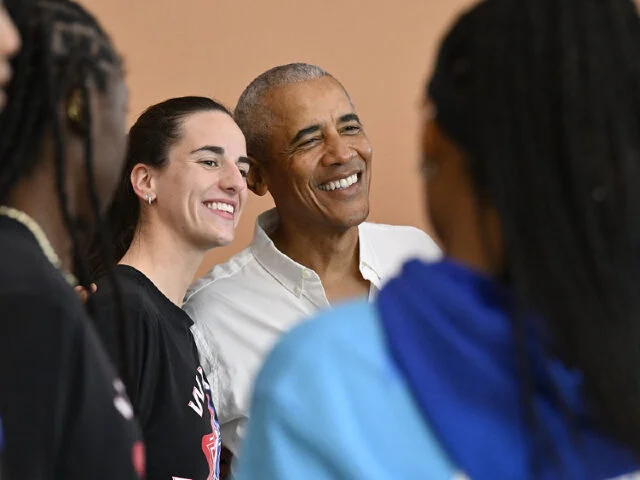
Former President Barack Obama engaged in a significant private conversation with WNBA rookie sensation Caitlin Clark in Chicago, providing her with invaluable advice as she prepared for her participation in the league’s All-Star Game. The interaction, which took place at the Obama Presidential Center’s indoor basketball court on Friday, July 12, 2024, saw the former president extend a message of encouragement and resilience to Clark, who has navigated an exceptionally challenging and scrutinized debut season in professional basketball. Obama’s counsel comes at a pivotal moment for Clark, whose electrifying play has brought unprecedented attention to the WNBA, but whose rookie year has also been marred by intense physicality on the court and a storm of public debate off it.
Obama, a well-known basketball enthusiast and keen observer of the sport, reportedly told Clark, “You’re great, you’re fantastic. Don’t let all this nonsense get you down. I always say one of the things that was luckiest for me was I didn’t get famous until I was like 45. So, I was an old man. You’re my daughters’ age; they haven’t had that much immersion in nonsense, so don’t lose that joy. The game’s, like, the game. And you’re a hooper.” This personal anecdote and direct encouragement underscore the unique pressures Clark faces as a young athlete catapulted into superstardom.
The Phenomenon of Caitlin Clark: A Transformative Force
Caitlin Clark’s journey to the WNBA was nothing short of historic. During her collegiate career at the University of Iowa, Clark shattered numerous scoring records, becoming the all-time leading scorer in NCAA Division I basketball history, regardless of gender. Her deep three-pointers, no-look passes, and magnetic charisma captivated audiences nationwide, leading to record-breaking viewership for women’s college basketball games. Her final season with the Hawkeyes culminated in a second consecutive appearance in the NCAA championship game, solidifying her status as a generational talent.
The anticipation surrounding Clark’s entry into the WNBA was immense, dubbed the "Caitlin Clark effect." The 2024 WNBA Draft, where she was selected first overall by the Indiana Fever, drew an unprecedented 2.45 million viewers, making it the most-watched WNBA draft in history. This immediate surge in interest translated directly to the professional league. Early-season WNBA games featuring Clark’s Indiana Fever consistently broke viewership records across various networks, with some games seeing audiences grow by over 300% compared to previous seasons. Arena attendance also soared, forcing several teams to move their games against the Fever to larger venues to accommodate demand. Merchandise sales, particularly Clark’s jerseys, also experienced exponential growth, signaling a new era of commercial viability for the league. This unprecedented spotlight, while beneficial for the league’s overall profile, also placed an extraordinary burden on Clark, making her every move, every shot, and every interaction a subject of intense scrutiny.
A Season Under Siege: Physicality and Public Scrutiny
Clark’s rookie season has been characterized by a relentless barrage of physical play from opponents, sparking widespread debate about player safety, officiating standards, and the perceived treatment of the league’s newest star. From the outset, Clark has been subjected to hard fouls, aggressive defense, and what many observers describe as targeted physicality.
A Chronology of Incidents:
- Early Season Adjustments: Even in preseason and the initial regular season games, Clark faced a stark increase in defensive intensity compared to her collegiate experience. Opposing players often employed aggressive tactics, including physical bumps, shoves, and hard screens, to limit her offensive impact.
- The Chennedy Carter Incident (June 1, 2024): A pivotal moment occurred during a game against the Chicago Sky, when Sky guard Chennedy Carter delivered a shoulder check to Clark from behind during an inbound play, knocking Clark to the ground. The foul, initially assessed as a common foul, was later upgraded to a flagrant 1 foul by the WNBA. The incident ignited a firestorm of public debate, with many condemning the foul as unsportsmanlike and potentially dangerous, while others defended it as part of the game’s competitive nature or "rookie treatment."
- Ongoing Physicality: Following the Carter incident, the level of physicality directed at Clark did not subside. Pundits and fans alike pointed to numerous instances where Clark appeared to be subjected to rougher play than other rookies or star players, often without commensurate foul calls. This led to accusations of inconsistent officiating and a perceived lack of protection for the league’s most prominent player.
- The DeWanna Bonner Foul (July 5, 2024): The controversy reached a new peak with the foul committed by Phoenix Mercury star DeWanna Bonner. During a game, Bonner viciously drove her fist into Clark’s neck while Clark was on the floor after a play. This egregious act, initially resulting in an ejection, escalated into a full-blown scandal. The WNBA’s initial response, which was criticized by many as insufficient, led to external pressure for stronger action. According to reports, NBA Commissioner Adam Silver had to intervene, pressuring WNBA Commissioner Cathy Engelbert to issue a more severe penalty. Bonner was subsequently suspended for one game, a decision that still left many questioning the league’s commitment to player safety and the enforcement of its own rules.
The public discourse surrounding these events has transcended typical sports analysis, delving into broader societal issues. Discussions have touched upon race, given that Clark is white in a league predominantly composed of Black players, and the dynamics of veteran players asserting dominance over a highly publicized rookie. The media, including ESPN’s Malika Andrews, has frequently pressed Clark on these controversies, forcing her to address the constant scrutiny.
Obama’s Counsel: Wisdom from Experience
Former President Obama’s decision to offer personal advice to Caitlin Clark carries significant weight. Obama’s lifelong passion for basketball is well-documented; he regularly played pickup games during his presidency and has often spoken about the sport’s lessons in teamwork and perseverance. His engagement with athletes, particularly those navigating high-pressure situations, is not new. He has hosted numerous championship teams at the White House and has often used sports as a metaphor for national unity and individual achievement.
His advice to Clark — "Don’t lose that joy" and "Don’t let all this nonsense get you down" — resonates deeply with his own experiences. Obama’s rise to national prominence was rapid, but he achieved widespread fame later in life, after years as a community organizer, civil rights attorney, and state and federal legislator. This allowed him to develop a strong sense of self and purpose before facing the relentless glare of the national and international spotlight. He contrasted his experience with Clark’s, noting her youth and the intensity of her early fame, similar to that of his own daughters. This connection highlights a paternal concern, urging her to maintain the intrinsic love for the game that first propelled her to greatness, rather than allowing external pressures to diminish her passion.
The timing of this interaction, just ahead of the WNBA All-Star Game, provides a symbolic moment of mentorship. For a player who has faced such intense public and physical challenges, a message from a figure of Obama’s stature can serve as a powerful affirmation and a reminder of the broader significance of her platform.
Clark’s Resilience: Addressing the Narrative
Caitlin Clark has consistently demonstrated a remarkable degree of poise and maturity in the face of constant pressure. In her interview with Malika Andrews, she articulated her perspective on the "false characterization" she often encounters in the media. “I think there’s just like a false characterization of who I am sometimes,” Clark stated. “And I get it, like, as a reporter or as a blogger, like you can write an opinion piece and that’s your job and whatever. But at the same time, like you don’t know me. Like we’ve never had a conversation. I get people have a job to do. But at the same time, like don’t make accusations about my character and who I am when you don’t know me. I understand this is your job and this is your profession, and this is what you get to do. And basketball is my profession, what I get to do. And the reason I play it is when I step in between the lines, I love it. And that’s what’s so fun about it for me: I get to compete. This was always my dream. And nobody should ever try to take that away from me.”
Clark’s statement underscores a common frustration among public figures: the disconnect between their public persona and their private reality. Her emphasis on the joy of competition and the fulfillment of a lifelong dream serves as a powerful counter-narrative to the often-negative portrayals of her season. It aligns perfectly with Obama’s advice to protect her inner joy and focus on the essence of being a "hooper."
The WNBA at a Crossroads: Growth, Safety, and Perception
The "Caitlin Clark effect" has undeniably propelled the WNBA into an unprecedented era of growth and visibility.
- Record Viewership and Attendance: In the first month of the 2024 season, the WNBA recorded its most-watched start ever, with games averaging over 1.3 million viewers across ABC, ESPN, and CBS. Arena attendance surged by over 15%, with multiple sellouts and teams playing in larger NBA venues.
- Economic Impact: The increased visibility is attracting new sponsors and investors, potentially leading to significantly larger media rights deals in the near future. This financial uplift is crucial for the league’s long-term sustainability and player compensation.
- Social Media Engagement: Social media metrics have exploded, with official WNBA accounts seeing massive increases in followers and engagement, reflecting a younger, more diverse fan base.
However, this rapid growth has also exposed underlying tensions and challenges within the league. The intense physicality directed at Clark, and the league’s handling of it, have drawn criticism regarding player safety and officiating consistency. Many analysts and former players have called for clearer guidelines on flagrant fouls and more rigorous enforcement to protect star players and prevent injuries. The perception that the league was slow to act on certain fouls, particularly the Bonner incident, has raised questions about Commissioner Cathy Engelbert’s leadership and the WNBA’s ability to manage its burgeoning popularity. The alleged intervention by NBA Commissioner Adam Silver highlights the inter-league relationship and the broader scrutiny the WNBA now faces.
Beyond the Court: Societal Implications
The debate surrounding Caitlin Clark’s rookie season has transcended the boundaries of sports, touching upon complex societal issues.
- Race and Gender Dynamics: The discourse has often intersected with discussions about race in sports. Some commentators have suggested that the criticism and physicality directed at Clark are partly fueled by racial dynamics within a predominantly Black league, while others argue that it’s simply part of "rookie hazing" regardless of race. These discussions highlight the ongoing challenges of race relations in America and how they manifest even in athletic competitions.
- Media Narratives: The extensive media coverage, both traditional and social, has amplified every incident and sparked heated debates. This phenomenon underscores the power of media to shape public perception and the difficulties public figures face in controlling their own narratives.
- Player Empowerment: The increased scrutiny on player safety and officiating also empowers athletes to demand better protections and more consistent rule enforcement, pushing the league to adapt to its evolving landscape.
The Power of a Voice: Obama’s Potential Influence
While Obama’s message to Clark was personal and encouraging, its public nature and the stature of the messenger could have broader implications. Obama is a figure who commands respect across various demographics, and his voice carries considerable moral authority. His counsel, framed around "not losing joy" and "not letting nonsense get you down," addresses the psychological toll of intense public scrutiny and physical challenges.
The original article suggested that a more direct message from Obama, particularly one urging WNBA players to cease aggressive tactics or calling on Commissioner Engelbert to better manage the league, could be impactful. While Obama’s message was not explicitly critical of the league or its players, his implicit acknowledgment of the "nonsense" Clark faces lends credence to her struggles. Given the political leanings of many WNBA players and the league’s history of social activism, a statement from a revered figure like Obama could subtly influence the locker room culture and encourage a more sportsmanlike environment.
Ultimately, Obama’s intervention serves as a powerful reminder of the human element behind athletic spectacle. It underscores the importance of mental fortitude and joy in the face of adversity, not just for Caitlin Clark, but for all athletes navigating the complexities of modern professional sports. As the WNBA continues its unprecedented growth trajectory, the challenges of managing its newfound prominence, ensuring player safety, and fostering a positive environment for all its stars will remain paramount. The wisdom offered by a former president to a rising phenom might just be a small, yet significant, step towards navigating these intricate dynamics.

Related Posts
Democratic Candidates Must Moderate to Win General Elections, Says Rep. Greg Stanton
Lisa Demuth Secures Republican Gubernatorial Nomination in Minnesota, Defeating Trump-Endorsed Mike Lindell