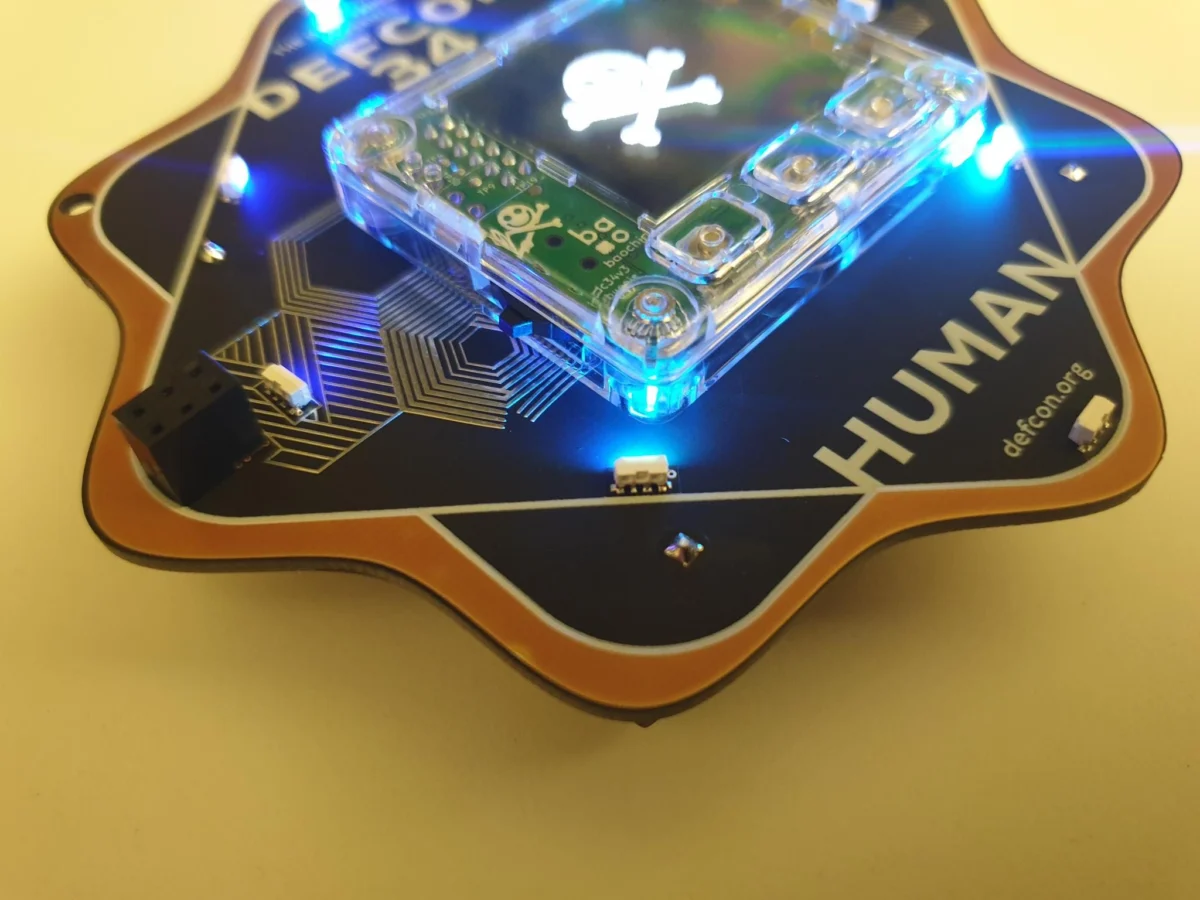
Defcon Attendees Receive First Fully Inspectable Open Source Hardware Security Token
For over three decades, the Defcon hacker conference has served as the global epicenter for cybersecurity research, where the annual conference badge is more than a mere credential—it is a coveted cultural artifact. These badges have evolved from simple plastic laminates into sophisticated electronic puzzles, often featuring intricate crypto-challenges, mechanical gear trains, and hidden Easter eggs. However, this year, the organizers have pivoted from aesthetic complexity to a groundbreaking achievement in hardware engineering. In collaboration with renowned hardware researcher Andrew “bunnie” Huang, Defcon is issuing 27,000 badges powered by the Baochip-1x, an innovative, open-source microcontroller designed to advance the standard for transparency and trust in computing.
The significance of this release extends far beyond the four-day event in Las Vegas. While traditional computer chips are "black-box" components—shrouded in opaque, impermeable resin that obscures their internal circuitry—the Baochip-1x is engineered to be fully verifiable. By publishing the source code for the operating system, firmware, processor core, and cryptographic engines on GitHub, Huang has provided a blueprint that allows researchers to audit the hardware down to the transistor level.
A Three-Year Journey Toward Verifiable Trust
The development of the Baochip-1x represents the culmination of a three-year research and development cycle. Huang’s objective was to address a fundamental flaw in modern supply-chain security: the inability for end-users to verify that a manufactured chip matches its design specifications. In the standard industry model, an opaque casing prevents physical inspection, leaving the user to rely entirely on the manufacturer’s integrity. If a malicious actor were to insert a backdoor during the fabrication process, it would be virtually impossible for the average user, or even a sophisticated firm, to detect it.
Huang’s breakthrough began three years ago through a strategic manufacturing partnership with Crossbar. By piggybacking on an existing commercial manufacturing run, Huang was able to integrate his CPU design onto the same wafer as Crossbar’s proprietary chip. This symbiotic approach allowed for the fabrication of a custom RISC-V-based microcontroller without the prohibitive multi-million-dollar costs typically associated with independent semiconductor production. The resulting hardware allows for both the proprietary Crossbar core and Huang’s open-source core to exist on the same silicon, with the latter being fully inspectable.
Technical Specifications and Transparency Features
The Baochip-1x is built on a 22-nanometer fabrication process, utilizing a 350 MHz RISC-V processor architecture. The chip is equipped with 2 megabytes of static random-access memory (SRAM) and 4 megabytes of resistive RAM (RRAM). Unlike traditional flash memory, RRAM is designed to be more resistant to physical extraction, complicating efforts by adversaries to dump data directly from the chip’s memory cells.

Perhaps most revolutionary is the physical packaging of the chip. By utilizing a transparent or infrared-permeable casing, the Baochip-1x allows researchers to shine infrared light through the silicon. This enables visual verification of the chip’s internal structures. By comparing the physical silicon against the published design files, auditors can ensure that the physical hardware has not been tampered with or modified during the fabrication phase.
While Huang acknowledges that some low-level physical-design elements associated with the fabrication process remain proprietary due to foundry restrictions, he emphasizes that this represents a quantum leap in openness for security-oriented silicon. The chip runs an operating system written in Rust—a programming language celebrated for its memory-safety guarantees—further mitigating risks associated with common vulnerabilities like buffer overflows.
Defcon 34: Agency and the Future of Authentication
The selection of the Baochip-1x as the core component for this year’s Defcon badge aligns with the conference’s overarching theme: “Agency.” Defcon founder Jeff Moss sought a solution that would empower attendees to take control of their own digital security, rather than relying on opaque, potentially vulnerable proprietary tokens.
The badge itself is designed for a second life after the conference. The core module is detachable and functions as a FIDO-compliant hardware security token. This allows users to employ the badge for two-factor authentication, password management, and time-based one-time password (TOTP) generation long after the event concludes. A low-resolution, nearsighted camera is included, specifically optimized for scanning QR codes during authentication processes. In adherence to Defcon’s strict privacy culture, the device is incapable of storing images and captures only the monochromatic data necessary for scanning.
This shift marks a departure from previous years, where the focus was primarily on social signaling and scavenger-hunt-style puzzles. By embedding a functional security tool into the badge, organizers are attempting to bootstrap the widespread adoption of open-source hardware, effectively putting a piece of cutting-edge, auditable security technology into the hands of 27,000 security professionals.
Security Analysis and Real-World Limitations
Despite the advancements offered by the Baochip-1x, Huang remains pragmatic regarding its security profile. He explicitly warns against the common industry tendency to overhype security products. While the Baochip-1x is designed to be highly resilient against remote, nonphysical attacks, Huang estimates that a determined adversary with a well-funded, multi-million-dollar hardware-analysis laboratory could potentially circumvent its defenses.

“I actually think it’s one of the most secure chips you can get out there, but I also think most chips have been oversold in terms of security,” Huang noted in recent discussions. By releasing the chip at Defcon, he is essentially inviting the world’s most talented hackers to attempt to find "zero-day" vulnerabilities. Rather than viewing this as a risk, Huang considers it a critical component of the development cycle. The collaborative, adversarial environment of the conference provides a unique testbed that would be impossible to replicate in a private lab.
Broader Implications for the Semiconductor Industry
The introduction of the Baochip-1x serves as a proof-of-concept for a more transparent future in hardware. The ability to verify the integrity of silicon is increasingly vital as concerns over state-sponsored supply-chain interdiction grow. By demonstrating that a collaborative, open-source approach to hardware is feasible, Huang is challenging the industry’s reliance on “security through obscurity.”
If successful, the Baochip-1x could influence future designs for hardware security modules (HSMs), secure enclaves, and consumer-grade security tokens. The project also demonstrates the potential for smaller research entities to leverage high-end fabrication processes through collaborative manufacturing, a model that could lower the barrier to entry for innovators in the open-hardware movement.
As the conference progresses, attendees are expected to begin porting their own software to the platform. With the chip already supporting MicroPython, C, and Rust development kits, the ecosystem surrounding the Baochip-1x is poised to expand rapidly. Whether the chip eventually evolves to run more robust environments like Linux or remains a specialized security token, its role as a milestone in the history of open-source hardware is already secured.
Ultimately, the Defcon 34 badge serves as both a tool and a statement. It represents a shift in the philosophy of security, moving away from the blind trust required by legacy black-box manufacturers toward a model where users possess the tools, knowledge, and agency to verify the integrity of the technology they rely on every day. As Huang aptly puts it, the goal is to reach a point where users can trust a chip down to the very core—down to the transistors themselves. With this year’s distribution, that goal is no longer a theoretical abstraction; it is in the hands of the attendees.

Related Posts

The Las Vegas Cybersecurity Summit and the Escalating Threat of Autonomous Digital Exploitation

New York City Council members and privacy advocates launch legislative campaign to ban biometric facial recognition at public entertainment venues