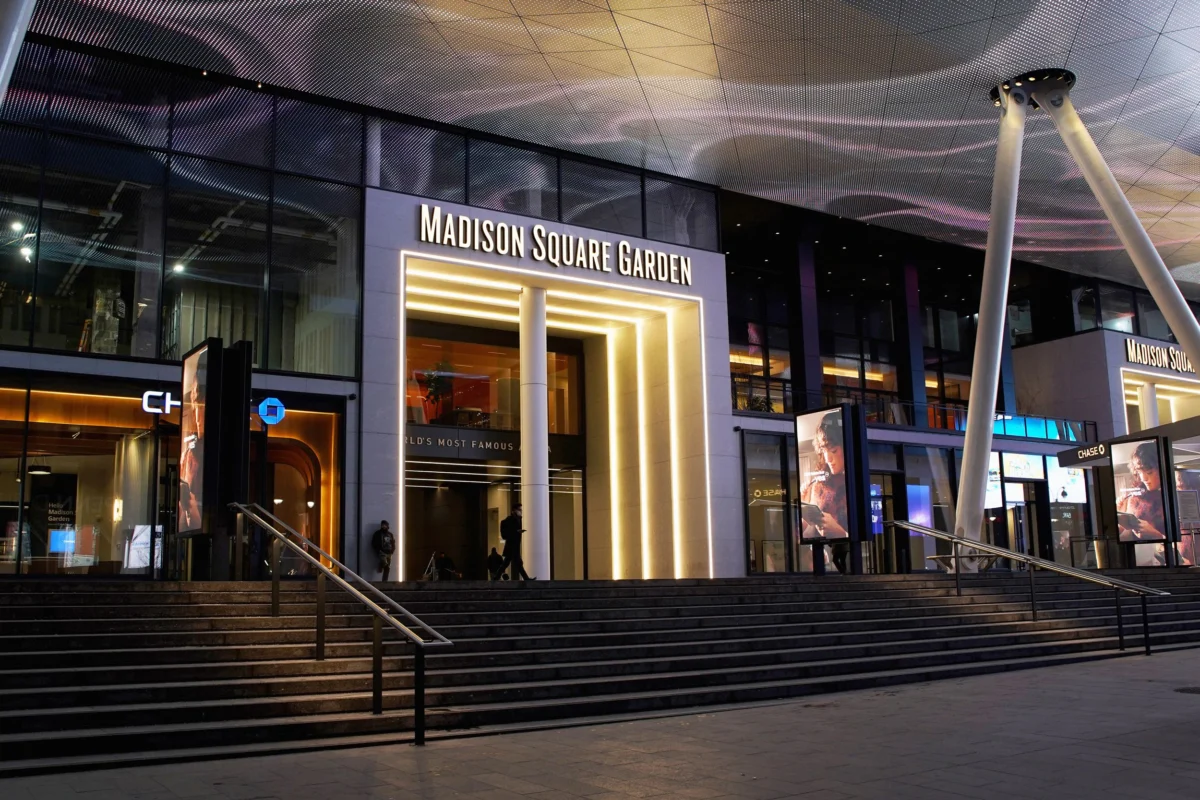
New York City Council members and privacy advocates launch legislative campaign to ban biometric facial recognition at public entertainment venues
Outside the iconic silhouette of Madison Square Garden on a brisk Friday, a coalition of privacy advocates, labor organizers, and musical artists gathered to demand an end to what they characterize as a pervasive surveillance apparatus. The rally, marked by the rhythmic chant of “ban the scan,” served as the public face of a burgeoning legislative push to prohibit the use of biometric facial-recognition technology in public-facing entertainment venues throughout New York City. At the center of the controversy is Madison Square Garden (MSG) and its chief executive, James Dolan, whose company has faced mounting scrutiny for its use of surveillance to enforce venue bans against individuals deemed unfavorable to the organization’s interests.
City Council member Shahana Hanif, the primary sponsor of the proposed legislation, addressed the crowd with a stark warning regarding the intersection of private sector data collection and public civil liberties. Hanif’s bill, introduced in January, seeks to establish a city-wide ban on the use of biometric recognition software by public venues, effectively challenging the operational status quo that has allowed MSG to maintain an extensive, highly granular database of its patrons. With 27 endorsements—representing a clear majority of the City Council—the bill is gaining political momentum, with supporters now in active discussions with Council Speaker Julie Menin to bring the measure to a floor vote.
The Evolution of the Surveillance Controversy
The friction between Madison Square Garden and the public has been simmering for years, rooted in the venue’s aggressive use of proprietary security protocols. While the venue has long defended its surveillance practices as necessary for ensuring public safety and maintaining an orderly environment, critics argue that the technology has been weaponized against perceived adversaries.
The controversy gained national attention when it was revealed that the venue utilized facial-recognition technology to identify and eject individuals involved in litigation against MSG or its subsidiary, MSG Entertainment. This included lawyers from firms engaged in active lawsuits against the company, as well as individuals who had previously expressed public criticism of the New York Knicks or the venue’s management.
One particularly notable incident involved a mother who was identified and blocked from entering Radio City Music Hall while attempting to escort her daughter to a holiday performance. Her exclusion was predicated on her status as an associate at a law firm that was, at the time, involved in a dispute with a restaurant property owned by the company. In other instances, fans have reported being tracked with such precision that the venue could catalog their movements within the arena, including duration of stay, restroom visits, food purchases, and the identities of those with whom they interacted.
Data Dossiers and Risk Scoring
The scope of the data collection extends beyond simple security screenings. In July, investigations revealed that MSG maintains a sophisticated database that assigns internal "risk scores" to approximately 400 celebrities, high-profile guests, and VIPs. These dossiers are not limited to behavioral history or litigation status; they have been reported to include sensitive demographic information, such as race and sexual orientation.
For civil liberties organizations like Fight for the Future and the NYC Democratic Socialists of America (DSA) Tech Action group, the existence of these dossiers represents a significant escalation in the commercial surveillance of private citizens. The aggregation of such sensitive data in a private database, without the explicit consent or knowledge of the individuals involved, raises fundamental questions regarding privacy rights and the potential for discriminatory profiling. MSG has vehemently denied these claims, leading to a defamation lawsuit filed by the company against the media outlet that broke the story.
Legislative Path: The "Ban the Scan" Bill
The "Ban the Scan" legislation represents a landmark attempt to regulate the deployment of AI-driven biometric tools at the municipal level. If passed, the law would mandate that private venues open to the public refrain from using facial recognition or similar biometric identifiers to vet, monitor, or track patrons.
Council member Hanif, drawing from her personal experience as a Muslim growing up in post-9/11 New York, views the legislation as a necessary corrective to the normalization of constant surveillance. She argues that the rhetoric of "safety" is frequently employed as a justification for the erosion of public anonymity. "New Yorkers need to understand that the tools being sold to us as solutions for city safety are, in practice, making our environment less predictable and less private," Hanif stated during the rally.
The legislative process has been methodical. By securing more than half of the City Council’s support, the proponents have signaled to leadership that there is a broad, bipartisan appetite for addressing the lack of oversight in how private entities use biometric data. The upcoming negotiations with the Speaker’s office will likely focus on the technical definitions within the bill to ensure it covers modern facial-recognition systems without creating unintended obstacles for legitimate, non-surveillance-based security measures.
The Defense of Biometric Security
In response to the growing public outcry, representatives for Madison Square Garden have maintained that their security practices are consistent with industry standards and are essential for protecting the thousands of people who pass through their doors daily.
"People have been recognizing each other’s faces since the beginning of time; we just do it electronically," an MSG spokesperson said in a statement provided to the press. This stance underscores the fundamental ideological divide in the debate: MSG views facial recognition as a modern, efficient version of human observation, while privacy advocates view it as an intrusive, mass-surveillance technology that fundamentally alters the relationship between the venue and the public.
Broader Implications for Privacy in Public Spaces
The struggle in New York City is indicative of a global debate regarding the role of AI in public spaces. As facial recognition technology becomes cheaper, more accurate, and easier to integrate into existing CCTV infrastructure, the threshold for its deployment continues to drop.
From a legal standpoint, the implications are profound. If the city successfully regulates the use of biometric technology by private venues, it could set a precedent for other jurisdictions. The central question remains: To what extent does an individual surrender their right to privacy when they enter a privately owned venue that is open to the public?
Legal analysts point out that while property owners have the right to exclude individuals from their premises, the use of automated, mass-surveillance technology to enforce these exclusions introduces a new layer of civil rights concerns. There is the risk of "false positives"—where innocent patrons are incorrectly identified as "high risk" due to algorithmic error—as well as the potential for the chilling effect that constant monitoring has on free expression and association.
Furthermore, the connection between corporate data collection and the political sphere has added a layer of urgency to the discourse. The association of James Dolan with political figures like Donald Trump has intensified concerns among some activists that the data collected by MSG could be used for political targeting or influence, a concern that Hanif echoed during her remarks at the rally.
The Future of "Ban the Scan"
As the legislative session progresses, the eyes of the nation will be on New York City. The city has historically been a testing ground for municipal regulations that eventually influence state and federal policy. Whether or not the "Ban the Scan" bill passes in its current form, it has successfully forced a public reckoning with the invisible surveillance networks that operate behind the closed doors of our most popular entertainment destinations.
The coalition behind the bill plans to continue their pressure campaign, organizing further rallies and informational sessions to educate the public on how facial recognition works and why they believe it poses a threat to democratic norms. For now, the debate remains deadlocked between those who prioritize the security and administrative convenience afforded by biometric technology and those who believe that the preservation of anonymity in public spaces is a non-negotiable component of a free society.
As New York City Council moves closer to deciding the fate of this legislation, one thing is certain: the era of unchecked biometric collection by private, public-facing venues is being challenged as never before. The result of this legislative battle will likely redefine the boundaries of corporate surveillance and individual privacy in the 21st-century urban landscape.

Related Posts

The Las Vegas Cybersecurity Summit and the Escalating Threat of Autonomous Digital Exploitation

Brazen AI Hardware Heists Signal a Dangerous Escalation in Global Cargo Theft