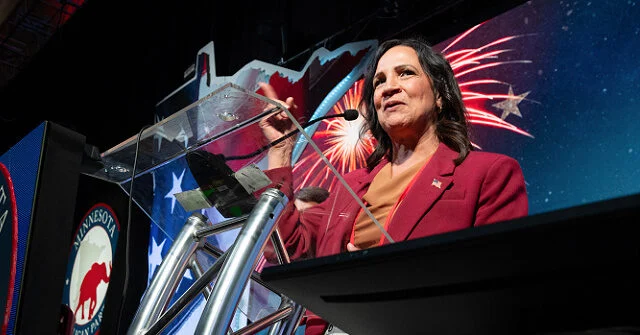
Lisa Demuth Secures Republican Gubernatorial Nomination in Minnesota, Defeating Trump-Endorsed Mike Lindell
Lisa Demuth, the seasoned Minnesota State House Speaker, has clinched the Republican nomination for Minnesota governor, decisively defeating MyPillow founder Mike Lindell in a primary election held on Tuesday night. The outcome marks a significant moment for the Minnesota Republican Party, as voters opted for a candidate with a long legislative track record over a high-profile figure whose political ascent has been closely tied to former President Donald Trump and his claims of widespread election fraud. Demuth’s victory sets the stage for a challenging general election campaign in a state often considered a crucial battleground.
The Primary Election Results and Key Figures
The contest saw Lisa Demuth secure 43.6 percent of the vote, comfortably ahead of Mike Lindell, who garnered 32.3 percent. This margin of over eleven percentage points underscores a clear preference among Republican primary voters for Demuth’s more traditional political background and legislative experience. The remaining votes were distributed among other, less prominent candidates in the crowded primary field. Demuth’s victory was a testament to her extensive grassroots organization, her established presence within the state’s political apparatus, and her ability to connect with a significant segment of the Republican base looking for a candidate with proven governmental experience.
Lindell, despite his national recognition and the coveted endorsement from former President Donald Trump, failed to translate his considerable media presence into a winning number of votes. His campaign largely centered on the controversial theme of "election integrity," a focus that resonated with a dedicated segment of the party but ultimately proved insufficient to overcome Demuth’s broader appeal and organizational strength.
The Contenders: A Contrast in Political Journeys
Lisa Demuth: The Established Legislator
Lisa Demuth’s political career is rooted in her long-standing engagement with Minnesota’s legislative process. Before her successful bid for the gubernatorial nomination, Demuth served as the Speaker of the Minnesota State House, a powerful position that requires deep understanding of policy, parliamentary procedure, and coalition-building. Her tenure as Speaker was marked by efforts to navigate complex legislative challenges, often involving negotiations across the aisle in a divided government. She represented a district that included both rural and suburban areas, giving her a nuanced perspective on the diverse needs of Minnesota constituents.
Throughout her legislative career, Demuth has championed fiscally conservative policies, advocating for lower taxes, responsible state spending, and deregulation to foster economic growth. She has also focused on issues pertinent to families and local communities, including education reform, public safety, and supporting small businesses. Her campaign for governor emphasized her ability to bring practical solutions to the state’s challenges, contrasting her legislative experience with the outsider status of her primary opponent. Her message resonated with voters seeking a candidate capable of effective governance rather than one primarily focused on national political narratives.
Mike Lindell: The Entrepreneur Turned Political Activist
Mike Lindell’s journey into politics is a story of celebrity, business acumen, and fervent activism. As the founder and CEO of MyPillow, Lindell built a successful brand through direct-response marketing and an omnipresent media presence. His transition into a prominent political figure began in earnest with his vocal support for Donald Trump during his presidency. Following the 2020 presidential election, Lindell emerged as one of the most fervent proponents of the unsubstantiated claims of widespread election fraud, investing significant personal resources into promoting these theories.
Lindell’s gubernatorial campaign was largely an extension of his national activism. He leveraged his media platform and direct-to-consumer marketing skills to reach voters, emphasizing his commitment to "election integrity" and his belief that Minnesota, like the nation, needed a leader willing to confront what he perceived as systemic corruption. His campaign rallies often featured discussions about voting machines, alleged irregularities, and the broader conservative movement, rather than traditional state-specific policy debates. While his message galvanized a passionate base, particularly those aligned with the "America First" movement and skeptical of election outcomes, it struggled to broaden its appeal beyond this core demographic.
Donald Trump’s Endorsement: A Double-Edged Sword?
A pivotal element of the primary race was the explicit endorsement of Mike Lindell by former President Donald Trump. Trump, known for his powerful influence within the Republican Party, issued a strong statement backing Lindell, referring to him as "the ‘Pillow Man,’ and one of America’s greatest and most hard working Patriots." Trump praised Lindell’s commitment to "Election Integrity" and stated, "if given the chance, Mike will be SPECTACULAR!!!" He further added, "Nobody has sacrificed more than Mike Lindell in fighting for our country, especially when it comes to Election Integrity."
Trump’s endorsement typically serves as a significant boost for candidates in Republican primaries, often proving decisive. However, in this Minnesota gubernatorial primary, its impact appeared to be mitigated. While it undoubtedly solidified Lindell’s support among a segment of the Republican base fiercely loyal to the former president, it was not enough to overcome Demuth’s deep roots in the state’s political landscape and her appeal to a broader cross-section of primary voters. This outcome provides another data point in the ongoing assessment of Trump’s endorsement power, suggesting that while still potent, it may not guarantee victory in every race, particularly when facing a well-organized and experienced local political figure. It highlights a potential divergence between national conservative media narratives and the preferences of state-level primary voters who prioritize local issues and proven governance.
The Campaign Trail Dynamics and Voter Turnout
The primary campaign unfolded over several months, with both candidates employing distinct strategies. Demuth focused on traditional campaign methods, including door-knocking, town halls, and leveraging her extensive network of legislative colleagues and party activists. Her messaging consistently highlighted her legislative achievements and her vision for a stronger Minnesota economy, improved public safety, and a more accountable state government. She presented herself as a pragmatic leader ready to tackle the state’s challenges head-on.
Lindell, conversely, relied heavily on his national media profile, social media presence, and direct appeals through his existing business channels. His rallies often drew enthusiastic crowds, but the organizational depth required for a statewide primary victory, particularly against an entrenched political figure like Demuth, proved challenging. The primary election saw a moderate turnout for an off-year primary, a factor that often favors candidates with strong grassroots operations capable of mobilizing their supporters. Demuth’s campaign demonstrated a superior ability to activate these crucial primary voters.
Demuth’s Victory and the Path Forward
Following her victory, Lisa Demuth celebrated in a post on X, articulating her gratitude and outlining her vision for the general election. "It’s an absolute honor to be the Republican candidate for governor of Minnesota. Today was a major milestone in this campaign, but we’re not done yet," she stated. Demuth’s remarks underscored her determination to push for "real change" at the state’s highest office. She emphasized themes of ending "fraud" – a term often used by Republicans to describe governmental inefficiency or mismanagement rather than specific election irregularities – restoring "common sense" to state government, and making Minnesota a place that "works for families, seniors, businesses and our next generation." Her call to "Let’s go win in November!" signaled an immediate pivot to the general election campaign.
Demuth’s victory speech carefully crafted a message that appeals to both traditional conservatives and potentially independent voters disillusioned with the current state administration. By focusing on broad themes of good governance, economic prosperity, and family values, she positioned herself as a mainstream Republican candidate capable of uniting different factions within the party and drawing support from beyond its core base.
Implications for the Minnesota Republican Party
Demuth’s win carries significant implications for the Minnesota Republican Party. It suggests a preference among primary voters for a candidate with governmental experience and a focus on traditional state-level issues, potentially signaling a desire to move beyond the more polarizing national debates that have often dominated the party’s recent discourse. Her nomination could be seen as an attempt by the state party to present a more electable face in a statewide general election, where success often depends on appealing to moderate and swing voters in the suburbs.
However, Lindell’s significant vote share (over 32%) also demonstrates the enduring influence of the "election integrity" movement and the Trump wing of the party. Demuth will need to skillfully navigate these internal party dynamics, working to unify the Republican base behind her candidacy while simultaneously broadening her appeal to win in November. Alienating Lindell’s supporters could prove detrimental, while leaning too heavily into their specific concerns might alienate moderates.
Looking Ahead to the General Election
The general election in Minnesota promises to be a highly competitive race. Minnesota is a state known for its political competitiveness, having voted for the Democratic presidential nominee in every election since 1976, yet often electing Republican governors and senators. The state’s political landscape is characterized by a stark urban-rural divide, with strong Democratic-Farmer-Labor (DFL) support in the Twin Cities metropolitan area and solid Republican strongholds in greater Minnesota, with suburban areas often acting as critical swing zones.
Demuth will likely face the incumbent DFL governor, whose administration has overseen a period of significant legislative activity and faced public scrutiny on issues ranging from the state budget and taxation to public safety and education. The upcoming contest will likely focus on several key issues:
- Economy and Taxation: Debates over the state’s budget surplus, tax policies, and cost of living will be central. Demuth is expected to advocate for tax cuts and fiscal restraint, while the DFL candidate will likely defend current spending priorities and investments in social programs.
- Public Safety: Crime rates and policing strategies, particularly in the Twin Cities, will be a major point of contention. Demuth will likely emphasize a "tough on crime" stance and support for law enforcement.
- Education: Discussions around school choice, curriculum, and educational outcomes will also feature prominently.
- Healthcare and Social Issues: These perennial issues will continue to shape voter decisions, reflecting the broader ideological divide between the parties.
Lisa Demuth’s challenge will be to translate her primary victory into a broader coalition capable of winning a statewide election. This will require not only energizing the Republican base but also convincing independent voters and disaffected Democrats that her vision for Minnesota offers a better path forward. Her extensive legislative experience and focus on practical governance could be a significant asset in this endeavor, positioning her as a credible and capable leader ready to assume the state’s highest office. The general election will serve as a crucial test of whether Minnesota voters are ready for a change in leadership and the direction of their state government.

Related Posts
Democratic Candidates Must Moderate to Win General Elections, Says Rep. Greg Stanton
Senator Sarah McBride Urges Strategic Shift in Transgender Rights Advocacy, Emphasizing Dialogue Over Disengagement