UK Supreme Court to Review Terrorist Designation of Palestine Action Amid Growing Concerns Over Protest Rights
The United Kingdom Supreme Court has officially granted permission for the direct-action group Palestine Action to appeal its designation as a terrorist organization, marking a pivotal moment in a protracted legal battle that has sparked intense debate over the boundaries of civil liberties and national security. The decision, handed down on July 30, comes after a series of conflicting judicial rulings and a period of significant political transition within the British government. The case is expected to serve as a landmark test for the UK’s proscription powers and the legal definition of terrorism as it applies to domestic protest movements.
The controversy stems from the 2025 decision by the UK government to proscribe Palestine Action under the Terrorism Act 2000. While the group initially successfully challenged this designation in the High Court, the ruling was subsequently overturned by the Court of Appeal in June, reinstating the group’s status as a terrorist entity. The Supreme Court’s intervention now offers a final judicial review of whether a group primarily engaged in property damage and civil disobedience can be legally categorized alongside organizations that engage in mass casualty violence.
Chronology of the Legal and Political Conflict
The trajectory of Palestine Action from a fringe activist group to a proscribed organization involves a series of legislative escalations and judicial shifts.
In the early 2020s, Palestine Action gained notoriety for its "direct action" tactics, which primarily targeted the UK-based facilities of defense contractors, most notably Elbit Systems. These actions frequently involved the occupation of factory roofs, the use of red paint to symbolize bloodshed, and the smashing of windows or equipment. At the time, participants were generally prosecuted for criminal damage, aggravated trespass, or burglary.
By 2025, citing the persistent nature of these disruptions and the alleged "intimidation" of employees and local communities, the Home Office took the unprecedented step of designating the entire organization as a terrorist group. This move shifted the legal landscape entirely; membership in the group, wearing its insignia, or expressing support for its aims became criminal offenses punishable by significant prison sentences.
In early 2026, the High Court ruled in favor of Palestine Action, suggesting that the government had overreached. The presiding judges argued that while the group’s actions were undoubtedly illegal under criminal law, they did not meet the threshold of "terrorism" as intended by Parliament, particularly when balanced against the rights to freedom of expression and assembly under the European Convention on Human Rights (ECHR).
However, the government appealed this decision. In June 2026, the Court of Appeal reversed the High Court’s findings. The appellate judges ruled that the statutory definition of terrorism—which includes serious damage to property intended to influence the government or an international organization for a political or ideological cause—was broad enough to encompass Palestine Action’s activities. This reinstatement of the ban led directly to the group’s current petition to the Supreme Court.
The Legislative Backdrop: A Successive Crackdown on Dissent
The legal struggle surrounding Palestine Action does not exist in a vacuum. It is the culmination of a multi-year legislative trend aimed at tightening control over public demonstrations. This era began under the previous Conservative administration, which introduced the Police, Crime, Sentencing and Courts Act 2022 and the Public Order Act 2023. These laws introduced new offenses such as "locking on" and gave police greater powers to shut down protests that were deemed "too noisy" or "seriously disruptive."
The transition to a Labour government did not signal a reversal of these policies. Under former Prime Minister Keir Starmer, the government introduced the Crime and Policing Act 2026. This legislation further expanded police powers, creating additional protest-related crimes and increasing the severity of penalties for peaceful activists. Critics argue that these laws have created a "patchwork" of confusing regulations that make it nearly impossible for citizens to know where lawful protest ends and criminal activity begins.
The current Prime Minister, Andy Burnham, who took office in July 2026, has inherited this legislative framework. While Burnham has historically projected a more populist and civil-liberties-focused image than his predecessor, his administration has yet to move toward repealing the most controversial aspects of the recent policing acts.
Data and Impact: The Scale of the Crackdown
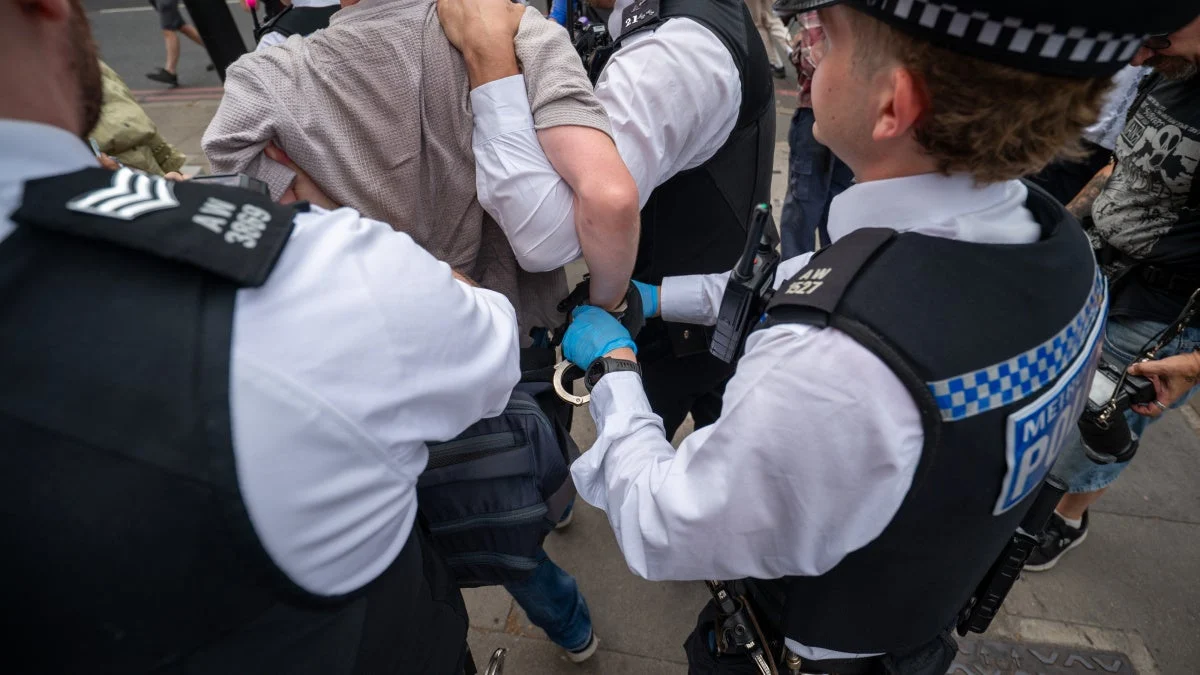
Since Palestine Action was designated as a terrorist organization in 2025, the impact on the ground has been substantial. According to data compiled by legal monitors and reported by various outlets, more than 3,000 individuals have been arrested for showing support for the group. These arrests range from individuals participating in direct action to those simply displaying the group’s logo at unrelated peaceful rallies.
The human cost of this designation is significant. Under the current anti-terror laws:
- Sentencing: Individuals convicted of membership in a proscribed organization face up to 14 years in prison.
- Police Powers: The designation allows for enhanced surveillance, stop-and-search powers without reasonable suspicion under Section 47A of the Terrorism Act, and the freezing of assets.
- Employment and Travel: Those arrested under terror legislation, even if not eventually charged, often face immediate suspension from employment, particularly in the public sector, and find themselves placed on international "no-fly" lists.
Human rights organizations, including Liberty and Amnesty International, have noted that the 3,000 arrests represent a historic high for the detention of protesters under anti-terrorism legislation in the UK, surpassing figures seen during the height of the environmental movements or anti-war protests of previous decades.
International Reactions and Human Rights Concerns
The UK’s approach to protest has drawn sharp criticism from the international community. Gina Romero, the United Nations Special Rapporteur on the rights to freedom of peaceful assembly and of association, has been vocal in her condemnation of the Crime and Policing Act 2026. In a recent statement, Romero described the legislation as "fundamentally incompatible with international human rights obligations."
Romero and other UN experts have expressed alarm over what they describe as the "systemic erosion" of the right to protest in the United Kingdom. They argue that by labeling property-focused activism as "terrorism," the UK government is setting a dangerous precedent that authoritarian regimes elsewhere might use to justify the suppression of their own domestic dissidents.
The Office of the United Nations High Commissioner for Human Rights (OHCHR) has also issued communications to the UK government, stating that the use of counter-terrorism measures against protest groups violates the principles of necessity and proportionality. The OHCHR emphasizes that while states have a duty to protect property and public order, they must do so using ordinary criminal law rather than the extraordinary powers reserved for national security threats.
Official Responses and Political Implications
The Burnham administration now faces a complex dilemma. Home Secretary Shabana Mahmood is under increasing pressure from civil rights groups and the more liberal wing of the Labour Party to reverse the proscription of Palestine Action. Proponents of this reversal argue that the designation was a "politically motivated mistake" by the previous administration that undermines the integrity of the UK’s counter-terrorism strategy.
Conversely, supporters of the ban, including some within the security services and the defense industry, argue that Palestine Action’s tactics constitute a form of economic sabotage that threatens national interests and public safety. They maintain that the group’s coordinated efforts to shut down manufacturing sites go beyond the scope of "peaceful protest" and require a robust state response.
A spokesperson for the Home Office stated following the Supreme Court’s decision to hear the appeal: "The government remains committed to ensuring the safety of the public and the protection of businesses from illegal disruption. While we respect the judicial process, we maintain that the designation of organizations is based on a rigorous assessment of their activities and the threat they pose to the rule of law."
Analysis of Broader Implications
The Supreme Court’s upcoming review will likely focus on the "proportionality" of the government’s actions. Legal experts suggest the court will examine whether the "terrorist" label is a necessary tool for the state or if existing laws against criminal damage and public disorder are sufficient to manage the group’s activities.
If the Supreme Court rules in favor of Palestine Action and strikes down the designation, it would be a major blow to the government’s current policing strategy. It would likely force a wholesale review of the proscription process and could lead to the quashing of hundreds of convictions and the dismissal of thousands of pending cases.
However, if the Court upholds the designation, it will solidify a new legal reality in the UK: one where the intent to influence government policy through property damage is legally indistinguishable from terrorism. This would have a "chilling effect" on all forms of activism, as groups advocating for climate action, animal rights, or social justice may find themselves vulnerable to similar designations if their tactics involve any degree of non-violent law-breaking.
As the Burnham government navigates its first year, the resolution of this case will define its stance on the balance between state authority and individual liberty. The decision will not only determine the fate of Palestine Action but will also signal to the world whether the United Kingdom intends to uphold its tradition of robust public dissent or continue its trajectory toward a more restrictive and controlled civic space.

Related Posts
Human Rights Watch Calls for Investigation into Death of Detainee Following Removal from Najaf Hospital by Iraqi Drug Police
Human Rights Watch Urges UN Security Council to Extend Lebanon Peacekeeping Mission Amid Escalating Conflict and Humanitarian Crisis