
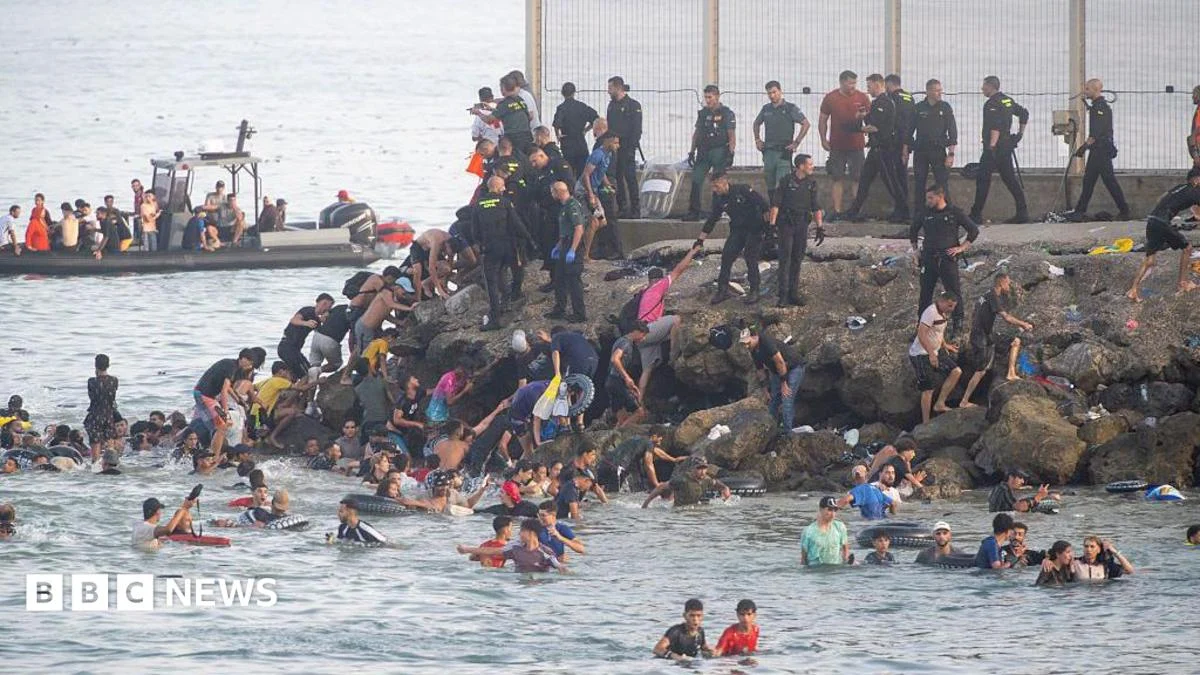
Ceuta: EU calls for stronger borders after migrant crossings into Spanish territory
The Ceuta Crisis: An Unprecedented Surge
The events unfolded with dramatic speed and scale, beginning on Monday, May 17, 2021, when an estimated 10,000 to 12,000 people, mostly Moroccan nationals, surged across the border into Ceuta. This Spanish autonomous city, along with Melilla, constitutes the European Union’s only land borders with an African nation. Migrants utilized various methods to cross, including swimming around breakwaters, scaling fences, and wading through shallow waters, often with little resistance from Moroccan border guards. Spanish authorities, initially overwhelmed, swiftly deployed military personnel and Guardia Civil reinforcements to the border, working to stem the flow and manage the thousands who had already entered.
By the end of the week, Spanish estimates indicated that approximately 6,950 individuals had been returned to Morocco, a figure exceeding initial projections of 5,000. This rapid repatriation effort, while demonstrating Spain’s resolve, also drew scrutiny from human rights organizations regarding due process. Tragically, the human cost of the crisis was significant, with the official death toll on the Spanish side of the border standing at 72, and 11 deaths reported on the Moroccan side, primarily due to drowning or injuries sustained during the hazardous crossings. The sheer volume and speed of the influx presented an immense humanitarian challenge, particularly concerning the hundreds of unaccompanied minors who arrived in Ceuta, placing significant strain on local social services.
Background and Geopolitical Context: A Deep-Rooted History
The Spanish enclaves of Ceuta and Melilla have long been flashpoints in Spain-Morocco relations and critical points for irregular migration into Europe. These cities, remnants of Spain’s colonial past, have been under Spanish sovereignty for centuries, but Morocco has consistently claimed them as integral parts of its territory. This historical and territorial dispute frequently simmers beneath the surface of diplomatic relations, occasionally erupting into open friction.
The immediate catalyst for the May 2021 surge was widely believed to be a diplomatic row between Madrid and Rabat. Spain had secretly allowed Brahim Ghali, the leader of the Polisario Front, a Western Sahara independence movement opposed by Morocco, to be hospitalized for COVID-19 treatment in a Spanish hospital. Morocco viewed this as a hostile act and a breach of trust. While Rabat officially denied any deliberate relaxation of border controls, many international observers and Spanish officials interpreted the sudden cessation of Moroccan border patrols as a retaliatory measure, a form of "migration blackmail" to pressure Spain into a more favorable stance on the Western Sahara issue.
For decades, Morocco has acted as a crucial partner for the EU in migration control, receiving substantial financial aid to manage its borders and prevent irregular departures to Europe. The Ceuta incident underscored the fragility of this arrangement and the potential for migration to be weaponized in geopolitical disputes.
A Detailed Timeline of the Crisis:
- April 2021: Brahim Ghali, leader of the Polisario Front, is secretly admitted to a hospital in Logroño, Spain, for COVID-19 treatment. Morocco learns of this and expresses strong disapproval.
- May 17, 2021 (Monday): Large numbers of migrants begin to cross into Ceuta from Morocco. Initial reports suggest thousands are entering, many swimming around the border fences. Moroccan border guards are notably absent or inactive. Spanish authorities are quickly overwhelmed.
- May 18, 2021 (Tuesday): The influx continues, with estimates reaching 8,000 to 12,000 arrivals within 24-48 hours. Spain deploys military units and additional police to the border. European Commissioner for Home Affairs, Ylva Johansson, expresses solidarity with Spain, emphasizing that "the Spanish border is a European border."
- May 19, 2021 (Wednesday): Spanish forces regain control of the border. Repatriations begin in earnest. Images of soldiers and police aiding migrants, as well as firmly pushing others back, circulate globally. The humanitarian situation for unaccompanied minors becomes a significant concern.
- May 20-21, 2021 (Thursday-Friday): The number of new arrivals significantly decreases as Moroccan authorities resume some border control functions. Spain focuses on processing and returning migrants, while humanitarian organizations raise concerns about the treatment of vulnerable individuals.
- May 22, 2021 (Saturday): Spanish Interior Minister Fernando Grande-Marlaska declares the situation has "almost returned to normal," with most adult migrants having been returned. Focus shifts to the welfare of unaccompanied minors and longer-term border security measures, including plans for an inflatable barrier in the water.
- May 25, 2021 (Tuesday): EU interior ministers hold an emergency video conference to discuss the crisis and its implications for European border security and migration policy.
Statistical Overview and Demographics of the Influx
The estimated 10,000 to 12,000 individuals who crossed into Ceuta represented an unprecedented single-event surge. While a precise demographic breakdown is still being compiled, initial assessments indicated that the vast majority were Moroccan nationals, including a significant proportion of young men and an estimated 1,500 to 2,000 unaccompanied minors. These children and adolescents presented a particular legal and humanitarian challenge, as international law dictates specific protections for minors, complicating immediate repatriation.
The economic fallout from the COVID-19 pandemic is widely cited as a major push factor. Morocco’s economy, heavily reliant on tourism and remittances, suffered significantly, exacerbating existing high youth unemployment rates and driving many to seek better prospects in Europe. The chaotic nature of the crossing also resulted in fatalities, with the identified 72 deaths on the Spanish side and 11 on the Moroccan side underscoring the extreme risks taken by migrants. Historically, migration flows through the Western Mediterranean route have been volatile, but the Ceuta incident dwarfed previous surges in both speed and volume, highlighting a new dimension of vulnerability at the EU’s external borders.
Official Reactions and Diplomatic Fallout
The Ceuta crisis immediately triggered a wave of reactions across Europe, laying bare both solidarity and simmering tensions within the bloc.
European Commission’s Stance:
Ursula von der Leyen, President of the European Commission, swiftly voiced strong support for Spain, praising Prime Minister Pedro Sánchez’s "swift handling" of the crisis in a letter. However, she underscored a critical lesson: "From this incident, it is clear that we must do more to further strengthen our borders at critical points." Von der Leyen reiterated that "the protection of all our external borders is a shared European responsibility," advocating for "vigilant monitoring and the use of physical barriers where needed."
Her call for "united action and solidarity" was accompanied by a five-point strategy for the EU to "double down" on:
- Preventing irregular migration: Through enhanced cooperation with partner states (like Morocco).
- Strengthening external borders: Implementing robust physical and technological measures.
- Implementing early warning systems: To anticipate and respond to future surges.
- Dismantling smuggling networks: Targeting the criminal organizations that facilitate irregular crossings.
- Reinforcing returns: Ensuring efficient and dignified repatriation of those without legal grounds to remain.
Spain’s Position and Internal EU Divisions:
Prime Minister Sánchez, while grateful for the support from most EU member states, expressed "serious concerns" about others who, he claimed, had chosen to attack Spain, "driven by prejudice, fake news, ignorance, or political interest." He pointedly noted that Ceuta, while Spanish territory, is not part of the Schengen Area, meaning the border with Morocco is Spain’s external border, but not directly a Schengen border in the same way as, for example, a border with a non-EU country in continental Europe. This distinction was crucial in light of reactions from certain member states.
The scenes in Ceuta profoundly strained relations among some of the EU’s 27 member states, particularly concerning the integrity of the Schengen agreement. Italy, a frontline state in its own right facing significant migration challenges, temporarily suspended the Schengen arrangement with Spain. This extraordinary move, citing concerns over border security and the free movement of people within the passport-free zone, was backed by Finland and Denmark. Even more forcefully, Czech Prime Minister Andrej Babiš urged a temporary suspension of Spain’s Schengen membership altogether, signaling a severe lack of confidence in Spain’s ability to manage its borders and, by extension, the EU’s collective external border. These reactions highlighted the enduring tension between national sovereignty and the shared responsibilities inherent in a borderless zone like Schengen.
Moroccan Response (Inferred and Official):
Moroccan officials largely maintained silence or offered vague statements regarding the border situation, though some government-aligned media outlets in Morocco framed the events as a consequence of Spain’s decision to host Brahim Ghali. While Morocco eventually resumed some level of border control, the initial lack of intervention was widely interpreted as a deliberate diplomatic maneuver. This incident starkly reminded the EU of Morocco’s strategic importance as a gatekeeper for African migration and its willingness to leverage this position.
Humanitarian Organizations’ Concerns:
Organizations such as UNHCR, UNICEF, and local NGOs operating in Ceuta quickly called for humane treatment of migrants, emphasizing the protection of unaccompanied minors. They stressed adherence to international and European law regarding asylum, non-refoulement, and child protection, urging authorities to ensure proper identification, registration, and care for all vulnerable individuals, rather than immediate, blanket repatriations.
Broader Implications and Future Challenges
The Ceuta crisis is more than an isolated incident; it serves as a potent microcosm of the multifaceted challenges facing the European Union regarding migration, border security, and internal cohesion.
Schengen Area Integrity:
The temporary suspension of Schengen arrangements by Italy and the calls for Spain’s suspension underscore the fragility of the passport-free travel zone. While Schengen has been temporarily suspended by member states in the past for security reasons (e.g., major sporting events, terror threats), the Ceuta incident demonstrated how a crisis at an external border, perceived as inadequately managed by one member state, can quickly erode trust and trigger internal border checks, threatening the fundamental principle of free movement within the EU. This ongoing tension between national control and collective responsibility will likely continue to fuel debates on the future of Schengen.
EU’s Migration Policy:
The crisis injected new urgency into the stalled negotiations surrounding the EU’s New Pact on Migration and Asylum. Proposed by the Commission in 2020, the pact aims to establish a more predictable and fair system for managing migration, emphasizing solidarity and responsibility-sharing. However, member states remain deeply divided on key aspects, particularly the mandatory relocation of asylum seekers. The Ceuta events will likely strengthen the arguments of "frontline" states like Spain, Italy, and Greece for greater EU support and more robust external border management mechanisms, potentially pushing for more emphasis on externalization and return policies.
External Border Management and "Fortress Europe":
Von der Leyen’s emphasis on "physical barriers" and "strengthening external borders" reinforces a growing trend towards a "Fortress Europe" approach. While such measures are presented as necessary for security and control, they also raise ethical questions about the humanitarian impact on vulnerable migrants and the long-term effectiveness of simply building higher walls against powerful push factors. Spain’s plan for an "inflatable barrier" to prevent water crossings is an example of the innovative, albeit potentially controversial, physical measures being considered.
EU-Morocco Relations and Diplomatic Leverage:
The crisis highlighted the delicate balance in EU-Morocco relations. Morocco is a vital partner for the EU in counter-terrorism, trade, and migration control. However, the Ceuta incident exposed Morocco’s willingness to use migration as a diplomatic tool. This raises concerns about the EU’s vulnerability to such tactics and the need for a more robust and predictable framework for engagement with key third countries on migration issues, ensuring that cooperation is not contingent on specific political concessions.
Unaccompanied Minors:
The hundreds of unaccompanied minors who arrived in Ceuta represent a specific and enduring challenge. Their legal status, protection needs, and integration prospects require specialized attention, often beyond the immediate capacity of local authorities. This issue necessitates a coordinated European response, including clear protocols for age assessment, guardianship, and potential relocation or family reunification, in strict adherence to child protection conventions.
Conclusion
The Ceuta migrant crisis served as a stark reminder of the complex and interconnected challenges facing the European Union in the 21st century. It underscored the critical need for a truly "united action" on border security, not only through robust physical measures but also through enhanced diplomatic engagement, a fair and effective migration policy, and unwavering solidarity among member states. As EU interior ministers convene for emergency talks, the lessons from Ceuta will undoubtedly shape future policy debates, seeking to strike a delicate balance between security imperatives, humanitarian responsibilities, and the preservation of the EU’s core values. The path forward remains fraught with diplomatic complexities and internal divisions, but the urgency for a cohesive European response has never been clearer.

Related Posts
Zambia on Edge: Opposition Leader Arrested Amid Allegations of Insurrection Plot and Election Tensions
Rescuers search for survivors of powerful Indonesia earthquake

