Trump at WH Correspondents’ Dinner Mocks ‘Trump Derangement Syndrome’ Press
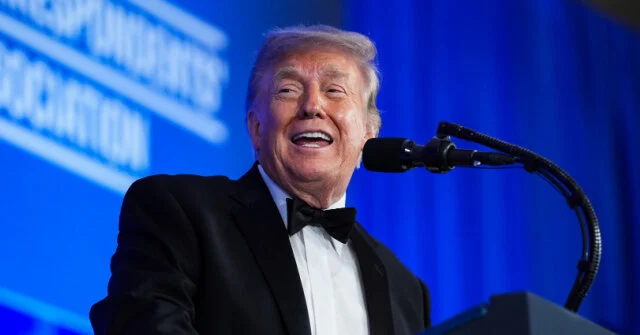
WASHINGTON – Former President Donald Trump delivered a contentious and characteristically unfiltered address at the White House Correspondents’ Dinner (WHCD) on Friday night, using the traditionally lighthearted event to launch sharp critiques against what he termed the "establishment media." Speaking before a gathering of prominent journalists, political figures, and celebrities, Trump provocatively declared the assembly to be the "largest group of Trump derangement syndrome people ever put together at one time," setting a confrontational tone for his remarks that deviated significantly from the event’s historical decorum. His appearance marked a notable return to an event he largely eschewed during his presidency, opting instead for counter-programming rallies, underscoring his ongoing, complex relationship with the press.
The White House Correspondents’ Dinner: A Tradition Under Scrutiny
The White House Correspondents’ Dinner, an annual gala hosted by the White House Correspondents’ Association (WHCA), has a storied history dating back to 1921. Its primary purpose is to raise money for scholarships for aspiring journalists and to honor excellence in the profession, while also serving as a symbolic gathering that, at least historically, aimed to foster a collegial, if sometimes tense, relationship between the presidency and the press corps. Presidents typically attend, offering a humorous roast of themselves, their administration, and the journalists covering them, often delivered by a comedian. This tradition, meant to underscore the First Amendment and the importance of a free press, often features self-deprecating humor from the Commander-in-Chief, a stark contrast to the direct political attacks Trump levied.
In recent years, the dinner has become a focal point for debates about the relationship between political power and the media. During his term, President Trump notably broke with tradition, boycotting the dinner from 2017 to 2019, opting instead to hold campaign rallies that served as direct counter-programming. His rationale consistently centered on his belief that the media was biased against him, labeling many outlets as "fake news" and "enemies of the people." His decision to attend this particular dinner, therefore, represented a significant shift, though his remarks indicated no softening of his stance towards the press. The WHCD has, at times, also faced criticism for appearing to normalize or overly fraternize with those it is meant to hold accountable, a tension amplified by Trump’s presence and rhetoric.
A Confrontational Return: The "Trump Derangement Syndrome" Thesis
Trump’s opening gambit, labeling the attendees as suffering from "Trump derangement syndrome" (TDS), immediately framed his address as an extension of his long-standing narrative. The term "Trump derangement syndrome," popularized during his 2016 campaign and presidency, is a pejorative used to describe perceived irrational or obsessive negative reactions to Trump, often attributed to political opponents and mainstream media outlets. By employing this phrase at the dinner, Trump not only dismissed potential criticisms but also characterized the very individuals gathered to cover politics as inherently biased and emotionally compromised. This assertion came moments after "establishment reporters" had concluded their own award ceremony, an irony not lost on many in the room.
His statement, "This place is the really largest group of Trump derangement syndrome people ever put together at one time, I suspect," served as both a joke and a direct challenge. It underscored his consistent portrayal of the media as an adversarial force rather than an impartial observer. This rhetorical strategy has proven effective with his base, reinforcing their distrust of mainstream news outlets and validating his claims of unfair treatment. For many journalists present, the remark was likely interpreted as a continuation of the hostilities that have defined the Trump era, further solidifying the chasm between his political movement and the traditional press.
Targeted Humor: Political Figures and Media Personalities
Beyond the broad condemnation of the media, Trump’s speech featured a series of pointed "zingers" aimed at specific individuals, blending political jabs with personal mockery. One notable target was Robert F. Kennedy Jr., who has emerged as a significant independent challenger in the upcoming presidential election. Kennedy, known for his environmental activism and controversial views on vaccines, found himself at the receiving end of a particularly graphic joke concerning the evening’s meal.
"I hope everyone finally got to enjoy their entire, very delicious beef tenderloin; It’s very special beef. And I want you all to know that Bobby Kennedy, who is right here, personally ran over the cow in his car and he cut it up, and he brought it here for you to eat tonight, so it’s very fresh," Trump quipped. He then extended the joke, involving Kennedy’s wife, Cheryl Hines: "And Bobby also suggested an appetizer featuring his favorite cut of male raccoon roadkill, but we drew the line at that, Cheryl." This type of humor, blending the absurd with a hint of the grotesque, is characteristic of Trump’s rally speeches, designed to elicit strong reactions and underscore perceived eccentricities of his political rivals. The joke played on Kennedy’s public persona, particularly his association with nature and his sometimes unconventional public image.
Media personalities were also prime targets. CNN’s Anderson Cooper and Kaitlan Collins, both prominent figures in cable news, were singled out. Trump’s comments on Cooper reflected a nuanced, if still critical, perspective: "I like Anderson actually because he’s covered me well for many years, then he went bad as soon as I went for politics… I did so many interviews with him, and he was great. But you know he’s got a little different persuasion than me, in many ways actually." This remark, hinting at Cooper’s personal life and perceived political shift, underscored Trump’s view that media coverage is often driven by personal biases rather than objective reporting. For many, it represented a thinly veiled accusation of partisan journalism.
The joke aimed at Kaitlan Collins, who has frequently engaged in direct and often combative exchanges with Trump, leveraged a recent cultural controversy. Trump likened Collins to transgender influencer Dylan Mulvaney, stating: "I thought Kaitlan had really made it big with a major new sponsorship, but then I informed her that it wasn’t her on the Bud Light can, it was Dylan Mulvaney." This comment referenced the widely publicized backlash against Bud Light after its partnership with Mulvaney, a controversy that became a flashpoint in the culture wars, particularly among conservative audiences. By associating Collins with Mulvaney in this manner, Trump tapped into a politically charged debate, simultaneously mocking a journalist and appealing to segments of his base who have expressed strong opinions on transgender issues and corporate endorsements. This rhetorical maneuver served to not only belittle Collins but also to align himself with conservative cultural grievances.
The "Fourth Term" Announcement: A Campaign Rally in Disguise
Trump concluded his remarks with a mock announcement of his intention to run for president again, specifically for a "fourth term," a clear nod to his previous two runs and the current 2024 campaign. "I’m pleased to announce my intention to, and this is somewhat of a scoop, my intention to run for a fourth term as president of the United States," he declared, dramatically donning a "Trump 2028" hat.
This closing joke served multiple purposes. Firstly, it reinforced his image as a political outsider and a disruptor of norms, given the constitutional limit of two presidential terms. Secondly, it acted as a campaign message, reminding his audience and viewers of his ongoing political ambitions and his commitment to returning to the White House. For his supporters, it was likely interpreted as a defiant, humorous signal of his determination. For critics, it might have highlighted what they perceive as his disregard for established political conventions and his perpetual campaign mode. The "scoop" element was ironic, as his 2024 candidacy had long been announced, but it allowed him to maintain a sense of playful subversion.
Reactions and Broader Implications
The immediate reactions to Trump’s appearance and speech were predictably polarized. Within the room, the laughter and applause were mixed with audible groans and silences, reflecting the diverse political leanings of the attendees. For many in the media, Trump’s presence and remarks at the WHCD were seen as a deliberate act of provocation, a calculated move to reinforce his anti-establishment credentials while simultaneously dominating a traditional media event. The decision to use the platform for direct attacks rather than traditional presidential humor underscored the persistent tension between the former president and the press.
Political analysts suggested that Trump’s performance was not merely a casual appearance but a strategic move within his broader 2024 presidential campaign. By delivering a speech that mirrored his rally rhetoric, he effectively transformed a media gathering into an extension of his campaign trail, leveraging the high-profile event to energize his base and reiterate his core messages: distrust of mainstream media, cultural conservatism, and a pugnacious approach to politics. His decision to attend, after years of boycotts, also signaled a potential shift in strategy, perhaps indicating a willingness to engage, albeit on his own terms, with institutions he once entirely shunned.
The event further highlighted the deepening polarization in American politics and media. Trump’s use of terms like "Trump derangement syndrome" and his attacks on specific journalists and cultural figures are indicative of a political environment where traditional lines between political discourse and personal attacks have blurred. The WHCD, once a symbol of a functional, if sometimes adversarial, relationship between power and the press, has increasingly become a battleground for competing narratives and ideological clashes.
In conclusion, Donald Trump’s appearance at the White House Correspondents’ Dinner was far more than a social event; it was a carefully orchestrated political performance. His remarks, characterized by sharp wit, direct attacks, and a consistent anti-establishment posture, served to reiterate his core political identity and campaign themes. Far from a conciliatory gesture, it was a reaffirmation of his confrontational stance towards the media, solidifying his image as a political force willing to challenge norms and provoke debate, even within the very institutions he often seeks to dismantle. The evening left little doubt that the contentious relationship between Trump and the "establishment media" remains a central, defining feature of American political discourse.

Related Posts
Democratic Candidates Must Moderate to Win General Elections, Says Rep. Greg Stanton
Lisa Demuth Secures Republican Gubernatorial Nomination in Minnesota, Defeating Trump-Endorsed Mike Lindell