
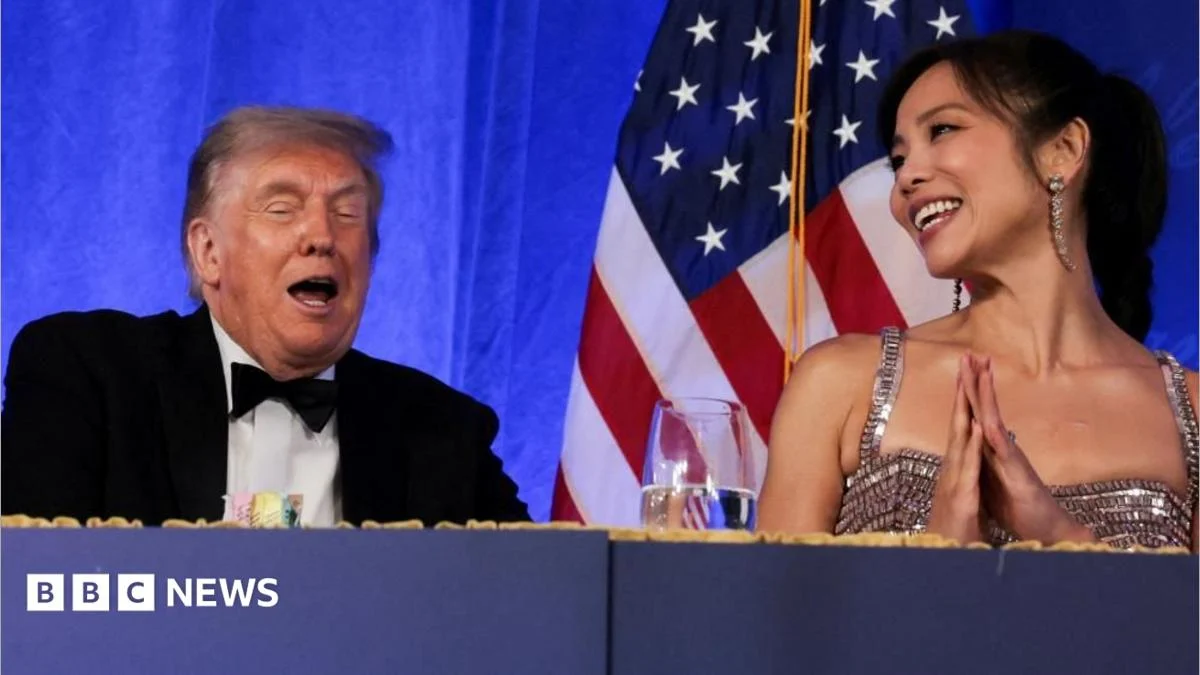
President Donald Trump Navigates Tense White House Correspondents’ Dinner Amidst Heightened Security and Calls for Press Freedom
President Donald Trump attended a significantly scaled-down and highly secured White House Correspondents’ Association (WHCA) dinner, an event that became a complex tableau of celebration for press freedom, a tribute to heroism, and a platform for the President’s characteristic jests and criticisms directed at the media. The gathering marked a poignant return to tradition for the WHCA, occurring three months after the original April event was abruptly cancelled due to a violent incident involving a gunman. This unique convergence of solemn remembrance, robust security, and the President’s often-antagonistic relationship with the press underscored the dinner’s unprecedented nature and its broader implications for democratic discourse.
The evening, held on a Saturday night, saw approximately 700 attendees gather, a stark reduction from the typical attendance of over 2,000 at previous WHCA dinners. The atmosphere was a blend of relief and lingering tension, with the shadow of the earlier violence dictating much of the evening’s logistics and underlying sentiment. The primary objective for the WHCA leadership was clear: to demonstrate the resilience of the press and its foundational role in American democracy, refusing to allow an act of violence to silence or intimidate.
The Shadow of Violence: Recalling the April Incident
The decision to hold a rescheduled dinner stemmed directly from the traumatic events of April 15th, when the initial WHCA gala at the Washington Hilton was abruptly halted. On that fateful evening, 31-year-old Cole Tomas Allen, later identified as the suspect, was apprehended by Secret Service agents just moments before he could access a ballroom where journalists, politicians, and celebrities were beginning to gather. Allen, armed and reportedly intent on assassinating the President, was tackled near a staircase leading to the main event space.
During the struggle, US Secret Service Officer Victor Gonzalez sustained a gunshot wound, bravely intercepting the assailant and preventing a potentially catastrophic security breach. The swift and decisive action of Officer Gonzalez and his colleagues averted a national tragedy, though the incident sent shockwaves through the nation’s capital and the journalistic community. The immediate aftermath saw the rapid evacuation of attendees, a lockdown of the area, and an intensive investigation that led to Allen being charged with attempting to assassinate the President of the United States. The cancellation of the traditional correspondents’ dinner, a fixture in Washington’s social and political calendar since 1921, was an unprecedented response, highlighting the severity of the threat.
A Resilient Return: The WHCA Dinner Reimagined
The rescheduled dinner was a deliberate statement of defiance against those who would seek to undermine democratic institutions through violence. WHCA President Weijia Jiang of CBS News articulated this resolve in her opening remarks, declaring that the association would "refuse to let an act of violence have the final word." This sentiment resonated throughout the evening, transforming a typically celebratory event into one imbued with profound symbolic meaning.
The choice to proceed with a dinner, albeit in a modified format, was a testament to the WHCA’s commitment to its mission: to advocate for press freedom, support journalists, and foster a dialogue between the White House and the news media. While the scale was reduced, the core purpose remained. The event traditionally serves as a platform to honor journalistic excellence through awards, provide scholarships for aspiring journalists, and offer a unique occasion for the President to engage, often humorously, with the press corps he interacts with daily.
President Trump’s Dual Performance: Jests and Jabs
Anticipation regarding President Trump’s tone was high, with many in the White House press corps theorizing he would deliver a stern rebuke of the media, given his consistent criticism of many journalists present in the room. However, the President’s address proved to be a complex mix of cordiality, conciliation, and his signature barbs.
Opening with a joke, Trump stated, "the second time is always better," referencing the rescheduled nature of the event. He continued, "As I said three months ago, the show must go on," echoing a sentiment often invoked in times of crisis. Throughout his speech, he projected an air of good humor, at one point playfully remarking, "sometimes I really do think that some of you don’t like me." He also offered praise, stating he respects "most of them" in the media, a notable softening from his usual broad condemnations.
Yet, true to form, the President could not resist aiming his characteristic barbs. He revived his frequent accusation of "fake news" and suggested that many journalists in the room suffered from "Trump Derangement Syndrome." In a moment of mock indignation, he quipped, "This place [the dinner] is really the largest group of ‘Trump derangement syndrome’ people ever put together at one time." He further joked, "I suspect some of you are lucky that our last dinner was cut short…I was going to go after you." These comments, delivered with a smile, highlighted the enduring tension that defines his relationship with the media, even on an evening meant to foster dialogue.
Significantly, President Trump also used the platform to underscore fundamental American values. He called on all Americans to respect freedom of speech, a cornerstone of democratic society. "We settle our differences not with bullets, but with open and vigorous debate," Trump asserted. "And no deranged loser with a gun will ever change that. We can’t let that ever happen." This powerful statement, coming from a President often at odds with the press, resonated deeply within the room, acknowledging the gravity of the April incident and reaffirming a commitment to peaceful discourse.
Honoring Bravery and Journalistic Excellence
A central feature of the WHCA dinner is the presentation of awards recognizing outstanding journalism and, on this occasion, extraordinary bravery. President Trump himself participated in the awards ceremony, standing and shaking hands with recipients.
One of the most poignant moments of the evening was the recognition of US Secret Service Officer Victor Gonzalez. Trump personally presented an award to Officer Gonzalez for his heroic actions on the night of the April shooting, acknowledging his bravery in confronting the assailant and sustaining injury in the line of duty. This gesture served as a powerful reminder of the human cost of protecting public figures and the vital role of law enforcement.
The dinner also celebrated the core mission of the WHCA by honoring journalistic achievements. A team from the Wall Street Journal received an award for their coverage of President Trump’s links to disgraced financier Jeffrey Epstein. This particular award underscored the critical role of investigative journalism in holding power accountable, even when the subject is the President himself. The recognition of outlets like the New York Times and CNN, frequently targeted by Trump’s "fake news" criticisms, further highlighted the WHCA’s commitment to journalistic independence. Reporters from these and other outlets, despite the President’s past sparring, came up to be honored, symbolizing the resilience of the press in the face of political pressure.
Unprecedented Security Measures
The memory of the April shooting necessitated an unprecedented level of security for the rescheduled dinner. The usually bustling blocks around the Washington Hilton were transformed into a fortified zone, with several thoroughfares completely blocked off to vehicular and pedestrian traffic. A heavy presence of uniformed police officers and National Guard personnel was visible, creating a formidable security perimeter.
Attendees underwent multiple layers of screening, a far more rigorous process than typically associated with such events. Guests were required to present QR codes and government-issued identification for initial verification. Following this, they were subjected to thorough physical screenings, reminiscent of airport security procedures, before being issued distinct wristbands for entry. At one point, visitors were directed to walk in a single file line past two Secret Service officers visibly holding rifles, a stark visual representation of the heightened threat assessment. These stringent measures, while perhaps unusual for a social gathering, were widely understood as necessary precautions to ensure the safety of all participants and to prevent a repeat of the April incident.
The WHCA’s Stance and Future Direction
Weijia Jiang, in her capacity as the outgoing WHCA President, articulated the association’s forward-looking perspective. Beyond emphasizing resilience, she announced that the WHCA dinner would return to the scene of the April shooting, the Washington Hilton, for next year’s event. This decision was a powerful symbolic gesture, signaling a refusal to be intimidated and a determination to reclaim the space for its traditional purpose. It was a statement that the WHCA would not allow violence to dictate its future or its commitment to fostering an open dialogue between the press and the presidency.
The WHCA, established in 1914, has a long history of advocating for access to the President and White House officials, setting standards for White House correspondents, and promoting journalistic excellence. The dinner, which began in 1921, evolved into a significant annual event, often attended by the President, cabinet members, and a host of public figures. The events of the past few months have undoubtedly reshaped the conversation around the dinner’s format, security, and its role in the broader landscape of presidential-media relations.
Historical Context and the Presidential-Press Relationship
The relationship between the President of the United States and the White House press corps has always been complex, often characterized by a delicate balance of cooperation and adversarial tension. Historically, the WHCA dinner has served as an annual détente, an evening where the President and the press could set aside daily skirmishes for a night of shared humor and mutual recognition. Presidents, from Calvin Coolidge to Barack Obama, frequently attended and often delivered humorous speeches, sometimes even at their own expense, to foster a sense of collegiality.
The Trump presidency, however, introduced an unprecedented level of antagonism into this dynamic. President Trump frequently labeled news organizations as "enemies of the people," accused them of disseminating "fake news," and often bypassed traditional media channels in favor of direct communication through social media. This persistent rhetoric created an environment where trust between the administration and the press was significantly eroded. The April shooting, regardless of the assailant’s specific motives, occurred within this highly charged atmosphere, raising concerns about the potential for rhetoric to incite violence.
The rescheduled dinner, therefore, represented a unique moment. President Trump’s decision to attend, coupled with his dual performance of jests and jabs alongside calls for free speech, reflected the intricate and often contradictory nature of his engagement with the media. His presence, particularly after the cancellation of the first event, underscored the symbolic importance of the dinner as a platform for both conflict and potential, albeit fleeting, conciliation.
Implications for Press Freedom and Democratic Discourse
The White House Correspondents’ Association dinner, in its rescheduled and reconfigured form, carries significant implications for press freedom and democratic discourse in the United States. Firstly, the very act of holding the dinner, under such stringent security and in the wake of violence, sent a powerful message of resilience. It affirmed that the institutions of a free press and the open exchange of ideas cannot be stifled by threats or acts of aggression.
Secondly, President Trump’s attendance and his remarks highlighted the ongoing tension between the presidency and the media. While his calls for freedom of speech and an end to violence were welcomed, his continued use of terms like "fake news" and "Trump Derangement Syndrome" reinforced the perception of an administration deeply skeptical of, and often hostile towards, critical journalism. This dynamic continues to pose challenges for the media’s ability to operate without undue political pressure and for the public’s trust in news institutions.
Finally, the heightened security measures serve as a stark reminder of the escalating threats faced by public figures and, by extension, the democratic process itself. The incident in April underscored the vulnerability of even well-protected events and the necessity for robust security protocols in an era of heightened political polarization and radicalization. The WHCA’s decision to return to the original venue next year signals a commitment to normalcy and tradition, but it also implies an ongoing vigilance against future threats.
In conclusion, the rescheduled White House Correspondents’ Association dinner was more than just an annual gathering; it was a complex and symbolic event. It reflected the nation’s resilience in the face of violence, the enduring, often contentious, relationship between the President and the press, and the unwavering commitment to the principles of free speech and independent journalism. It served as a testament to the fact that, even in challenging times, the show, in the context of democratic dialogue, must indeed go on.

Related Posts
Zambia on Edge: Opposition Leader Arrested Amid Allegations of Insurrection Plot and Election Tensions
Rescuers search for survivors of powerful Indonesia earthquake

