UK Government Secretly Considered Suspending Israeli Trade Deal Amid Gaza Famine and West Bank Concerns
The British government quietly assessed the possibility of suspending Israel’s preferential trade privileges before ultimately deciding against such a measure, according to a recent report by Sky News. This internal review, which remained undisclosed to both Parliament and the public, took place against a backdrop of severe humanitarian crisis in Gaza, including widespread famine, and escalating concerns over alleged ethnic cleansing and the expansion of an apartheid system in the occupied West Bank. The revelations underscore the complex interplay between economic interests, foreign policy, and international human rights obligations for the United Kingdom.
Background to the UK-Israel Trade Partnership
The existing trade relationship between the UK and Israel is governed by the UK-Israel Trade Partnership Agreement, originally established in 2019. This agreement is a cornerstone of economic ties, allowing most Israeli goods to enter Britain tariff-free. Such preferential treatment is designed to foster trade, investment, and economic cooperation, providing significant benefits to businesses in both countries. For the UK, these trade links support thousands of jobs and contribute to various sectors, while for Israel, access to the British market is economically valuable. The agreement is a successor to the EU-Israel Association Agreement, which the UK rolled over post-Brexit to ensure continuity in trade relations.
The Department for Business and Trade’s consideration of suspending this agreement marks a significant potential shift in UK policy, reflecting mounting international pressure and severe criticism regarding Israel’s actions in the Palestinian territories. The confidential nature of the review suggests a cautious approach by the government, navigating the political sensitivities and economic implications of such a decision.
Chronology of Events and Escalating Crisis
The internal review was initiated in August 2025, a period when the humanitarian situation in Gaza had deteriorated to an extreme degree. According to the Sky News report, Israel was accused of deliberately imposing conditions that led to famine in the besieged territory. This critical phase of the crisis saw widespread hunger and deprivation, drawing urgent calls for international intervention and humanitarian aid. The timing of the review highlights the direct link between the deteriorating conditions on the ground and the UK government’s internal deliberations.

Simultaneously, pressure was mounting over Israel’s actions in the occupied West Bank. Reports detailed accelerating ethnic cleansing, continued settlement expansion, and the entrenchment of an apartheid system. These developments, consistently highlighted by international human rights organizations and UN bodies, added to the growing clamour for accountability and policy responses from global powers, including the UK.
Three months prior to the Department for Business and Trade’s assessment, in May 2025, the Labour party had already suspended negotiations on an expanded free trade agreement with Israel. This earlier move by the opposition signalled a hardening stance, driven by concerns over Israeli policies. Then Foreign Secretary David Lammy had publicly condemned remarks made by Israel’s defence minister regarding "cleansing" Gaza and "destroying what’s left," describing them as "repellent" and "monstrous." While Labour’s action pertained to future expansion, the existing 2019 agreement remained in place, becoming the focus of the later, secret government review.
Government’s Internal Assessment and Lack of Transparency
The impact assessment, conducted by the Department for Business and Trade under former Prime Minister Keir Starmer, specifically examined the possible suspension of the existing UK-Israel Trade Partnership Agreement. Despite the gravity of the issues prompting this review—allegations of genocide and famine in Gaza, and ethnic cleansing in the West Bank—the government chose not to announce the assessment publicly or disclose its findings.
This lack of transparency extended to parliamentary scrutiny. When Members of Parliament questioned ministers about the trade agreement, the assessment was not mentioned. Its existence only came to light following a Freedom of Information (FOI) request submitted by the advocacy group Global Justice Now. Even after the FOI request, officials reportedly refused to release key details such as the assessment’s scope, findings, timetable, or any decisions that arose from it, citing various reasons for confidentiality. This reluctance to disclose information has raised questions about government accountability and the public’s right to know, especially on matters with significant ethical and foreign policy implications.
Official Justifications and Political Context
In October 2025, Trade Minister Chris Bryant publicly defended the government’s position to maintain the existing trade agreement. Speaking in Parliament, Bryant argued that "exports to Israel support thousands of jobs in the UK," emphasising the economic benefits derived from the trade relationship. He further warned that suspending preferential treatment risked "unpredictable consequences and significant economic disruption for British businesses." This argument highlights the government’s perceived need to balance human rights concerns with domestic economic stability and the livelihoods of British workers.

Bryant’s remarks are also viewed by some through the lens of his longstanding connections to Labour Friends of Israel, a prominent pro-Israeli lobby group. His previous role as the group’s vice-chair and his acceptance of visits to Israel financed by the organization and Israel’s Ministry of Foreign Affairs provide a political context to his defence of the trade deal, suggesting potential influences on policy formulation.
International Legal and Political Landscape
The UK government’s review coincided with broader international pressure for economic sanctions against Israel. The European Union, a major trading partner, also faced demands to suspend parts of its agreement with Israel and later proposed withdrawing some trade concessions. This parallel movement within the EU underscores a growing international concern and a potential shift in how global powers engage with Israel in light of its actions in the Palestinian territories.
Furthermore, these discussions took place more than a year after a significant ruling by the International Court of Justice (ICJ). The ICJ had stated that nations must prevent trade or other actions that sustain Israel’s illegal settlement enterprise in occupied Palestinian territory. This ruling provided a crucial legal framework, implying that continued trade benefits could be seen as complicity in, or support for, activities deemed illegal under international law. The UK, as a signatory to international conventions and a proponent of the rule of law, faces a particular challenge in reconciling its trade policies with such international legal pronouncements. The government’s decision to maintain the trade agreement, despite the ICJ’s guidance and widespread condemnation of settlements, highlights a complex diplomatic and legal tightrope walk.
Implications for UK Foreign Policy and International Standing
The UK government’s decision to preserve Israel’s trade privileges, while conducting a secret review and facing allegations of genocide and ethnic cleansing, carries significant implications for its foreign policy and international standing. Critics argue that this stance undermines the UK’s commitment to human rights, international law, and its stated role as a moral actor on the global stage. Maintaining trade as usual, particularly during a period of documented famine and severe human rights abuses, could be interpreted as tacit approval or, at minimum, a failure to exert meaningful diplomatic and economic pressure.
The lack of transparency surrounding the review further compounds these concerns. Public trust in government decision-making, especially on sensitive foreign policy issues, relies on open communication and accountability. The revelation via an FOI request, rather than a proactive government statement, fuels perceptions of a government attempting to avoid scrutiny on contentious matters.

Conversely, proponents of maintaining the trade deal argue that suspending it could be counterproductive, potentially harming dialogue and limiting the UK’s influence on Israel. They also emphasize the economic repercussions for British businesses and the broader bilateral relationship. This perspective often suggests that engagement, rather than isolation, is the more effective path for promoting change.
However, the ethical considerations of trade during a humanitarian crisis remain paramount. The alleged deliberate starvation of Palestinians in Gaza and the ongoing expansion of settlements in the West Bank present a moral dilemma for nations like the UK. The choice to prioritize economic ties over direct action in response to severe human rights violations could have long-term consequences for the UK’s credibility and its relationships with other international partners, particularly those in the Global South and nations advocating for Palestinian rights.
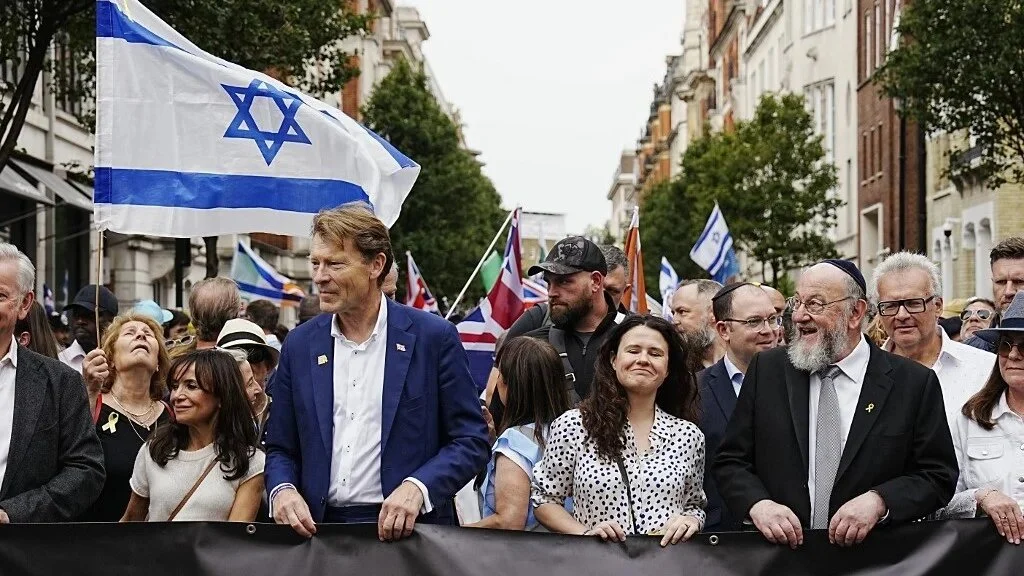
The photograph of Chief Rabbi Ephraim Mirvis leading a pro-Israel demonstration in central London on September 7, 2025, further illustrates the intense domestic and international political pressures surrounding the UK government’s decisions. Such demonstrations reflect the deeply divided public opinion and the significant lobbying efforts from various groups, all vying to influence official policy.
As of the publication date of this report on July 23, 2026, the British government continues to navigate these turbulent waters, with the 2019 trade agreement with Israel remaining untouched. The revelations about the secret review, however, bring to light the internal struggles and the complex calculations underpinning the UK’s approach to one of the most contentious geopolitical issues of our time. The ongoing debate will undoubtedly continue to shape future UK foreign policy and its commitment to human rights on the international stage.

Related Posts
Over 150 Israeli Settlers Storm Al-Aqsa Compound and Perform Prayers, Violating Status Quo Under Police Protection.
UN Report Highlights Over 900 Obstacles Hampering West Bank Aid Amid Escalating Humanitarian Crisis