Zelensky Speaks with Trump Envoys on Ukraine Peace
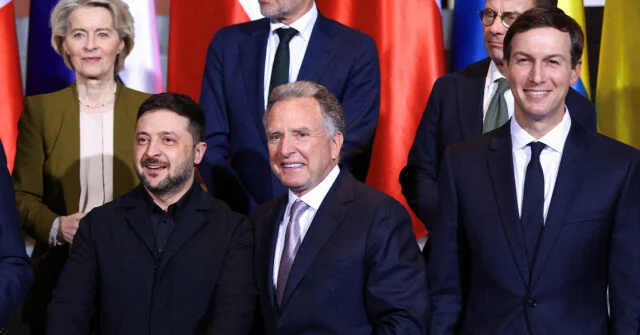
Ukrainian President Volodymyr Zelensky held discussions on Wednesday with Steve Witkoff and Jared Kushner, envoys representing former President Donald Trump, focusing on strategies to reignite diplomatic initiatives aimed at resolving the ongoing conflict with Russia. The meeting, which underscores a complex interplay of official and unofficial diplomatic efforts, was first reported by Axios correspondent Barak Ravid, who cited a source familiar with the conversation. President Zelensky later confirmed the engagement via a post on X (formerly Twitter), reiterating Ukraine’s enduring commitment to achieving peace.
Zelensky framed the dialogue as a crucial step to infuse new momentum into stalled peace processes. "It was a good, important conversation on how to reinvigorate diplomacy and bring peace closer," he wrote, emphasizing Ukraine’s readiness for a peace settlement that upholds its dignity and territorial integrity. He extended gratitude to Witkoff and Kushner for their personal involvement, and acknowledged both former President Trump and the American people for their steadfast support. Zelensky also noted that negotiating teams remain in continuous contact to build upon the points discussed during the call, signaling a sustained effort to maintain the diplomatic channel.
The Role of Unofficial Envoys Amidst Formal Diplomacy
The involvement of Steve Witkoff, a prominent real estate developer and close associate of Trump, and Jared Kushner, Trump’s son-in-law and former senior advisor, introduces a unique dimension to the intricate landscape of international peacemaking. Operating outside official governmental structures, their participation reflects former President Trump’s consistent public statements about his capacity to resolve the conflict in Ukraine swiftly, should he return to the Oval Office. This informal approach contrasts sharply with established diplomatic protocols, yet it offers a potentially flexible channel for communication, particularly given the deep mistrust between Kyiv and Moscow.
Witkoff and Kushner’s engagement follows a series of recent diplomatic overtures by former President Trump. Days before their call with Zelensky, Trump had held separate telephone conversations with both President Zelensky and Russian President Vladimir Putin. These calls were reportedly part of Trump’s broader initiative to explore avenues for de-escalation, with Witkoff and Kushner signaling their readiness to travel to Moscow to continue their mediation efforts. The precise mandate and scope of these unofficial envoys remain a subject of considerable speculation within diplomatic circles, particularly concerning how their proposals might align or diverge from the existing policies of the current U.S. administration and its allies.
Precursors to the Dialogue: Ankara NATO Summit and Aid Commitments
The Wednesday call between Zelensky and Trump’s envoys took place shortly after the July 8 NATO summit in Ankara, Turkey, a critical gathering where President Trump and President Zelensky met face-to-face. During their interaction in Ankara, Trump made a significant announcement: the United States would license Ukraine to domestically manufacture its own Patriot air defense missiles. This pledge represents a substantial upgrade in U.S. military assistance, moving beyond direct provision of weapons systems to enabling Ukraine’s self-sufficiency in critical defense technology. The Patriot system is vital for Ukraine’s air defense, having proven effective against various Russian aerial threats, including ballistic and cruise missiles. Allowing Ukraine to produce these systems locally could significantly enhance its long-term defensive capabilities and reduce reliance on external supply chains.
At the Ankara summit, President Zelensky reiterated his urgent plea for more advanced air defense systems and renewed his push for Ukraine’s full membership in NATO. Ukraine’s aspiration for NATO membership has been a central point of contention with Russia, with Moscow viewing it as an existential security threat. While direct membership remains a complex issue with varying degrees of support among NATO allies, the summit saw European allies and Canada collectively commit approximately $80 billion in defense aid to Ukraine for the current year. This substantial financial and material support underscores the international community’s ongoing commitment to bolstering Ukraine’s defense against Russian aggression, encompassing a wide array of military hardware, training, and humanitarian assistance. This aid is critical for sustaining Ukraine’s war effort, enabling it to procure necessary armaments, maintain its military infrastructure, and provide for its personnel.
The Evolving Military and Geopolitical Landscape
The diplomatic efforts unfold against a backdrop of a protracted and brutal conflict. Russia’s ground advance in Ukraine has largely stalled in recent months, largely due to fierce Ukrainian resistance, robust Western military aid, and the strategic deployment of advanced weaponry. Ukrainian forces have also demonstrated an increasing capacity to conduct strikes deep within Russian territory, targeting critical military infrastructure, supply depots, and, significantly, oil refineries. These strikes have reportedly led to gasoline shortages in parts of Russia, biting into President Putin’s war economy and potentially impacting public morale. The economic repercussions for Russia, compounded by extensive international sanctions, continue to be a significant factor in the conflict, though Moscow has shown resilience in adapting its economy to wartime conditions.
In retaliation for Ukrainian strikes, Russia has intensified its aerial assaults on Ukrainian cities, including the capital Kyiv, and other major population centers. Using a combination of missiles and drones, these attacks frequently overwhelm Ukraine’s existing air defense systems, causing widespread destruction, disrupting essential services, and resulting in civilian casualties almost daily. The relentless nature of these attacks highlights the ongoing human cost of the war and the critical need for more robust air defense capabilities, reinforcing Zelensky’s appeals at the NATO summit.
From a diplomatic standpoint, President Putin has consistently maintained a rigid stance regarding peace negotiations. He has, so far, refused to meet directly with President Zelensky unless a completed agreement is ready for finalization, whether in Moscow or a neutral third country. A key precondition set by Moscow for any potential deal is Ukraine’s complete withdrawal from the parts of the Donbas region currently held by its forces, a demand that Ukraine views as a blatant violation of its sovereignty and territorial integrity, rendering it largely unacceptable. This fundamental disagreement over territorial concessions remains the primary obstacle to substantive peace talks.
Historical Context of Peace Efforts and Their Challenges
The current discussions initiated by Trump’s envoys are not the first attempts to mediate an end to the conflict. Early in the full-scale invasion in February 2022, there were several rounds of direct negotiations between Ukrainian and Russian delegations, notably in Belarus and then in Istanbul, Turkey. These talks, which initially offered a glimmer of hope, ultimately collapsed as the scale of Russian atrocities became apparent, and Ukraine solidified its resolve to defend its sovereignty. Key sticking points included Russia’s demand for Ukraine’s "demilitarization" and "denazification," which Ukraine interpreted as calls for regime change and capitulation, alongside Russia’s insistence on recognizing its annexation of Crimea and its claims over other occupied territories.
Various international actors have also attempted to broker peace. China presented a 12-point peace plan in early 2023, which called for a ceasefire and respect for sovereignty but was criticized by some Western nations for not explicitly demanding Russia’s withdrawal from occupied Ukrainian territories. An African peace initiative, spearheaded by several African heads of state, also sought to facilitate dialogue, emphasizing humanitarian aspects and a path towards de-escalation. While these efforts have kept diplomatic channels nominally open, they have failed to achieve any breakthrough due to the maximalist positions of both Kyiv and Moscow on core issues, particularly concerning territorial integrity and security guarantees.
Ukraine’s "Peace Formula," first articulated by President Zelensky in late 2022, outlines ten key points for a comprehensive and just peace. These include the restoration of Ukraine’s territorial integrity, withdrawal of Russian troops, release of all prisoners of war and deportees, establishment of a special tribunal for Russian war crimes, and security guarantees for Ukraine. This formula has garnered significant international support, but Russia has dismissed it as unrealistic, insisting that any peace settlement must acknowledge the "new realities" on the ground, referring to its territorial annexations.
Implications of Unofficial Diplomacy and Future Prospects
The involvement of unofficial envoys like Witkoff and Kushner presents both opportunities and risks. On one hand, it could offer a degree of flexibility and creativity not always possible within formal diplomatic frameworks. Without the constraints of official government policy or the need for immediate public accountability, such envoys might be able to explore unconventional solutions or convey messages that official channels cannot. This could be particularly relevant if former President Trump is serious about pursuing a unique approach to ending the war, potentially independent of the current U.S. administration’s strategy.
However, the unofficial nature also carries significant drawbacks. Any agreements or understandings reached through such channels would lack the weight and enforceability of formal diplomatic accords. There is also the potential for confusion or misinterpretation, as these envoys do not represent the official policy of the United States government. Allies might view such parallel diplomacy with caution, concerned about potential fragmentation of Western unity or the undermining of established international efforts. Furthermore, the very presence of unofficial envoys could be perceived by Russia as a sign of disunity or a potential weakening of Western resolve, which could inadvertently prolong the conflict rather than hasten its end.
The immediate implications of this specific call remain to be seen. President Zelensky’s public confirmation and positive framing suggest that Ukraine is willing to explore all possible avenues for peace, even those outside traditional diplomatic channels, provided they align with its core principles of sovereignty and dignity. For Russia, the willingness to engage with Trump’s envoys, even if through separate calls, might indicate an openness to alternative negotiation frameworks, particularly if they perceive a potential shift in U.S. policy should Trump win the upcoming presidential election.
Ultimately, achieving a lasting peace in Ukraine will require overcoming immense obstacles. The fundamental disagreement over territorial control, coupled with the profound loss of life and destruction, has created deep scars that will be difficult to heal. While the engagement of Trump’s envoys adds another layer to the complex diplomatic tapestry surrounding the conflict, it highlights the ongoing search for solutions in a war that continues to exact a heavy toll on human lives and global stability. The success of these, or any, diplomatic efforts will hinge on the willingness of all parties to make significant concessions, something that has, so far, proven elusive. The path to peace remains long and fraught with challenges, with every conversation, official or unofficial, representing a small, yet potentially significant, step in a highly uncertain journey.

Related Posts
Democratic Candidates Must Moderate to Win General Elections, Says Rep. Greg Stanton
Lisa Demuth Secures Republican Gubernatorial Nomination in Minnesota, Defeating Trump-Endorsed Mike Lindell