Lagos State Government reaffirms commitment to inclusive education as student presents portrait to Permanent Secretary
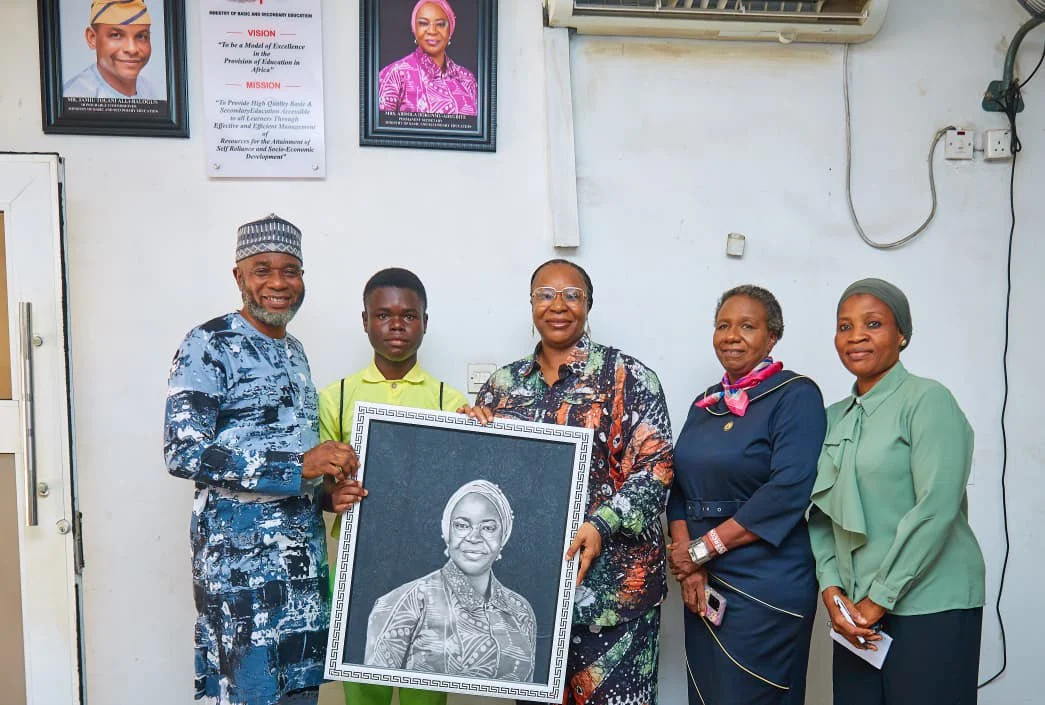
The Lagos State Government has reiterated its unwavering commitment to fostering an inclusive educational landscape, emphasizing that the state remains dedicated to ensuring that every child, regardless of physical, sensory, or learning challenges, possesses the necessary support to realize their full potential. This policy stance was highlighted on Monday, July 20, 2026, when Michael Oluwadamilare, a student of Sango Senior Secondary (Inclusive) School, Sango-Ota, visited the Ministry of Basic and Secondary Education headquarters in Alausa, Ikeja, to present a hand-crafted portrait to the Permanent Secretary, Mrs. Abisola Dokunmu-Adegbite.
The event, which served as a poignant intersection of artistic excellence and educational advocacy, underscored the state’s ongoing efforts to integrate learners with disabilities into the broader school system. By showcasing the talent of a student from an inclusive facility, the government aimed to provide a tangible demonstration of the efficacy of its current educational policies, which prioritize the dismantling of barriers to academic and personal growth.
Chronology of the Visit and Presentation
The visit occurred on Monday morning, drawing representatives from the school’s management and the ministry’s leadership. Upon his arrival at the Alausa secretariat, Oluwadamilare was received by ministry officials before presenting the artwork to Mrs. Dokunmu-Adegbite. The portrait, which captured the Permanent Secretary’s likeness with remarkable precision, served as the focal point of the engagement.
The presentation was not merely a ceremonial exchange; it was a platform for the ministry to observe the practical outcomes of the state’s investments in specialized pedagogy. Following the presentation, the Permanent Secretary engaged with the student and his educators, commending the school’s administration for their dedication to nurturing the latent talents of students who might otherwise be marginalized in traditional settings.
The Landscape of Inclusive Education in Lagos
Inclusive education in Lagos State is defined by the deliberate integration of children with special needs into the mainstream school system, supported by specialized infrastructure, teacher training, and assistive technologies. Over the past several years, the state government has significantly increased its budgetary allocations toward this sector.
Data from the Lagos State Ministry of Basic and Secondary Education suggests that there are currently dozens of inclusive units embedded within public secondary schools across the state’s educational districts. These units are staffed by trained special education needs coordinators and equipped with resources ranging from Braille machines for visually impaired students to specialized furniture and sensory-friendly learning spaces for those with neurodivergent conditions.
The state’s policy is guided by the philosophy that a "one-size-fits-all" approach to schooling is insufficient in a diverse society. By investing in the Sango Senior Secondary (Inclusive) School and similar institutions, the government is attempting to reduce the dropout rate among students with disabilities—a demographic that historically faces higher rates of educational exclusion globally.
Analysis: Beyond the Classroom
The presentation by Oluwadamilare carries broader implications for disability advocacy in Nigeria. According to educational psychologists, the ability of a student with a disability to produce high-level artistic work is often a reflection of a well-supported emotional and psychological environment.
"When a student feels valued, their capacity for cognitive and creative output expands," noted a policy analyst familiar with Lagos State’s education reforms. "This event is a public-facing validation of the ‘abilities in disabilities’ narrative. It challenges the societal stigma that equates disability with a lack of productivity."

The implications for the state are twofold. First, the government is signaling to parents and guardians of children with disabilities that the public school system is equipped to handle their children’s specific needs. Second, the event serves as a call to the private sector and non-governmental organizations to partner with the state in funding assistive technologies, which remain costly and require consistent maintenance.
Official Responses and Government Policy
In an official statement released on its verified social media platforms, the Lagos State Government described the portrait presentation as a "powerful reminder" of the potential inherent in all students. Mrs. Abisola Dokunmu-Adegbite, in her response, emphasized that the state’s vision for education is anchored in the concept of "leaving no child behind."
"Inclusive education is the bedrock of our long-term strategy for human capital development," the Permanent Secretary remarked during the event. "We are not merely providing classroom space; we are providing a pathway for every child to discover and develop their unique gifts. The artistic skill displayed by Michael is not an isolated incident; it is a product of an environment that refuses to view disability as a limitation."
The government’s rhetoric has consistently focused on the economic and social necessity of inclusive education. By preparing students with disabilities for the workforce and creative industries, the state aims to reduce the long-term economic dependency of this demographic, fostering a more inclusive and productive citizenry.
Challenges and Future Outlook
Despite the progress made, experts highlight that significant challenges remain. While the government has made strides in infrastructure, the demand for specialized teachers often outstrips supply. Furthermore, the transition of students from secondary inclusive units into tertiary education remains a hurdle, as many universities and vocational centers in the region are still in the process of updating their facilities to meet universal accessibility standards.
To address these gaps, the Lagos State Government has indicated plans to expand its teacher training programs, focusing on curriculum differentiation—a method of teaching that allows educators to tailor their instruction to the varied needs of students within the same classroom. Additionally, there is a push to modernize the "Inclusive Education Policy" to include digital accessibility tools, such as screen readers and speech-to-text software, which are becoming standard in modern classrooms.
The success of students like Michael Oluwadamilare serves as a metric for the government. It provides evidence that when the state provides the right "scaffolding"—the necessary support structures—the educational outcomes improve significantly.
Conclusion: A Testament to Inclusive Vision
The visit of the student to the Ministry of Basic and Secondary Education stands as a microcosm of the larger, ongoing efforts within Lagos State. It highlights the shift from a charitable model of disability care—which often focuses on mere survival—to a rights-based model, which focuses on opportunity, self-expression, and academic achievement.
As the Lagos State Government continues its mandate, the focus will likely remain on scaling these inclusive units. By fostering an environment where a student’s artistic talent is celebrated by the highest levels of the ministry, the government is setting a precedent. It is a clear message that in the pursuit of a modern, prosperous Lagos, the intellectual and creative contributions of all students, regardless of their physical or cognitive starting points, are essential.
The portrait now held by the Ministry is more than just a depiction of a civil servant; it is a symbol of a student’s agency and a government’s stated commitment to equality in education. The path forward will be measured not by individual gestures, but by the systemic consistency with which the state supports the next generation of students with disabilities, ensuring that their potential is not just recognized, but fully empowered.