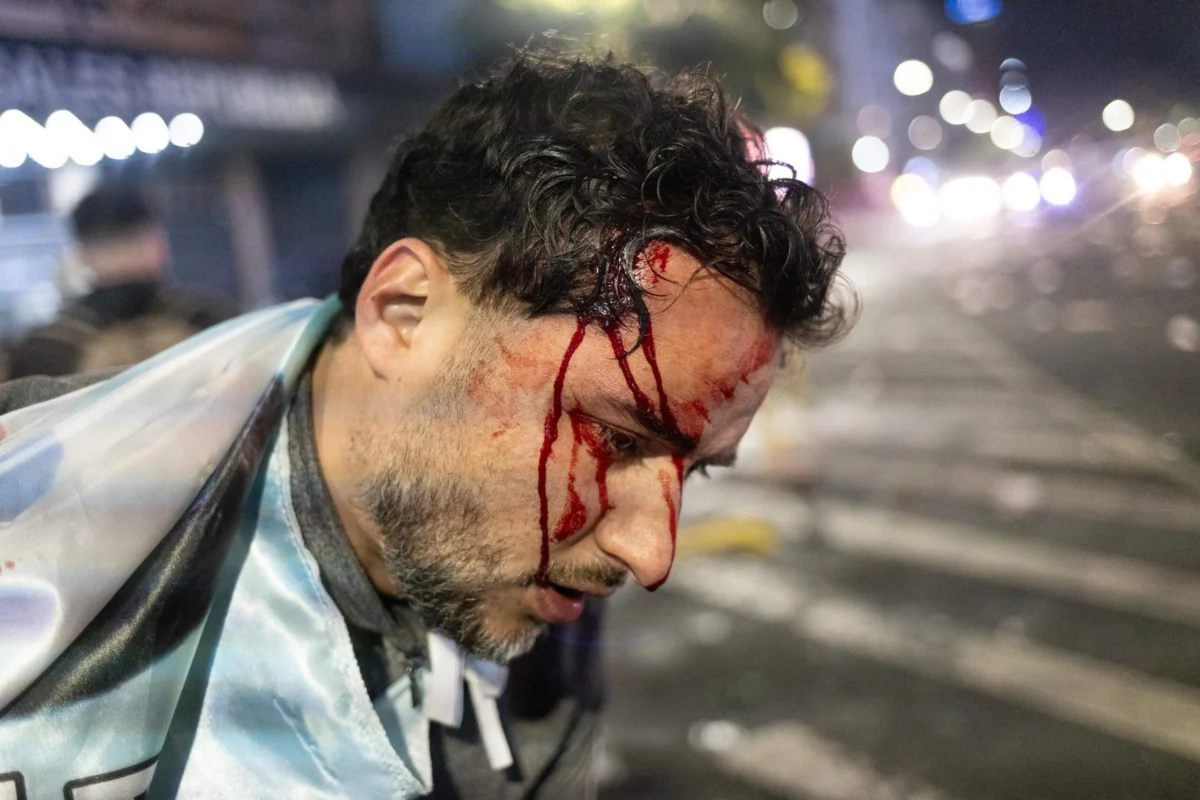
Chaos Erupts at Obelisco: Celebrations for World Cup Final Descend into Violent Clashes with Police
What began as a night of fervent celebration in support of the national football team transformed into a chaotic scene of widespread unrest, marked by projectile throwing, chases, and confrontations between law enforcement and citizens. Thousands had gathered at the iconic Obelisco in Buenos Aires, the city’s focal point, to commemorate the World Cup final, despite the Argentine team’s 1-0 defeat to Spain. The disappointment of the loss did little to dampen the spirit of many who came out to honor the team’s remarkable journey to another World Cup final, led by the talismanic Lionel Messi.
The heart of the city, specifically the intersection of Avenida 9 de Julio and Corrientes, became a critical nexus for these public gatherings. Authorities in Buenos Aires had anticipated large crowds, regardless of the match’s outcome, and had deployed a significant operational force. This included approximately 1,000 police officers, protective barriers, and water cannons, all meticulously positioned to manage the expected influx of tens of thousands of fans. The government’s preparedness was a testament to the deep emotional connection Argentinians have with their national football team and the significance of reaching the pinnacle of international competition.
The convergence of supporters began around 6 PM, with the numbers swelling significantly by 8 PM, coinciding with the onset of nightfall and a light drizzle. The atmosphere was initially charged with a mixture of camaraderie, defiant chants, and the palpable emotion of the match’s conclusion. Amidst the cacophony of stadium anthems and the shared tears of disappointment, the situation took a dramatic turn. According to reports obtained by LA NACION, police intervention became necessary when a segment of the crowd began to hurl bottles and stones at security personnel. This abrupt shift from collective lament to aggressive action marked the precipice of the ensuing disorder.
Escalation of Violence and Police Response
The police contingent advanced towards the individuals initiating the aggression, deploying a water cannon to disperse the dense clusters of people amassed on Avenida 9 de Julio. The scene depicted a rapid escalation, with some demonstrators breaching the perimeter fencing that had been erected by authorities to delineate and control the celebration zones. The organized effort to manage the public space dissolved into a scene of disarray as the crowd’s energy, initially directed towards national pride, became a source of conflict.
The repercussions of the clashes were significant. Reports indicate that at least 15 individuals were detained by law enforcement. Furthermore, three people sustained injuries during the unrest. The violence not only disrupted the intended atmosphere of patriotic solidarity but also created a dangerous environment for many families and children present.
Eyewitness Accounts of the Unfolding Chaos
Eyewitnesses shared harrowing accounts of the events that transpired. One individual speaking with LN+ described the scene, stating, "We were celebrating really well. Even if we lost, we are 100% Argentine. But how they ruin it… They started throwing bottles and it went south. It’s a disaster." This sentiment reflects a common thread among many present: a deep-seated pride in their team’s performance, juxtaposed with frustration and anger over the actions of a disruptive minority that led to a forceful police response.
Another witness, a woman who was with her son near the Obelisco, narrowly avoided being struck by flying projectiles. She corroborated the earlier accounts, noting, "The people started throwing bottles." The widespread nature of the bottle-throwing incidents suggests a spontaneous eruption of discontent or an organized instigation that quickly spread through the crowd.
However, not all accounts focused solely on the actions of the crowd. Some individuals directed their criticism towards the police, alleging excessive force. One person recounted, "They started shooting because we were celebrating. They repressed us. They threw pepper spray and hit us." This perspective highlights a different facet of the confrontation, suggesting that the police response may have been perceived as overly aggressive by some segments of the gathered populace.
Further compounding the chaotic narrative, a man with visible injuries to his head and hands claimed to have been hit by rubber bullets. He expressed his dismay, stating, "We were passing by with family. It’s a shame to end up like this. Knowing that the players gave everything on the pitch." His words underscore the profound disappointment felt by many who believed the celebration of national pride had been marred by violence, both from within the crowd and in the subsequent police intervention.
Dispersal and Separation: The Human Cost of the Clashes
The ensuing chaos and dispersal efforts led to further distress. Reports emerged of children becoming separated from their parents amidst the running and panic. A father, desperately searching for his son, pleaded, "I need to find my boy." He managed to locate his elder child but remained unable to find his 12-year-old son, a stark illustration of the human toll these incidents can take on families caught in the crossfire.
A mother holding her daughter, both clad in national team jerseys, voiced her bewilderment and anger: "It’s a disgrace, I can’t understand it. They started repressing, shooting rubber bullets and gas. I was far away, luckily. But they ride by on motorcycles and hit you." Her statement reflects a sentiment of injustice and disbelief that a patriotic gathering could devolve into such a confrontational situation, particularly with the use of crowd-control measures.
Precursors to the Unrest: Fireworks and Flare-Ups
Adding to the volatile environment, the use of fireworks and loud firecrackers was reported during the broader celebrations. Security personnel had issued warnings about the dangerous proximity of these pyrotechnics to individuals, highlighting the potential for injury. Later, these same projectiles, along with flares and smoke bombs, were reportedly used against the police. This indicates a shift in the nature of the unrest, with some individuals escalating their actions from mere projectiles to more potent forms of confrontation.
Context and Background: A Nation’s Passion for Football
The events at the Obelisco occurred in the immediate aftermath of the 2022 FIFA World Cup final, a tournament that deeply captivates the Argentine public. Football is more than just a sport in Argentina; it is an integral part of the national identity, a source of immense pride, and a unifying force. The journey to the final, especially with Lionel Messi at the helm, had generated an unprecedented level of national euphoria, culminating in widespread anticipation for a potential victory.
The defeat, while disheartening, did not diminish the collective respect for the team’s efforts. The decision to gather and celebrate their achievement, regardless of the final score, was a testament to this deep-seated national sentiment. The Obelisco, as the traditional site for major national celebrations, naturally became the focal point for these expressions of pride and solidarity.
The government’s preparedness for large crowds underscores the predictable nature of such public displays of emotion surrounding major sporting events. The deployment of significant police resources was intended to ensure public safety and maintain order, a standard practice in managing large-scale public gatherings in urban centers worldwide. However, the effectiveness and proportionality of the response in this specific instance remain subjects of debate, as evidenced by the differing eyewitness accounts.
Analysis of Implications: The Double-Edged Sword of Public Passion
The incidents at the Obelisco highlight a recurring challenge faced by authorities in managing public passion, particularly in a country where football evokes such intense emotions. While the desire to celebrate national achievement is understandable and even commendable, the potential for such gatherings to devolve into disorder is a persistent concern.
The use of force, including pepper spray and rubber bullets, by law enforcement, while sometimes necessary for de-escalation, can also inflame tensions and lead to accusations of overreach. The reports of injuries, including those sustained by civilians, raise questions about the tactics employed and the need for clear protocols to minimize harm during crowd control operations.
Furthermore, the reports of lost children underscore the inherent risks associated with large, boisterous crowds, especially when they are disrupted by violence. The rapid dispersal of individuals can lead to panic and separation, creating a secondary crisis for families.
The broader implication is the delicate balance between allowing citizens to express their collective joy and pride, and ensuring public safety and order. The events at the Obelisco serve as a stark reminder that even the most fervent celebrations can be overshadowed by the actions of a few, and that the response to such actions carries its own set of consequences. The narrative of the night is therefore a complex tapestry woven with threads of national pride, profound disappointment, uncontrolled exuberance, and the harsh realities of crowd control and its potential for unintended harm. The investigation into the precise sequence of events and the justification for the force used will likely continue to be a point of discussion and concern in the days and weeks to come.

Related Posts

The Electric Vehicle Battery Health Debate Emerges as Argentina’s EV Market Accelerates
President Donald Trump Confirms Secret Departure from Turkey Amidst Assassination Threat