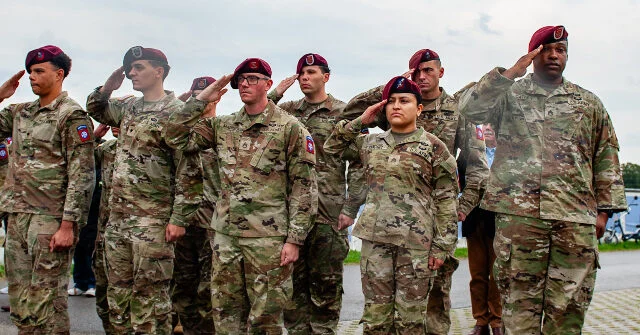
Pentagon Orders 3,000 Elite 82nd Airborne Troops to Middle East Amid Iran Tensions, Bolstering U.S. Force Posture and Diplomatic Leverage
The Pentagon is poised to issue orders in the coming hours for the deployment of approximately 3,000 soldiers from the U.S. Army’s elite 82nd Airborne Division to the Middle East, according to a detailed report by the Wall Street Journal. This significant movement represents an imminent deployment of a rapid-response brigade combat team, intended to bolster U.S. capabilities and support potential operations related to escalating tensions with Iran. The decision marks a critical juncture in the U.S. strategic approach to the region, combining robust military preparedness with ongoing diplomatic efforts.
The Imminent Deployment: Details and Strategic Intent
On Tuesday, March 24, 2026, the Wall Street Journal, citing two unnamed U.S. officials, reported that a formal deployment order for the 82nd Airborne unit, along with its crucial headquarters element responsible for planning and coordination, was anticipated shortly. This deployment signifies a substantial expansion of the United States’ military footprint in the Middle East, positioning a highly capable ground force ready to execute a diverse range of missions if directed by the President. The 82nd Airborne Division is renowned as the Army’s emergency response force, distinguished by its ability to deploy anywhere globally within a mere 24 hours. Its brigade combat teams are rigorously trained for airborne operations, including parachuting into contested or hostile environments to secure airfields and establish strategic footholds for subsequent military actions.
This strategic move is multifaceted. While officials were quick to caution that no decision has been made to deploy American ground forces directly into Iran, the Journal emphasized that the presence of the 82nd Airborne would significantly broaden President Donald Trump’s array of military options. These potential options include, but are not limited to, efforts to forcefully reopen the Strait of Hormuz—a vital global chokepoint for oil shipments—seizing strategic islands or coastal areas, or securing Iran’s stockpile of highly enriched uranium. The unit’s inherent flexibility and rapid deployment capabilities make it an ideal asset for scenarios requiring swift and decisive action.
Further corroborating these reports, Fox News chief national security correspondent Jennifer Griffin also indicated the planned deployment and its scale. Griffin reported that Major General Brandon Tegtmeier, the commanding officer of the 82nd Airborne Division, along with his "command element," had received orders for deployment to the Middle East. This initial movement of leadership suggests an advanced stage of planning for a broader force deployment, potentially for ground operations. Griffin noted the ongoing speculation about the U.S. potentially utilizing ground forces for missions such as taking Kharg Island, Iran’s primary oil export hub, or other internal operations, underscoring that the current deployment would serve as an initial, critical step in preparing for such contingencies.
Adding to the chorus of reports, a New York Times article published on Monday, March 23, 2026, had previously revealed that senior military officials were considering the deployment of a roughly 3,000-soldier brigade from the 82nd Airborne’s Immediate Response Force (IRF). The IRF is a specialized, high-readiness unit capable of global deployment within hours, underscoring the urgency and strategic importance attributed to this potential deployment. The Times report further speculated on potential scenarios, including operations targeting Kharg Island, possibly in coordination with U.S. Marine forces already en route to the region. Reuters, in its own reporting on Tuesday, echoed these sentiments, indicating that thousands of additional troops from the same 82nd Airborne formation were expected to be dispatched, placing the potential deployment range between 3,000 and 4,000 soldiers, though specific destinations or timelines remained undisclosed by anonymous sources.
Background: Escalating U.S.-Iran Tensions and Regional Dynamics
The decision to deploy additional forces is set against a backdrop of persistently high tensions between the United States and Iran, which have simmered and occasionally flared since the U.S. withdrawal from the Joint Comprehensive Plan of Action (JCPOA), commonly known as the Iran nuclear deal, in 2018. The subsequent re-imposition of stringent U.S. sanctions on Iran’s economy, particularly its oil sector, has significantly exacerbated economic pressures on Tehran, leading to a cycle of reciprocal actions and heightened rhetoric.
In the preceding months and years, the region has witnessed a series of incidents that underscore the fragility of peace and the potential for wider conflict. These have included attacks on international shipping in the Persian Gulf and the Strait of Hormuz, drone incidents, and regional proxy confrontations. The U.S. has consistently maintained a robust military presence in the Middle East, with approximately 50,000 troops already positioned across various bases and naval assets, aimed at deterring aggression, ensuring freedom of navigation, and supporting counter-terrorism operations. The Strait of Hormuz, a narrow waterway connecting the Persian Gulf to the open ocean, is particularly critical, as roughly 20% of the world’s petroleum and a significant portion of its liquefied natural gas pass through it daily. Any disruption to this vital artery has immediate global economic implications, making its security a paramount U.S. interest. The potential for Iran to threaten or impede passage through the Strait has long been a major concern for international maritime security.
The 82nd Airborne: A Pillar of Rapid Global Response
The selection of the 82nd Airborne Division for this rapid deployment underscores its unique and critical role within the U.S. military structure. Headquartered at Fort Bragg, North Carolina, the 82nd Airborne is one of the most storied and decorated divisions in the U.S. Army, with a history of combat operations dating back to World War I. Its designation as the Army’s "Immediate Response Force" (IRF) means it is specifically tasked with being ready to deploy anywhere in the world, often within hours, to respond to crises.
The IRF structure is designed for maximum agility and combat readiness. Its soldiers undergo intensive training, including parachute operations, urban warfare, and counter-insurgency tactics, ensuring they are prepared for a wide spectrum of combat scenarios. Each brigade combat team within the 82nd is a self-contained fighting unit, equipped with its own artillery, logistics, and support elements, capable of sustained independent operations. This makes the 82nd Airborne an invaluable asset for establishing initial entry points, securing critical infrastructure, or conducting rapid offensive actions in austere or hostile environments. Their ability to "parachute into hostile or contested territory to secure airfields and establish footholds for follow-on operations" directly aligns with some of the potential scenarios being considered in the current context, such as seizing strategic islands or coastal areas. The command element’s early deployment further emphasizes the need for meticulous planning and coordination, which are hallmarks of the 82nd Airborne’s operational doctrine.
A Dual-Track Strategy: Diplomacy and Deterrence
The military buildup is not occurring in isolation but is intricately linked with ongoing diplomatic overtures, reflecting a dual-track strategy by the Trump administration. Simultaneously with reports of troop movements, Axios reported on Tuesday that the United States was actively exploring the possibility of high-level talks with Iran as early as the same week. However, U.S. officials were reportedly awaiting a definitive response from Tehran, with significant uncertainty surrounding the progress or even the commencement of substantive negotiations.
This interplay between military and diplomatic channels was explicitly articulated by President Trump on Monday, March 23, 2026. The President announced a five-day pause on a prior ultimatum targeting Iran’s energy infrastructure, indicating that discussions had reached "major points of agreement." Crucially, he also issued a stern warning that military action would resume if diplomatic efforts failed to achieve a satisfactory resolution. This approach highlights a deliberate strategy: leveraging military readiness as a form of coercive diplomacy, aiming to create sufficient pressure to bring Iran to the negotiating table while also providing credible options should those talks falter. The deployment of the 82nd Airborne, therefore, can be viewed as both a deterrent and a significant piece of negotiating leverage. It signals to Tehran that the U.S. is prepared to back its diplomatic demands with military force, while simultaneously assuring allies of American commitment to regional security.
Reinforcing the Regional Posture: Beyond the 82nd Airborne
The deployment of the 82nd Airborne is part of a broader, ongoing reinforcement of U.S. military capabilities in the Middle East. Additional U.S. forces have been continuously moving into the region, augmenting the substantial buildup already in progress. Notably, Marine Expeditionary Units (MEUs) are advancing toward the Middle East. These include the 31st MEU aboard the USS Tripoli, an America-class amphibious assault ship, and the 11th MEU operating from the USS Boxer, a Wasp-class amphibious assault ship. These MEUs bring thousands of Marines and sailors, along with their associated air and ground combat elements, including helicopters, fixed-wing aircraft, and amphibious assault vehicles.
The integration of these diverse forces—elite airborne infantry, naval assets, and Marine expeditionary units—creates a formidable and highly flexible power projection capability. Marine Expeditionary Units are self-sustaining, air-ground task forces designed for a wide range of missions, from humanitarian assistance to full-scale combat operations. Their presence significantly enhances the U.S. ability to conduct amphibious assaults, provide naval gunfire support, and project air power from the sea. Together, the combined movement of the 82nd Airborne and the continued positioning of Marine forces, alongside existing air and naval assets, represents a comprehensive and coordinated approach. This strategy aims to preserve the possibility of a negotiated resolution with Iran while simultaneously ensuring the United States is fully positioned and equipped to act decisively if diplomatic efforts collapse or if U.S. interests are directly threatened. This robust posture also serves to reassure regional allies, many of whom share concerns about Iranian influence and actions.
Potential Military Options and Strategic Implications
The Wall Street Journal‘s mention of specific military options—reopening the Strait of Hormuz by force, seizing strategic islands or coastal areas, or securing Iran’s stockpile of highly enriched uranium—underscores the gravity of the situation and the potential scope of operations.
- Strait of Hormuz: Any military action here would be aimed at ensuring the free flow of international commerce. Such an operation would be complex, involving naval power, air superiority, and potentially ground forces to neutralize Iranian shore-based anti-ship capabilities or secure key positions. The 82nd Airborne’s ability to quickly seize and hold territory would be crucial in this scenario.
- Strategic Islands or Coastal Areas: Seizing islands like Kharg Island, Iran’s primary oil export terminal, would aim to cripple Iran’s economic lifeline and apply immense pressure. Such an operation would likely involve a combined force, with the 82nd Airborne potentially securing initial landing zones or key facilities, supported by naval and air assets.
- Securing Iran’s Uranium Stockpile: This would be an extremely sensitive and high-stakes operation, likely aimed at preventing nuclear proliferation. Such a mission would require highly specialized forces and intelligence, with the 82nd Airborne potentially providing perimeter security or rapid assault capabilities.
The strategic implications of such a deployment are profound. For Iran, it sends an unequivocal message of U.S. resolve and readiness to employ military force if necessary. For U.S. allies in the Gulf, it offers reassurance of American commitment to regional security. For the international community, it signals the heightened risk of conflict but also the U.S. determination to protect vital interests and international norms. The balance lies in demonstrating credible deterrence without inadvertently provoking an escalation that spirals out of control.
Conclusion: A Tense Equilibrium
The impending deployment of the 82nd Airborne Division represents a critical escalation in the U.S. military posture in the Middle East. It reflects a carefully calibrated strategy to manage tensions with Iran, balancing assertive military readiness with active diplomatic engagement. While President Trump seeks a negotiated resolution, the movement of elite rapid-response troops and other significant naval assets ensures that the United States possesses a full spectrum of credible options should diplomacy fail. The coming days and weeks will be crucial in determining whether this dual-track approach can de-escalate the volatile situation or if the region is poised for further confrontation. The coordinated efforts, involving high-readiness ground forces, powerful naval assets, and persistent diplomatic outreach, embody the U.S. commitment to safeguarding its interests and promoting stability in a strategically vital yet inherently complex and volatile part of the world.

Related Posts

Department of Homeland Security Reports Steady 2,000 Daily Migrant Arrests Amidst Intense Political Scrutiny and Calls for Greater Enforcement

Federal Building in New York City Targeted by Incendiary Device, Suspect in Custody Following Incident at 26 Federal Plaza