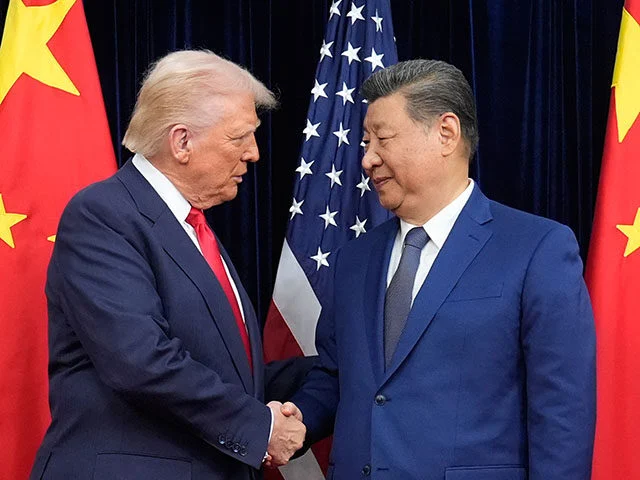
Exclusive – Top European Economic Minister Says Europe Rooting for Trump in Beijing Talks: ‘We Share Many of the Concerns’ U.S. Has with China
WASHINGTON – In a significant declaration underscoring transatlantic alignment on critical economic and geopolitical issues, a top European Union official has stated unequivocally that Europe supports President Donald Trump’s forthcoming discussions with China. Valdis Dombrovskis, the European Commission’s Commissioner for Economy and Productivity and former Prime Minister of Latvia, conveyed this stance in an exclusive interview with Breitbart News near the White House on Tuesday, during his attendance at the annual spring meetings of the International Monetary Fund (IMF) and the World Bank Group.
Dombrovskis articulated a shared perspective between the EU and the United States regarding numerous economic challenges posed by China, signaling a concerted effort to address global imbalances. "As regards to relations with China, we share many of the concerns with the U.S. including with imbalance in our trading relationship, including with China’s industrial overcapacities and non-market policies and practices, including China attempting to use our dependency for example on critical minerals like rare earths supplies as a leverage or choke point," Dombrovskis elaborated. He stressed that these concerns are central to ongoing transatlantic dialogue and broader international forums, including the IMF Spring Meetings, where global economic imbalances remain a key topic.
The European position, as articulated by Dombrovskis, emphasizes "de-risking" rather than outright "decoupling" from China. This strategy entails continuing engagement while actively addressing unfair competition, trade imbalances, and reducing strategic dependencies. This nuanced approach seeks to safeguard economic ties while building resilience against potential vulnerabilities, a policy framework that has gained increasing traction across European capitals.
A Shared Transatlantic Stance on China’s Economic Practices
The EU’s explicit support for the U.S. position ahead of President Trump’s mid-May state visit to Beijing highlights a growing convergence of concerns among major Western economies regarding China’s economic model. For years, both the U.S. and the EU have raised objections to what they describe as China’s state-backed industrial policies, which include extensive subsidies, forced technology transfers, intellectual property theft, and other non-market practices. These policies are widely perceived to distort global markets, create unfair competition, and undermine the principles of a rules-based international trading system.
One of the most pressing issues cited by Dombrovskis is China’s industrial overcapacities. Sectors such as steel, aluminum, solar panels, and more recently, electric vehicles (EVs), have seen massive investment and production in China, often supported by significant state aid. This has led to a surplus of goods flooding global markets at prices that Western manufacturers struggle to match, threatening industries and jobs in Europe and the U.S. For instance, the European Commission has launched investigations into Chinese EV subsidies, fearing that unfairly low-priced imports could harm the nascent European EV industry. Similar concerns have been voiced regarding Chinese steel and solar panel exports, which have faced anti-dumping duties in various markets.
The trade imbalance is another critical point of contention. The EU, like the U.S., runs a substantial trade deficit with China. In 2023, the EU’s trade deficit with China reportedly stood at hundreds of billions of euros, reflecting a persistent pattern of European economies importing far more from China than they export. This imbalance is attributed not only to competitive pricing but also to market access barriers, regulatory hurdles, and other non-tariff measures that disadvantage foreign companies operating in China. The U.S. has historically reported an even larger trade deficit with China, making it a central theme of its economic diplomacy.
Furthermore, the issue of critical minerals, particularly rare earths, underscores a significant dependency challenge. China currently dominates the global supply chain for many rare earth elements, which are vital for a wide range of advanced technologies, from electric vehicles and wind turbines to defense systems. This dominance grants China considerable geopolitical leverage, as demonstrated by past instances where Beijing restricted rare earth exports during diplomatic disputes. Dombrovskis’s reference to China "attempting to use our dependency… as a leverage or choke point" reflects European and American efforts to diversify supply chains and reduce reliance on single-source suppliers for these essential materials, a strategy encapsulated in the EU’s Critical Raw Materials Act.
Chronology of Engagement and Geopolitical Context
President Trump’s impending visit to Beijing, scheduled for mid-May, follows a period of intense trade friction and geopolitical maneuvering between the U.S. and China. The trip was initially planned for early April but was postponed due to heightened geopolitical tensions, specifically cited as the "war in Iran" in the original report. While the term "war" might refer to specific regional escalations or increased military activity rather than a full-scale conventional conflict, it nonetheless indicates a significant diversion of diplomatic attention and resources. This postponement underscores the volatility of the current global landscape and the interconnectedness of various geopolitical flashpoints.
The visit comes after a tumultuous period during Trump’s previous administration, characterized by the initiation of a comprehensive trade war with China. This era saw the imposition of tariffs on hundreds of billions of dollars worth of goods by both sides, significantly impacting global supply chains and economic stability. Despite these tensions, negotiations eventually led to a "Phase One" trade deal in early 2020, though many structural issues remained unresolved.
Since "Liberation Day" a year ago (a term often used to refer to a significant political or economic milestone in Trump’s political narrative), President Trump has reportedly inked trade deals with nations accounting for over 85 percent of global gross domestic product (GDP). This includes agreements with the European Union, Japan, South Korea, India, and the United Kingdom, among others. These agreements, regardless of their specific terms or ultimate impact, are presented as part of a broader strategy to rebalance global trade relationships in favor of the United States and its allies.
The EU-U.S. Trade Deal: A Pillar of Transatlantic Stability
A crucial element of the current transatlantic economic landscape is the trade deal signed last summer between President Trump and European Commission President Ursula von der Leyen. This agreement, forged during Trump’s stay at his Turnberry resort in Scotland, has been hailed by both sides as a critical step in stabilizing and strengthening the world’s largest trade relationship.
Dombrovskis emphasized the immense economic significance of this partnership: "EU-U.S. trade relationships are the largest in the world. So we trade every year around 1.7 trillion euros. So there’s lots of stake economically. So this stability and predictability was much needed." The sheer volume of trade underscores why maintaining a stable and predictable framework is paramount for both economies. The deal aimed to reduce trade barriers, streamline regulatory cooperation, and foster a more amicable environment for transatlantic commerce, moving away from the tariff disputes that had characterized parts of Trump’s previous term.
The path to full implementation of this deal, however, involves domestic political processes. Dombrovskis noted that the European Parliament is making progress in its review, as parliamentary approval is necessary for the agreement to be fully greenlighted by the EU. He also confirmed receiving "reassurances from President Trump’s administration that also from their side, they are committed to this deal and ensuring the terms EU negotiated under this deal." This mutual commitment is vital for ensuring the longevity and effectiveness of the agreement, providing a degree of certainty for businesses and investors on both sides of the Atlantic.
President Trump, in an interview with Breitbart News at Turnberry following the signing, described the agreement as a "great deal for both" Europe and the United States, highlighting his administration’s focus on achieving what he viewed as beneficial trade outcomes through direct negotiation.
Broader Geopolitical Implications and the Global Economic Order
Beyond the immediate trade concerns, Dombrovskis touched upon a broader geopolitical apprehension: the potential for Russia, Iran, and China to collaborate in ways that could destabilize the global economic order. This concern reflects a growing sentiment among Western leaders about the formation of an "axis of revisionist powers" seeking to challenge the existing international system. Economic cooperation, technological sharing, and diplomatic alignment among these nations are closely monitored by NATO and EU member states, particularly in the context of the ongoing conflict in Ukraine.
In response to these geopolitical challenges, the European Union has reaffirmed its robust commitment to supporting Ukraine. Dombrovskis highlighted a recent pledge of an additional 90 billion euros over the next two years to aid Ukraine’s defense and reconstruction efforts. This substantial financial commitment underscores the EU’s strategic resolve to counter Russian aggression and uphold international law, even as it navigates complex economic relationships with other global powers. The allocation of such significant resources demonstrates Europe’s dedication to its security interests and its role in maintaining regional stability.
Dombrovskis’s presence in Washington for the IMF and World Bank Group spring meetings further contextualizes these discussions. These annual gatherings bring together finance ministers, central bankers, and development officials from around the world to discuss pressing global economic issues, including growth prospects, inflation, debt sustainability, and, crucially, global economic imbalances. The platform provides an opportunity for major economies to coordinate policies, address shared challenges, and build consensus on the future direction of the global economy. The alignment of the EU and U.S. on China’s economic practices during these meetings sends a powerful message to Beijing and other international actors about the unified stance of these influential economic blocs.
The Path Forward: De-risking and Strategic Autonomy
The EU’s strategy of "de-risking" rather than "decoupling" from China is a carefully calibrated approach. It recognizes the deep economic interdependence with China—which remains the EU’s second-largest trading partner—while simultaneously seeking to mitigate risks associated with overreliance and unfair practices. This strategy involves several key pillars:
- Supply Chain Diversification: Encouraging companies to spread their sourcing geographically to reduce vulnerability to disruptions or political leverage from any single country.
- Domestic Industrial Strengthening: Investing in key strategic sectors within the EU to build resilience and reduce reliance on imports, particularly for critical goods and technologies.
- Investment Screening: Implementing robust mechanisms to scrutinize foreign direct investments, particularly from state-backed entities, to prevent the acquisition of critical infrastructure or sensitive technologies.
- Export Controls: Strengthening controls on the export of dual-use technologies that could be repurposed for military or repressive uses.
- Regulatory Harmonization: Working with like-minded partners to develop common standards and regulations that promote fair competition and protect intellectual property.
This approach reflects Europe’s quest for "strategic autonomy," a concept that aims to enhance the EU’s capacity to act independently in key policy areas while maintaining strong alliances. For the U.S., a united European front on China provides significant leverage in its own negotiations, amplifying the message that the international community expects China to adhere to global trade rules and norms.
The forthcoming discussions between President Trump and President Xi Jinping in Beijing will undoubtedly be complex, touching upon a myriad of issues from trade and technology to regional security and human rights. With the explicit backing of a major economic bloc like the European Union, the U.S. negotiating position is bolstered, underscoring a broader international consensus on the need for China to reform its economic practices. The outcomes of these talks will have far-reaching implications, not only for U.S.-China relations but also for the future of global trade, supply chain resilience, and the evolving geopolitical landscape. The stability provided by the EU-U.S. trade deal, coupled with shared concerns about China and the broader geopolitical environment, positions the transatlantic partnership as a crucial anchor in an increasingly multipolar and challenging world.

Related Posts

Democratic Candidates Must Moderate to Win General Elections, Says Rep. Greg Stanton
Lisa Demuth Secures Republican Gubernatorial Nomination in Minnesota, Defeating Trump-Endorsed Mike Lindell