
Argentina Faces Fifa Disciplinary Action After Falklands Banner Celebration in World Cup Semi-Final
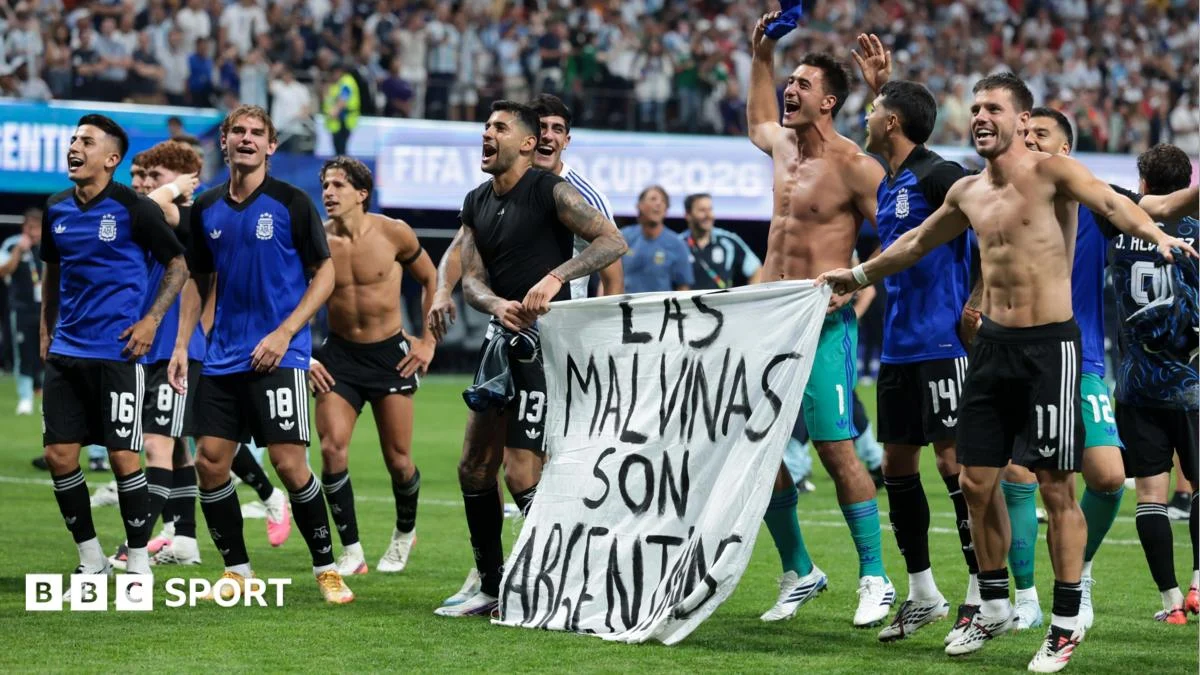
Argentina’s triumphant advance to the World Cup final has been overshadowed by the prospect of severe disciplinary action from Fifa, after their players displayed a banner asserting their nation’s claim to the Falkland Islands following their dramatic semi-final victory against England. The incident, which unfolded amidst jubilant post-match celebrations in Atlanta, has ignited a fresh diplomatic and sporting controversy, drawing sharp condemnation from the United Kingdom and prompting urgent calls for Fifa to intervene decisively.
The defending world champions secured their spot in Sunday’s final against Spain with a thrilling 2-1 comeback win over Thomas Tuchel’s England side, scoring two late goals to overturn a deficit. However, the euphoria was quickly tempered when, after the final whistle, Argentine players were seen holding aloft a banner that prominently read: "Las Malvinas son Argentinas" – translating to "The Falklands are Argentine." This act directly contravenes Fifa’s strict regulations against political statements in sport, setting the stage for a potentially significant penalty.
A Deep-Seated Dispute: The Falklands/Malvinas Question
The Falkland Islands, known in Argentina as the Malvinas, are a British overseas territory situated approximately 300 miles off Argentina’s east coast in the south-west Atlantic Ocean. The sovereignty of these islands has been a contentious and deeply emotional issue between the United Kingdom and Argentina for centuries, rooted in conflicting historical claims.
British presence on the islands dates back to 1765, though Spanish claims were asserted from the late 18th century. Argentina inherited Spain’s claim upon its independence in the early 19th century, establishing a settlement in 1820. However, Britain reasserted its sovereignty in 1833, expelling the Argentine officials and maintaining continuous administration ever since. Argentina has consistently protested this, viewing the islands as an integral part of its national territory, illegally occupied by a colonial power.
The dispute dramatically escalated into armed conflict in 1982, when Argentina, under the military junta led by General Leopoldo Galtieri, invaded the islands on April 2. The United Kingdom responded swiftly, dispatching a naval task force to reclaim the territory. The ensuing Falklands War lasted for 74 days, from April 2 to June 14, 1982, resulting in significant casualties: 655 Argentine servicemen, 255 British servicemen, and three civilians from the islands lost their lives. The conflict ended with an Argentine surrender and the islands remaining under British control.
Despite the military defeat, Argentina has never relinquished its claim, maintaining it through diplomatic channels and often invoking the issue in national discourse. The United Nations Special Committee on Decolonization has repeatedly called for negotiations between the two countries, though the islanders themselves, in a 2013 referendum, voted overwhelmingly (99.8%) to remain a British overseas territory, a right to self-determination supported by the UK but not recognized by Argentina. The phrase "Las Malvinas son Argentinas" is not merely a political slogan but a deeply ingrained national sentiment, taught in schools and celebrated in popular culture, particularly resonant among war veterans and their families.
Fifa’s Stance on Political Displays: A History of Enforcement
World football’s governing body, Fifa, maintains a firm stance against political, religious, or personal statements and symbols in football. Article 16 of the Fifa Disciplinary Code, concerning "Order and Security at Matches," explicitly prohibits "the use of gestures, signs, or words that are insulting, offensive, or of a political, religious, or ideological nature." Furthermore, Article 11, which addresses "Offensive Behaviour and Breaches of the Principles of Fair Play," can also be invoked. This policy is designed to uphold the neutrality of sport, prevent the exploitation of matches for non-sporting agendas, and ensure a welcoming environment for all participants and spectators, regardless of their background or political affiliations.
This is not the first instance of Argentina facing repercussions for similar actions. In 2014, the Argentine Football Association (AFA) was fined £20,000 by Fifa after its players displayed a banner with the identical "Las Malvinas son Argentinas" message before a friendly match against Slovenia. At the time, Fifa cited the gesture as a breach of rules on political action and team misconduct, underscoring its consistent enforcement of these regulations.
Beyond the AFA, Fifa and other governing bodies have a track record of punishing political expressions. A notable precedent involves South Korea’s midfielder Park Jong-woo, who, after the 2012 Olympic Games bronze medal match, held a sign in Korean that read "Dokdo is our territory." Dokdo (also known as Liancourt Rocks) is a group of islets administered by South Korea, but also claimed by Japan. Park was charged by Fifa and subsequently handed a two-match suspension, causing him to miss two World Cup qualifiers. This case demonstrates Fifa’s willingness to impose individual player sanctions for such breaches.
More recently, European football’s governing body, Uefa, banned Spain players Alvaro Morata and Rodri for one game after they chanted "Gibraltar is Spanish" during their side’s Euro 2024 victory celebrations. Gibraltar, an enclave at Spain’s southern tip, has been under British rule since the 18th century, with Spain long calling for its return. This incident highlights that such political declarations, even in celebratory contexts, are taken seriously across major football organizations. The context of these previous rulings provides a clear framework for the potential actions Fifa might take against Argentina.
Official Reactions and Calls for Action
The display of the banner immediately drew strong reactions from the United Kingdom. Downing Street quickly backed calls for Fifa to launch a thorough investigation. The prime minister’s official spokesperson delivered a unequivocal statement: "The World Cup might not be ours, but the Falkland Islands definitely are. Our commitment to the Falklands will never waver." This firmly reiterated the UK’s position on the sovereignty dispute and its expectation for Fifa to uphold its rules.
Liberal Democrat leader Ed Davey went further, sending an open letter to Fifa president Gianni Infantino, explicitly calling for the Argentine players involved in holding the banner to be suspended for Sunday’s final against Spain. Davey specifically referenced the Uefa ban on Morata and Rodri for their "Gibraltar is Spanish" chants, arguing for consistency in disciplinary action. "Football should unite, not divide," Davey stated, emphasizing the need for Fifa to act decisively to prevent the exploitation of sporting events for political propaganda.
MP Peter Kyle, Secretary of State for Business and Trade, echoed these sentiments, labeling Argentina’s banner as "entirely inappropriate" and expressing confidence that Fifa would conduct a comprehensive investigation. "I think [an investigation] is certain to happen because it was such an egregious violation of the rules of not having political activity as part of the football," Kyle told BBC Breakfast, underscoring the severity of the breach from the British perspective. The UK Prime Minister’s official spokeswoman reiterated Kyle’s view, adding that any potential action was "a matter for Fifa," while also offering a pointed, albeit diplomatic, closing remark: "The PM wishes both teams well for the final, especially Spain."
Argentina’s Perspective: More Than Just a Game
From the Argentine side, the banner display was framed as a deeply emotional and patriotic act, reflecting a sentiment widely shared across the nation. Argentina midfielder Leandro Paredes articulated this sentiment after the match, stating that the Falklands War was a "sad part of our history" and adding that the semi-final "wasn’t just a football match" for his nation. This highlights the profound cultural and historical weight the Malvinas issue carries in Argentina, where the islands are considered a sacred national cause.
Victoria Villarruel, Argentina’s vice-president, a figure known for her strong nationalist views and connections to military families, posted on X (formerly Twitter) after the victory, asserting that "it wasn’t just another match." Her post, accompanied by a video appearing to show Argentine soldiers, declared: "The Falklands are Argentine. They banned bringing them to the stadium and forgot that we carry them in our blood and our hearts." In the build-up to the game, Villarruel had explicitly framed the semi-final as an opportunity to "put the invaders in their place," signaling the political undercurrents that many in Argentina attached to the match.
It is important to note that this was not an isolated incident during the tournament. Argentina players had also been heard singing chants referencing the Falklands, alongside their national football heroes Diego Maradona and Lionel Messi, following their dramatic 3-2 victory over Egypt in the last 16. These repeated expressions underscore the deeply embedded nature of the Malvinas claim within Argentine national identity and its connection to sporting triumphs.
However, the team’s manager, Lionel Scaloni, had attempted to distance the squad from such political statements before the semi-final. "The reality is that this is a football match. I can’t mix things up, especially out of respect for what happened so many years ago," Scaloni had said. "It was a very sad period in our history, and there isn’t much we can do about it, that’s the reality. Things are happening elsewhere in the world, and we criticise the existence of war. We certainly remember those people, of course. But it is a football match – we shouldn’t confuse the two." Scaloni’s comments highlight the delicate balance between national sentiment and sporting neutrality that teams must navigate on the global stage.
Potential Disciplinary Pathways and Implications
Fifa typically takes disciplinary action for general breaches of regulations by players or a country’s supporters in the weeks following a tournament. Therefore, immediate sanctions before Sunday’s final might be unlikely, though not entirely impossible given the high-profile nature and direct political messaging. However, Fifa could potentially treat this situation more seriously than past incidents because it occurred during a World Cup, a tournament with immense global viewership and diplomatic sensitivity, and directly involved the two nations at the heart of the sovereignty dispute.
While there is no prospect of Argentina losing their place in the final due to this incident – such a severe penalty would be unprecedented for a post-match political display – the range of potential sanctions is broad. These could include significant fines for the Argentine Football Association (likely exceeding the £20,000 imposed in 2014), suspensions for the individual players identified as holding the banner, or even a stadium ban or points deduction for future qualifying campaigns, though the latter is less common for this type of infraction. The call from Ed Davey for player suspensions for the final is a clear indication of the pressure Fifa faces to act firmly and consistently with its own precedents.
The incident also draws parallels with the broader debate surrounding political expression in sport. At the 2022 World Cup in Qatar, England, Wales, and other European nations notably abandoned plans to wear the rainbow-coloured OneLove armband, a symbol of LGBTQ+ rights, due to the threat of players receiving yellow cards from Fifa. This demonstrated Fifa’s strict enforcement of its rules against non-approved symbols, even those advocating for human rights, suggesting it will apply similar rigor to overtly nationalistic political statements.
Broader Implications for Sport and Diplomacy
This incident carries significant implications, not only for Argentina and the integrity of the World Cup but also for the broader relationship between sport and geopolitics. It underscores the enduring sensitivity of the Falklands/Malvinas dispute and its capacity to spill over into seemingly unrelated international events. For Fifa, the challenge is to enforce its rules consistently without appearing to favor one political stance over another, while also navigating the complex emotional and nationalistic currents that often run through international football.
The episode could also strain diplomatic relations between the UK and Argentina, which, while improved since the immediate aftermath of the 1982 conflict, remain delicate regarding the islands. Such high-profile political statements on a global stage can reignite tensions and complicate efforts to foster dialogue and cooperation.
Ultimately, Fifa’s decision will be closely watched as a litmus test of its commitment to maintaining the neutrality of sport. It will set a precedent for how future political expressions at major tournaments are handled, and potentially influence the delicate balance between national pride and the universal values of fair play and unity that football ostensibly seeks to promote.
Looking Ahead: The Final and Beyond
As Argentina prepares to face Spain in the World Cup final, the shadow of potential disciplinary action looms large. While the focus of the team will undoubtedly be on the impending match, the AFA will be bracing for a formal investigation and the eventual ruling from Fifa’s Disciplinary Committee. The outcome will not only determine the immediate consequences for Argentina but also send a clear message about the boundaries of political expression in international football for years to come. The incident serves as a stark reminder that even in the realm of sport, history, politics, and national identity remain deeply intertwined, capable of igniting controversy on the world’s biggest stages.

Related Posts
Zambia on Edge: Opposition Leader Arrested Amid Allegations of Insurrection Plot and Election Tensions
Rescuers search for survivors of powerful Indonesia earthquake

