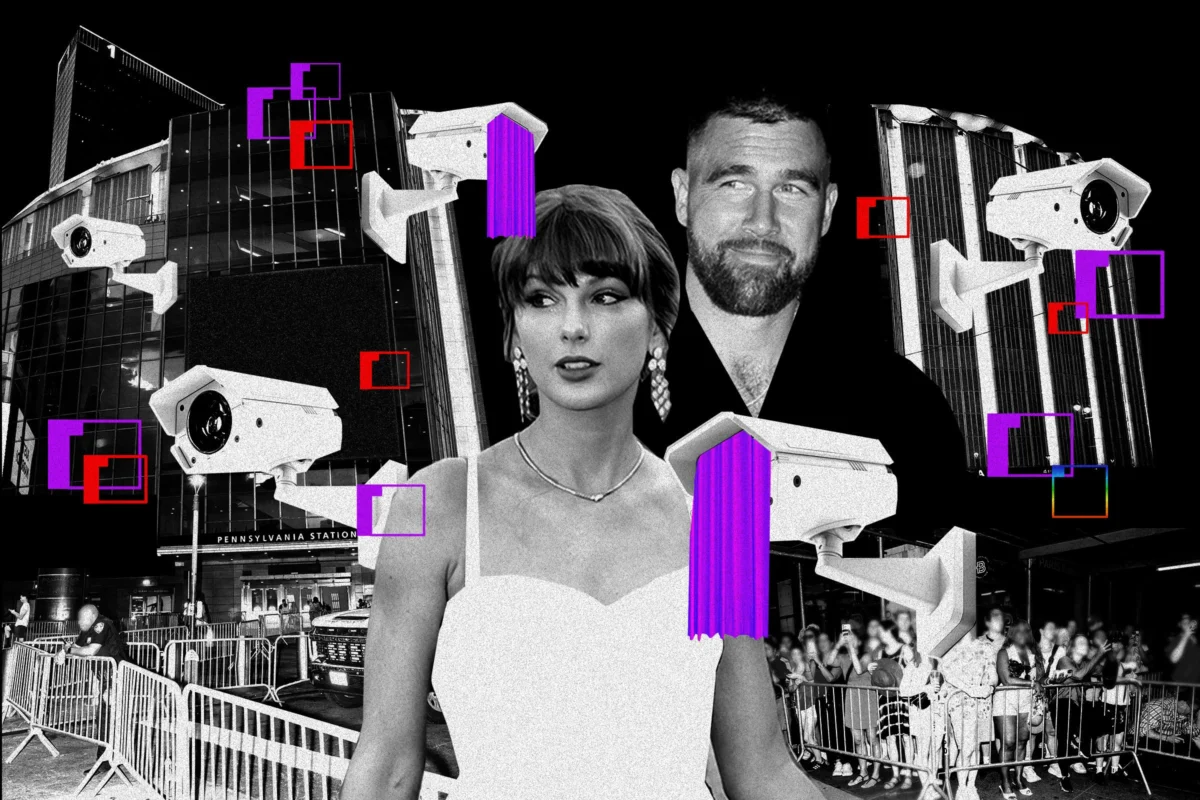
The Surveillance Paradox: Madison Square Garden Disables Biometric Security for Swift-Kelce Wedding
Madison Square Garden, long touted by owner James Dolan as the most secure venue in the United States, recently underwent a significant, albeit temporary, reconfiguration of its security infrastructure. On July 2 and July 3, 2026, the arena—a facility defined by its aggressive deployment of facial-recognition technology and extensive surveillance networks—effectively went "dark" regarding its biometric monitoring capabilities. This operational pivot occurred during the high-profile wedding celebration of global pop icon Taylor Swift and NFL star Travis Kelce, an event that drew nearly 1,000 of the world’s most influential figures in media, business, and entertainment to the venue’s Infosys Theater.
Internal documentation reviewed by journalists confirms that an MSG executive mandated a seven-hour lockdown of the facility’s video management system on July 2. The order, issued to accommodate a specific client privacy request, explicitly barred the venue’s security personnel from accessing the Genetec-based surveillance network. For the duration of this window, the controversial facial-recognition software, which has become a hallmark of Dolan’s venue management strategy, was rendered non-functional for the rank-and-file security team.
A Chronology of the Lockdown
The events of early July 2026 were characterized by extreme sensitivity. New York City was already in a state of heightened alert due to the convergence of America 250 anniversary celebrations and rising geopolitical tensions involving the Middle East. Against this backdrop, the NYPD had deployed approximately 130 officers to the vicinity of the Garden, with plans to restrict vehicle and pedestrian traffic in the surrounding blocks for the following day.
On July 2, as preparations for the rehearsal dinner began, the internal memo circulated to MSG security staff was unambiguous: "If you somehow still have access to cameras after 3 PM, you will be forcibly logged off." The directive restricted access to the surveillance feed to a minute circle of company leadership and specialized engineers. According to sources familiar with the operations, this lockout protocol was repeated on July 3, the night of the wedding ceremony itself.
The lengths taken by the couple to ensure discretion were extraordinary. Guests were required to sign non-disclosure agreements (NDAs) prior to receiving digital invitations. To circumvent the biometric scanners installed at the venue’s standard entrances, specialized tents were erected to facilitate private, secure vehicle entry. Despite the massive security apparatus typically utilized by the Garden, the specific demand to disable the camera network represents a departure from standard operating procedure, marking a rare instance where the "World’s Most Famous Arena" effectively yielded its surveillance mandate for a private client.

The Evolution of MSG Surveillance
Since 2018, James Dolan has championed the integration of biometric surveillance across his portfolio, which includes Radio City Music Hall, the Beacon Theater, and the Sphere in Las Vegas. The company has consistently maintained that these measures are essential for public safety, specifically the identification of hostile actors. However, the application of this technology has frequently sparked controversy.
Public record reveals numerous instances where the facial-recognition system was utilized not for broad security, but for targeted exclusions. Attorneys involved in litigation against MSG-controlled entities have been identified and ejected, as have casual attendees who were flagged due to personal or professional disputes involving the company. This pattern of use has prompted legal challenges and intensified scrutiny from civil liberties advocates who argue that the technology functions as a tool for retribution rather than public safety.
The software backbone, provided by Genetec and linked to eConnect facial-recognition modules, allows for granular tracking. Security personnel can monitor individuals in real-time, transitioning across camera feeds to document movement through the facility. Documented cases—including the granular tracking of a transgender woman through the facility, down to her entry and exit from restrooms—have highlighted the invasive potential of this infrastructure.
Data Privacy and the VIP Database
The scrutiny of MSG’s security practices was further amplified by a significant data breach. The hacker collective ShinyHunters leaked an internal database containing information on more than 39,000 VIPs associated with the Garden. While MSG has pursued legal action against outlets reporting on this breach, court filings have inadvertently confirmed the existence of a "Threat Management" system.
This database included fields for race, gender, and sexual orientation. MSG has defended the inclusion of sexual orientation data as a mechanism for "inclusion-oriented outreach" and community engagement. However, the leak also revealed that high-profile individuals—including actors, athletes, and musicians—were assigned "risk scores." Guests at the Swift-Kelce wedding, such as Selena Gomez, Benny Blanco, Michael Strahan, and Mariska Hargitay, were among those categorized within these internal risk metrics.
The coexistence of a robust, active surveillance state for the general public and a "privacy-on-demand" model for the ultra-wealthy creates a stark disparity in the expectation of digital rights.

Implications and Regulatory Landscape
The decision to deactivate the system for the Swift-Kelce wedding raises fundamental questions regarding the nature of corporate surveillance. If the system is truly vital for security, as management claims, why would it be rendered inoperable during an event involving some of the most targeted public figures in the world?
"Clearly, the technology is not that helpful if it wasn’t needed at one of MSG’s highest-profile events of the year," says Michelle Dahl, executive director for the Surveillance Technology Oversight Project (STOP). This sentiment is echoed by broader civil rights groups, who view the exemption as a disturbing preview of a tiered society. In this vision, privacy is transformed from a basic right into a luxury commodity, available only to those with the financial leverage to negotiate it.
Legislative efforts to curb this trend are ongoing. In Chicago, for instance, local laws prohibit private entities from collecting biometric data without explicit written consent—a regulatory barrier that does not currently exist in the same capacity in New York. While the New York State Liquor Authority recently concluded a multiyear inquiry into the Garden’s use of facial recognition with a relatively minor administrative penalty, the political pressure continues to mount.
Broader Societal Impact
The events of July 2026 serve as a focal point for the growing debate over the ubiquity of biometric data. As the infrastructure for such monitoring becomes cheaper and more integrated, the potential for abuse grows. When private corporations assume the role of intelligence agencies—maintaining databases on political figures, activists, and legal opponents—the distinction between public safety and corporate control blurs.
The Swift-Kelce event demonstrates that even the most surveillance-heavy environments are capable of turning off their systems when the commercial incentives align. This suggests that the persistence of facial recognition in public venues is a policy choice rather than a technological necessity. As the public continues to grapple with the normalization of biometric monitoring, the case of Madison Square Garden provides a compelling look at the power dynamics governing our digital and physical footprints. Whether such surveillance becomes an permanent feature of the urban landscape or a regulated practice will likely be determined by the upcoming cycle of biometric data legislation in Albany and beyond. For now, the Garden remains a site of both immense entertainment and intense, if inconsistent, scrutiny.

Related Posts
The Las Vegas Cybersecurity Summit and the Escalating Threat of Autonomous Digital Exploitation
New York City Council members and privacy advocates launch legislative campaign to ban biometric facial recognition at public entertainment venues