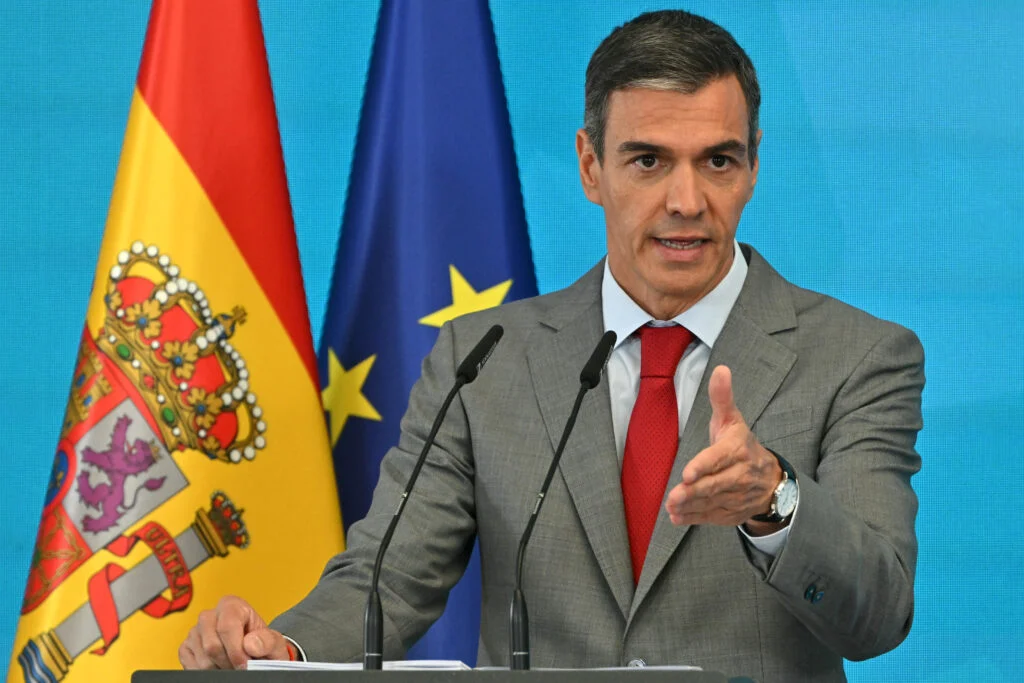
European Union unity fractures as twenty-two member states challenge Spanish migration policy following the Ceuta border crisis
The stability of the European Union’s border policy is currently facing its most severe test in years, as a coalition of twenty-two member states has launched a concerted diplomatic offensive against Spanish Prime Minister Pedro Sánchez. The dispute, triggered by a massive surge of approximately 50,000 unauthorized migrants into the Spanish North African enclave of Ceuta in late July 2026, has escalated into a fundamental debate over the integrity of the Schengen Area and the efficacy of national migration strategies.
The standoff pits a bloc of nations—led by Italy and Denmark and supported by heavyweights including Germany—against the Spanish government. At the heart of the controversy is a fundamental disagreement over whether Spain’s domestic regularization policies act as a "pull factor" for illegal migration, or whether the current crisis is a result of external actors weaponizing human displacement against the bloc.
A Chronology of the Ceuta Surge
The current crisis began in the final week of July 2026, when border authorities in Ceuta reported an unprecedented wave of arrivals from Morocco. The surge, which saw 50,000 individuals cross the perimeter in a matter of days, overwhelmed local infrastructure and prompted an immediate security response from Madrid. While the Spanish government moved quickly to process and return the majority of those who crossed, the incident sent shockwaves through the European Council.
By July 31, the situation had largely stabilized on the ground, with Spanish authorities confirming that nearly all those who entered the exclave had been repatriated to Morocco. However, the political fallout had only just begun. On August 1, a letter signed by the leaders of 22 EU nations was dispatched to European Commission President Ursula von der Leyen, European Council President António Costa, and Irish Prime Minister Micheál Martin, signaling a rare and public rebuke of a fellow member state.
The Arguments Against Madrid: The Pull Factor Debate
The signatories of the letter, including German Chancellor Friedrich Merz and Italian Prime Minister Giorgia Meloni, argue that the crisis in Ceuta cannot be viewed in isolation. They point directly to Spain’s controversial policy of granting legal status to up to 1.2 million undocumented migrants, a measure they contend creates a perception of impunity that encourages further illegal attempts to reach European soil.

"We have a duty to effectively deter and relentlessly combat illegal migration," the signatories stated in their joint correspondence. "This includes addressing all policies that can serve as pull factors, such as the regularization of a very large number of irregular migrants."
For these 22 leaders, the risk is not merely the individual entries into Ceuta, but the potential for these incidents to be exploited as "hybrid threats." The letter expressed "serious concern" regarding the threat to the EU’s external frontiers and suggested that if Spain cannot secure its borders, the integrity of the entire Schengen zone—which allows for passport-free travel between 29 countries—is at risk.
The Spanish Defense: Legal Nuance and Geopolitical Context
Prime Minister Pedro Sánchez has mounted a robust defense, characterizing the accusations as "selfish," "unlawful," and based on a fundamental misunderstanding of Spanish law. His government maintains that there is no causal link between the regularization scheme and the crisis in Ceuta.
A spokesperson for the Spanish foreign ministry clarified that the regularization program, launched in April 2026, is highly restrictive. Eligibility is contingent upon proof of residency in Spain prior to January 1, 2026, and the maintenance of residency for at least five consecutive months. Furthermore, the application window closed in June, meaning those who entered Ceuta in July were legally ineligible for the program by definition.
In his own letter to EU leadership, Sánchez argued that calls for Spain’s temporary suspension from the Schengen Area are legally baseless and contrary to the spirit of European solidarity. He cited data showing that Spain recorded only 50% of the illegal entries compared to Italy between 2021 and 2026, suggesting that the targeting of Spain is politically motivated rather than based on an objective assessment of border security performance.
The Escalation: Schengen and the Future of Free Movement
The diplomatic dispute has already moved beyond rhetoric. On July 30, Italy’s Giorgia Meloni became the first leader to openly advocate for Spain’s suspension from the Schengen Area. By August 1, Italy had implemented de facto restrictions on free movement, imposing additional checks on travelers arriving from Spain at Italian ports and airports. France, citing the "hybrid threat" of the Ceuta surge, similarly increased border controls, creating a cascade effect that threatens to turn the Schengen zone into a series of fragmented checkpoints.

This move has drawn sharp criticism from Brussels and Madrid, as it represents a significant rollback of the European project’s hallmark achievement: the freedom of movement. For smaller member states and those reliant on cross-border tourism and trade, the prospect of reintroducing internal borders is an economic and political nightmare.
Analytical Perspectives: Implications for the Bloc
The current crisis underscores a deepening ideological divide within the European Union regarding migration management. The "security-first" camp, led by Italy and joined by nations like Poland, Hungary, and the Netherlands, argues that strict border enforcement and the prevention of any "legalization" of illegal entry are the only ways to maintain order.
Conversely, proponents of the Spanish approach—or those who at least advocate for a more nuanced view—point out that the weaponization of migration by external powers like Morocco or, as seen in 2021, Belarus, requires a coordinated EU response rather than the isolation of a single member state.
From an analytical standpoint, the implications are profound:
- Schengen Integrity: The willingness of member states to unilaterally impose border controls in response to a diplomatic dispute signals a weakening of the European Commission’s authority to maintain a unified, borderless zone.
- Internal Cohesion: The fact that 22 leaders signed a letter against Spain highlights a significant shift in the balance of power. The traditional center-left influence, represented by figures like Sánchez, is being increasingly challenged by a coalition of center-right and nationalist-leaning leaders.
- Future Policy: The demand for a video conference of interior ministers suggests that the EU will likely move toward a more restrictive and centralized migration policy. The debate over whether to formalize the link between domestic regularization and "pull factors" will likely dominate the European Council’s agenda for the remainder of the year.
The Path Forward
As the EU prepares for the emergency meeting of interior ministers, the situation remains fluid. The Spanish government has signaled it will continue to resist what it calls "prejudice and fake news," while the opposing coalition has indicated it will not back down until there is a tangible change in how Spain manages its border and legal status procedures.
The crisis has brought to the fore a uncomfortable reality for the bloc: the absence of a unified, comprehensive migration policy leaves the union vulnerable to both external manipulation and internal fracture. Whether the current tension leads to a new, stricter consensus or a prolonged period of diplomatic and economic friction remains to be seen. For now, the border at Ceuta serves as a stark, physical reminder of the precarious state of European unity in an era of global displacement and political polarization.