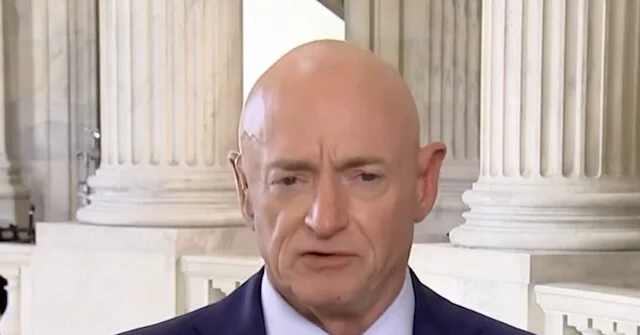
Senator Mark Kelly Criticizes Trump Administration’s Iran Policy, Citing Lack of Strategic Cohesion and Economic Fallout
On a recent Monday broadcast of MS NOW’s “The Briefing,” Senator Mark Kelly (D-AZ) launched a scathing critique of then-President Donald Trump’s Iran policy, characterizing it as "flailing" and attributing its perceived failures to a fundamental inability to think strategically. Kelly, a former astronaut and combat veteran, underscored the profound risks faced by U.S. service members deployed overseas, arguing that while they understand inherent dangers, they do not expect to be drawn into conflicts lacking clear strategic objectives, comprehensive plans, or defined exit strategies. His remarks resonated with concerns about the human cost of military engagement and broader economic ramifications impacting American citizens.
Background: The Joint Comprehensive Plan of Action and U.S. Withdrawal
To fully understand Senator Kelly’s criticisms, it is essential to contextualize the Trump administration’s approach to Iran. The multilateral nuclear agreement, officially known as the Joint Comprehensive Plan of Action (JCPOA), was signed in July 2015 between Iran and the P5+1 group of world powers (China, France, Germany, Russia, the United Kingdom, and the United States, plus the European Union). This landmark deal aimed to prevent Iran from developing nuclear weapons in exchange for relief from international sanctions. Under the JCPOA, Iran agreed to significant restrictions on its nuclear program, including reducing its centrifuges, limiting uranium enrichment levels, and submitting to an intrusive verification regime by the International Atomic Energy Agency (IAEA).
However, Donald Trump, both as a presidential candidate and after taking office, consistently denounced the JCPOA as "the worst deal ever negotiated." He argued that the agreement did not adequately address Iran’s ballistic missile program or its support for regional proxy groups, and that its sunset clauses would eventually allow Iran to resume its nuclear activities. On May 8, 2018, President Trump announced the United States’ unilateral withdrawal from the JCPOA, reimposing a sweeping array of sanctions on Iran that had been lifted under the deal. This move marked a dramatic shift in U.S. foreign policy toward Iran, initiating what the administration termed a "maximum pressure" campaign designed to cripple Iran’s economy and compel Tehran to negotiate a new, more comprehensive agreement addressing all U.S. concerns.
Escalation of Tensions and Regional Instability
Following the U.S. withdrawal and the subsequent intensification of sanctions, the relationship between Washington and Tehran rapidly deteriorated, leading to a series of escalating incidents in the Middle East. The year 2019, in particular, saw a significant uptick in regional tensions. In May, four oil tankers, including two Saudi vessels, were damaged by what U.S. officials described as limpet mines in the Gulf of Oman, with Washington blaming Iran. Later that month, Iranian-backed Houthi rebels in Yemen claimed responsibility for drone attacks on Saudi oil pipelines.
The summer of 2019 witnessed further provocations. In June, Iran shot down a U.S. RQ-4 Global Hawk surveillance drone over the Strait of Hormuz, claiming it had violated Iranian airspace. The U.S. maintained the drone was in international airspace. President Trump initially authorized retaliatory strikes but called them off at the last minute, citing potential casualties. In September, major Saudi oil facilities at Abqaiq and Khurais were attacked by drones and missiles, temporarily halving Saudi Arabia’s oil production. While the Houthis again claimed responsibility, the U.S. and its allies directly accused Iran of orchestrating the sophisticated assault.
The most dramatic escalation occurred in late 2019 and early 2020. Rocket attacks on U.S. bases and personnel in Iraq, attributed to Iran-backed militias, became more frequent. On December 27, 2019, a rocket attack on a base near Kirkuk killed a U.S. contractor and wounded several service members. In response, the U.S. conducted airstrikes against Kataib Hezbollah, an Iranian-backed militia, in Iraq and Syria. This culminated in a massive protest at the U.S. Embassy in Baghdad on December 31. On January 3, 2020, a U.S. drone strike near Baghdad International Airport killed Qassem Soleimani, the powerful commander of the Islamic Revolutionary Guard Corps’ (IRGC) Quds Force, and Abu Mahdi al-Muhandis, a leader of Kataib Hezbollah. Iran retaliated five days later by launching over a dozen ballistic missiles at two Iraqi military bases housing U.S. troops, Al-Asad Airbase and a facility in Erbil. While there were no immediate fatalities, over 100 U.S. service members later reported traumatic brain injuries (TBIs). These events formed the immediate backdrop to Senator Kelly’s comments, highlighting a period of intense volatility and military engagement.
Senator Kelly’s Critique: Lack of Strategic Thought and "Flailing" Policy
Senator Kelly’s experience as a combat pilot in the first Gulf War and his subsequent career as an astronaut inform his perspective on military deployments and strategic planning. He articulated a core understanding among service members: "Every service member who volunteers to join the U.S. military deploy overseas, they understand the risk. The risk is from doing something that’s in furtherance of our safety and our national security. And people get that." He contrasted this inherent acceptance of risk with what he perceived as the Trump administration’s approach to Iran, which he described as lacking fundamental strategic clarity.
"What you don’t expect is to have a president that takes us into a conflict without an explainable strategic goal, without a plan, without a timeline, without an exit strategy," Kelly asserted. He characterized the administration as "flailing," particularly noting the shift back to discussions about nuclear weapons. Kelly’s concern was that without a discernible strategy, military actions become disconnected from achievable political objectives, leaving service members vulnerable to risks that do not demonstrably enhance national security. This sentiment echoes a common critique among military strategists who emphasize the importance of clear objectives, a well-defined theory of victory, and a realistic assessment of resources and timelines before committing forces. The absence of these elements, in Kelly’s view, made the sacrifices of military personnel feel purposeless and the policy direction rudderless.
The Nuclear Question and Iran’s Program Status
A significant point of contention for Senator Kelly was the administration’s renewed emphasis on Iran’s nuclear program, particularly given his assessment of its status. "He’s back to talking about nuclear weapons. The Iranians weren’t accelerating the development of a nuclear weapon. They’re pretty much at the same place where they were when I came to the Senate five and a half years ago," Kelly stated. This claim speaks to the debate surrounding the effectiveness of the "maximum pressure" campaign in curbing Iran’s nuclear ambitions.
According to reports from the IAEA, which continued to monitor Iran’s nuclear activities even after the U.S. withdrawal, Iran initially remained largely compliant with the JCPOA’s restrictions for over a year, despite U.S. sanctions. However, in response to the U.S. withdrawal and the inability of European signatories to fully mitigate the economic impact of U.S. sanctions, Iran began to incrementally reduce its commitments under the deal starting in May 2019. These steps included exceeding the uranium enrichment limit of 3.67%, increasing its stockpile of low-enriched uranium, and activating advanced centrifuges. While these actions certainly represented a departure from JCPOA limits, they did not immediately signify an acceleration towards a weapons-grade program, which requires enrichment to much higher levels (around 90%) and weaponization capabilities. The "breakout time" (the theoretical time it would take Iran to produce enough weapons-grade fissile material for one nuclear weapon) was indeed shrinking compared to the JCPOA’s original provisions but remained longer than pre-JCPOA estimates. Senator Kelly’s point was likely that the situation, while concerning, had not drastically escalated to the point of immediate weaponization acceleration, questioning whether the U.S. policy was effectively managing or exacerbating the nuclear risk. The Trump administration, conversely, argued that its pressure campaign was precisely what was needed to prevent future acceleration and force a more restrictive agreement.
The Human Cost and Economic Ramifications
Kelly poignantly questioned the justification for military losses: "So how do you explain to those family members, like what? Why did their sons and daughters, in this case, parents in a lot of cases, children. Why did they lose their lives? What was this for? How did this make us safer?" This direct appeal highlights the profound moral and ethical implications of military action without clear strategic benefit. The 2020 Al-Asad Airbase attack, which resulted in numerous TBIs, provided a stark example of such risks. While no deaths occurred directly from the missile impacts, the long-term health consequences for service members raised questions about the true cost of the escalation.
Beyond the immediate human cost, Senator Kelly also drew a direct link between the administration’s perceived strategic failings and broader economic distress. "Not only is this not making us safer, people are losing their lives. It’s also having this huge impact on the American people," he stated, adding, "You’re to see farms and ranches start going out of business because of a president who fundamentally doesn’t know what he’s doing and can’t think strategically." This part of his critique points to the ripple effects of geopolitical instability and policy decisions on the domestic economy.
While Kelly’s statement doesn’t explicitly detail the mechanism, several factors could contribute to this economic impact:
- Global Oil Price Volatility: Tensions in the Middle East, particularly around the Strait of Hormuz, a critical chokepoint for global oil shipments, frequently lead to spikes in oil prices. Higher fuel costs directly impact farmers and ranchers through increased operational expenses for machinery, transportation, and heating.
- Trade Disruptions and Uncertainty: Although the primary drivers of distress for American agriculture during this period were often linked to the U.S.-China trade war and tariffs, geopolitical instability in other regions can exacerbate global economic uncertainty. This uncertainty can dampen demand for agricultural exports, depress commodity prices, and disrupt supply chains, all of which disproportionately affect the agricultural sector. Kelly’s broader critique of the president’s strategic thinking likely encompassed these wider economic policies, seeing them as interconnected manifestations of a lack of coherent planning.
- Investment Climate: A volatile international environment and unpredictable foreign policy can deter investment, both foreign and domestic, leading to slower economic growth and job losses across various sectors, including those supporting rural communities.
Official Responses and Alternative Perspectives
The Trump administration consistently defended its "maximum pressure" campaign as a necessary and effective strategy. Officials argued that the JCPOA was flawed and that only extreme economic pressure would force Iran to abandon its pursuit of nuclear weapons and cease its destabilizing activities in the Middle East. They pointed to the severe economic contraction in Iran as evidence of the sanctions’ impact and maintained that the policy was designed to protect U.S. interests and allies. Proponents of the "maximum pressure" strategy also argued that it had deterred larger-scale Iranian aggression, despite the localized escalations.
Conversely, many U.S. allies, particularly the European signatories to the JCPOA (France, Germany, and the United Kingdom, collectively known as the E3), voiced strong opposition to the U.S. withdrawal and the reimposition of sanctions. They maintained that the JCPOA, despite its imperfections, was the best mechanism for preventing Iran from developing nuclear weapons and that the U.S. policy was leading to dangerous escalation and undermining international non-proliferation efforts. The E3 repeatedly attempted to establish financial mechanisms (like INSTEX) to facilitate legitimate trade with Iran and preserve the nuclear deal, but these efforts largely failed to counteract the overwhelming impact of U.S. sanctions.
Broader Implications and Lasting Impact
Senator Kelly’s critique highlighted several broader implications of the Trump administration’s Iran policy:
- Regional Stability: The policy contributed to a significant increase in regional instability, with heightened risks of direct conflict between the U.S. and Iran, and intensified proxy warfare across the Middle East. This volatility had profound consequences for countries like Iraq, Syria, Yemen, and Lebanon.
- U.S. Credibility and Alliances: The unilateral withdrawal from the JCPOA strained transatlantic relations and raised questions about U.S. commitment to international agreements. Allies expressed concerns about the erosion of multilateralism and the unpredictable nature of U.S. foreign policy, making coordinated international responses to global challenges more difficult.
- Non-Proliferation Regime: The unraveling of the JCPOA posed a challenge to the global non-proliferation regime. Iran’s incremental breaches of the agreement, while a response to U.S. actions, moved it closer to a potential nuclear weapons capability, raising fears of a regional arms race.
- Domestic Impact: Beyond the direct economic costs and the profound sacrifices of military personnel, the policy contributed to a polarized domestic debate about the efficacy of military intervention, the role of diplomacy, and the economic well-being of American communities.
Senator Mark Kelly’s remarks on "The Briefing" encapsulated a significant perspective on the Trump administration’s Iran strategy, drawing on his military background to critique a policy he viewed as strategically unsound and detrimental to both national security and the American economy. His criticisms underscored the complexities of U.S.-Iran relations and the far-reaching consequences of foreign policy decisions on a global and domestic scale.

Related Posts
Democratic Candidates Must Moderate to Win General Elections, Says Rep. Greg Stanton
Lisa Demuth Secures Republican Gubernatorial Nomination in Minnesota, Defeating Trump-Endorsed Mike Lindell