
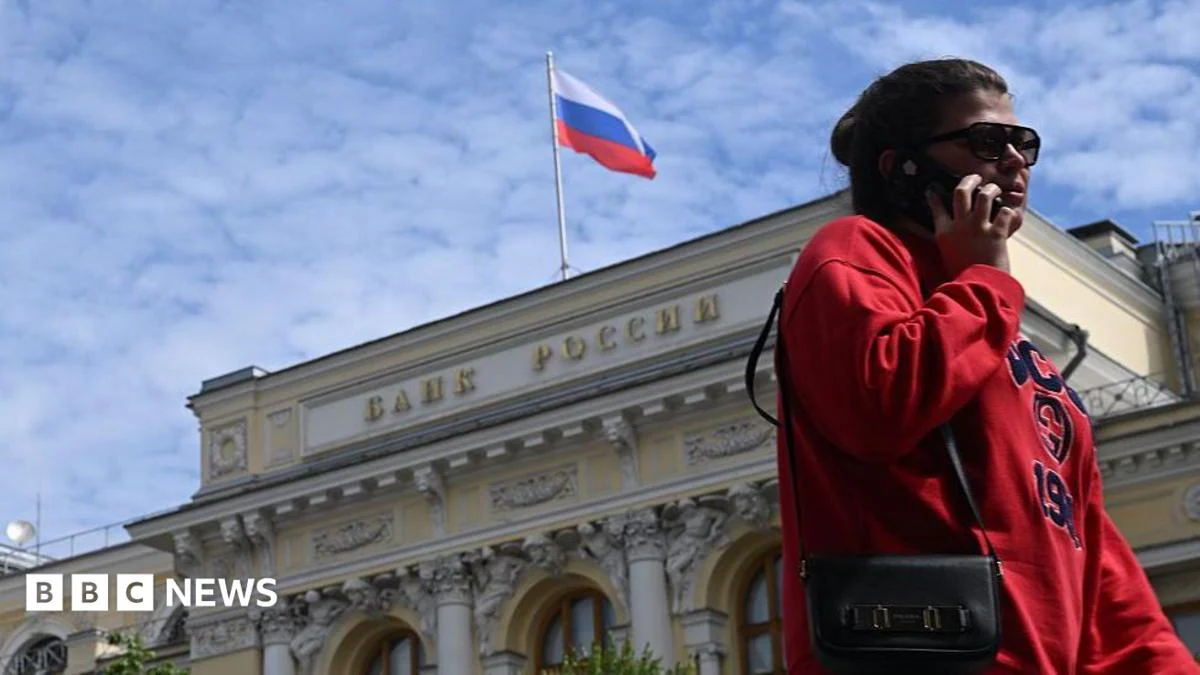
Russia’s Escalating Shadow Economy Undermines War Chest Amidst Worsening Fiscal Strain
A persistent surge in cash withdrawals across Russia is intensifying the Kremlin’s struggle to collect vital tax revenues, deepening a widening budget deficit at a critical juncture for funding its military operations in Ukraine. This flight to physical currency, a recurrent feature of wartime uncertainty, is now compounding the economic pressures facing the state, pushing businesses into a burgeoning shadow economy despite government efforts to combat illicit financial activities.
Chronology of Uncertainty-Driven Cash Surges
The latest uptick in cash circulation is not an isolated incident but rather the continuation of a pattern observed since the full-scale invasion of Ukraine began in February 2022. Russians have consistently sought tangible assets as a hedge against geopolitical instability and economic uncertainty. Significant spikes in cash demand have historically coincided with pivotal moments of heightened anxiety.
One such surge occurred in September 2022, immediately following President Vladimir Putin’s announcement of a "partial mobilisation" of military reservists. The decree, which called up an estimated 300,000 men, triggered widespread apprehension, leading many citizens to withdraw funds from their bank accounts. This period saw an exodus of hundreds of thousands of Russians, further unsettling the economy and demonstrating a direct correlation between perceived instability and financial behavior.
Another pronounced surge in cash withdrawals was recorded in June 2023, during the brief but dramatic mutiny by the Wagner mercenary group led by Yevgeny Prigozhin. The rapid advance of Wagner forces towards Moscow created a profound sense of political instability, prompting many to secure their assets in the face of an uncertain future. While the mutiny was swiftly quelled, its impact on public confidence and the financial system was palpable, again manifesting as a rush for physical cash. These events underscore a deep-seated distrust in the stability of the banking system and the broader economy during times of crisis, an instinct reminiscent of Soviet-era financial habits.
Escalating Economic Pressures and Fiscal Gaps
The current flight to cash is occurring against a backdrop of increasing fiscal strain on the Russian state. While Russia’s vital oil and gas sector, which traditionally accounts for approximately a quarter of state revenues, has recently benefited from a rise in global oil prices – partly influenced by the conflict in the Middle East – the broader economy is exhibiting clear signs of deceleration. This benefit, though significant, is proving insufficient to offset the burgeoning costs of the war and the impact of Western sanctions.
In May, the Russian economy ministry revised its GDP growth forecast downwards to a mere 0.4% for 2026. This projection places the country on a trajectory for its weakest economic expansion since 2022, signaling a protracted period of stagnation. The revised forecast reflects a confluence of factors, including persistent labor shortages exacerbated by mobilization and emigration, reduced foreign investment, and the long-term effects of technological sanctions limiting access to critical components and expertise.
The widening budget deficit is a primary concern for the Kremlin. The cost of the war in Ukraine, encompassing military expenditure, social support for mobilized personnel and their families, and reconstruction efforts in occupied territories, has placed immense pressure on state finances. In 2023, Russia’s budget deficit reached 1.9% of GDP, or 3.24 trillion roubles ($35.3 billion), a significant increase from pre-war levels. Projections for 2024 indicate continued fiscal challenges, with the government planning to spend heavily on defense, further straining public finances.
Government’s Response: Tax Hikes and Unintended Consequences
In an attempt to bolster state revenues and address the fiscal imbalance, the Kremlin implemented a series of tax adjustments at the beginning of the year. Effective January 2024, the standard Value Added Tax (VAT) rate was increased from 20% to 22%. Simultaneously, the government lowered the threshold at which small and medium-sized businesses (SMEs) are required to pay VAT. These measures were designed to broaden the tax base and extract more funds from the private sector.
However, these tax hikes have had significant unintended consequences, particularly for the already struggling SME sector. Businesses operating on tight margins, such as pharmacies, restaurants, beauty salons, and corner shops, have found their profitability further eroded. Faced with higher tax burdens and a slowing economy that reduces consumer spending, many firms are increasingly resorting to informal practices to keep more income "off the books."
The owner of a small clothing shop in a market in Pskov, a city in western Russia, articulated the sentiment prevalent among many small business owners: "Stalls at our market have been closing one after another because it’s no longer profitable to stay open. Most of those still trading ask customers to pay in cash whenever they can, so less money goes through the till." This direct appeal for cash payments allows businesses to understate their turnover, enabling them to remain below the VAT threshold and avoid mandatory contributions.
The Proliferation of the Shadow Economy
The shift towards cash payments is a clear indicator of the expanding shadow economy, a phenomenon that poses a direct threat to the state’s revenue collection capabilities. Taras Skvortsov, Chief Financial Officer of Sberbank, Russia’s largest lender, issued a stark warning last month, highlighting "very serious signs" of an increase in businesses paying wages "in envelopes" – an informal practice where employees receive a portion or all of their salary in undeclared cash.
Skvortsov’s concerns extend beyond undeclared wages: "This is a very worrying moment… We are not seeing cash return to the banking system through cash collection, ATMs or self-service terminals. It is staying in people’s hands." This observation is critical, as a healthy financial system relies on the circulation of money through formal channels. When cash remains outside the banking system, it becomes untraceable, facilitating tax evasion and making it impossible for the state to levy payroll taxes, income taxes, and other mandatory contributions.
A May survey conducted by Opora Russia, the country’s largest association for small and medium-sized enterprises, underscored the severity of the issue. Approximately 6% of surveyed entrepreneurs admitted to resorting to "grey schemes" to cope with the new tax burden. These schemes include not issuing cash-register receipts, a common tactic to conceal transactions and reduce reported income. The prevalence of such practices signifies a growing resistance among businesses to the increased tax demands, preferring to operate outside official scrutiny.
The Paradox of Trust: Cash vs. Banking System
The increasing preference for cash is particularly noteworthy given the relatively attractive returns offered by Russian banks on deposits. Despite the "Soviet-era instinct" to keep money "under the mattress," the Central Bank of Russia has maintained high key interest rates, leading to double-digit returns on bank deposits. This policy is primarily aimed at combating stubborn, war-fueled inflation, which has hovered around 7-8% in recent months, significantly above the Central Bank’s 4% target. For instance, a 100,000-rouble (£950; $1,280) one-year fixed-term deposit at Sberbank currently yields 10% interest.
Logically, such high returns should incentivize individuals to keep their money in banks. However, central bank data reveals a contradictory trend: Russians withdrew a substantial 550 billion roubles from bank accounts in May alone, with 200 billion roubles originating from fixed-term deposits. This indicates that the desire for liquidity and perceived security of physical cash outweighs the financial benefits of interest earnings for a significant portion of the population. This behavior suggests a deep-seated apprehension that transcends purely economic considerations, hinting at a lack of trust in the long-term stability of the financial system or a desire to avoid official scrutiny.
The Double-Edged Sword of State Policy
The Kremlin is acutely aware of the threat posed by the expanding shadow economy. Before the VAT increase took effect, President Putin himself warned against policies that might "push firms into the shadows" and called for a "radical reduction in illegal employment." This highlights a fundamental tension within government policy, as different arms of the state pursue potentially conflicting objectives.
Alexander Kolyandr, a non-resident senior fellow at the Center for European Policy Analysis, articulated this paradox to the BBC: "One arm of the government is trying to squeeze as much money as possible out of people through higher taxes, fines and other charges. But another, in trying to counter so-called terrorist threats, is undermining that strategy by making it harder to collect tax."
Kolyandr’s observation points to the increasing frequency of mobile internet shutdowns, particularly during periods of heightened security, such as Russia’s Victory Day celebrations in May. While these shutdowns are ostensibly implemented to prevent "terrorist threats" or disrupt potential unrest, they inadvertently disrupt digital payment systems, forcing citizens and businesses to rely on cash. Anton, a copywriter in Moscow, recounted struggling to withdraw money during these shutdowns to make purchases at a flower market, observing a woman "going from one ATM to another, looking for one that still had banknotes." Such experiences reinforce the utility of cash in an unpredictable environment, even if it runs counter to the state’s broader fiscal objectives.
Broader Implications for Russia’s Economy and War Effort
The proliferation of the shadow economy and the persistent flight to cash carry significant implications for Russia’s economy and its ability to sustain the war effort in Ukraine.
Firstly, the inability to effectively collect taxes directly impacts the state’s capacity to fund its military. Every rouble that remains outside the formal financial system is a rouble less for defense spending, social programs, and public services. This exacerbates the budget deficit, potentially leading to further fiscal tightening, increased borrowing, or even more aggressive tax measures in the future, creating a vicious cycle.
Secondly, a large shadow economy distorts official economic statistics, making it harder for policymakers to accurately assess the health of the economy and implement effective interventions. It also hinders long-term economic development by diverting resources from productive investment and innovation. Businesses operating in the grey zone are less likely to invest in modernization or expand their operations, preferring to remain small and obscure to avoid detection.
Thirdly, the shift to cash undermines the Central Bank’s efforts to control inflation. When large amounts of cash circulate outside the banking system, monetary policy tools become less effective. The central bank’s interest rate hikes, intended to cool inflation, may have a diminished impact if a significant portion of economic activity occurs informally.
Finally, the erosion of trust in formal financial institutions and the rule of law can have long-term societal consequences. It fosters a culture of evasion and makes it more challenging to build a transparent and robust market economy.
As Russia grapples with the immense costs of its military campaign and faces a protracted period of economic stagnation, the growing shadow economy presents a formidable challenge. The Kremlin finds itself in a precarious balancing act: needing to extract more resources from its populace while simultaneously battling the very instability and control measures that push economic activity into the untraceable realm of cash transactions. The current trends suggest that Russia’s fiscal challenges are far from over, with the shadow economy acting as a continuous drain on the state’s war chest.

Related Posts
Zambia on Edge: Opposition Leader Arrested Amid Allegations of Insurrection Plot and Election Tensions
Rescuers search for survivors of powerful Indonesia earthquake

