
Ukrainian Drone Strikes on Wildberries Warehouses Kill Eight, Injure Dozens, Deepening Logistics and Energy Sector Woes for Russia
Eight individuals have been confirmed dead and 62 sustained injuries following a series of Ukrainian drone attacks that targeted two major logistics warehouses belonging to Wildberries, Russia’s largest online retailer, according to official Russian statements. The coordinated strikes, which unfolded overnight, represent a significant escalation in Ukraine’s strategy of hitting key Russian infrastructure, extending deep into its territory and impacting both commercial and military-linked supply chains.
The primary attack site was a Wildberries facility in Tambov, approximately 295 miles (475km) south-east of Moscow, where seven fatalities and 25 injuries were reported. A second strike occurred at another Wildberries warehouse in Elektrostal, situated within the Moscow region, resulting in one death and 37 injuries. Ukrainian President Volodymyr Zelensky subsequently acknowledged the attacks, stating they had successfully struck "major logistics facilities" which he alleged were being utilized to "supply sanctioned components for drone production and navigation equipment." The Ukrainian leader further confirmed that additional targets in the Sea of Azov, the Black Sea, and Russian-annexed Crimea had also been hit as part of these extensive operations.
The Targets: Wildberries and Russia’s Logistics Backbone
Wildberries, often characterized as the Russian equivalent of e-commerce giant Amazon, holds a pivotal position within Russia’s domestic economy. Its vast logistics network is essential for consumer goods distribution across the country, serving millions of customers daily. The company’s significant scale is underscored by the valuation of the merged RWB group, which combines Wildberries with advertising company Russ, estimated at approximately $12.6 billion (£9.3 billion) by Forbes Russia in 2026. Such large-scale commercial logistics hubs, while primarily serving civilian purposes, can also be adapted or indirectly contribute to military supply chains, particularly for items with dual-use applications. Ukraine’s assertion that these facilities were supplying "sanctioned components for drone production and navigation equipment" points to a deliberate strategy to disrupt not just the civilian economy but also critical elements supporting Russia’s ongoing military efforts.
The CEO of Wildberries, Tatyana Kim, who is recognized as one of Russia’s pioneering female billionaires, expressed profound distress over the events, describing it as a "terrible night" for both Russia and the company. Her statement underscored the immediate and severe impact of the strikes on a major national enterprise and its workforce. The attacks on such prominent commercial entities, far from the front lines, are likely intended to exert economic pressure, sow public discontent, and demonstrate Ukraine’s expanding reach and capability in drone warfare.
The Human Cost and Harrowing Aftermath
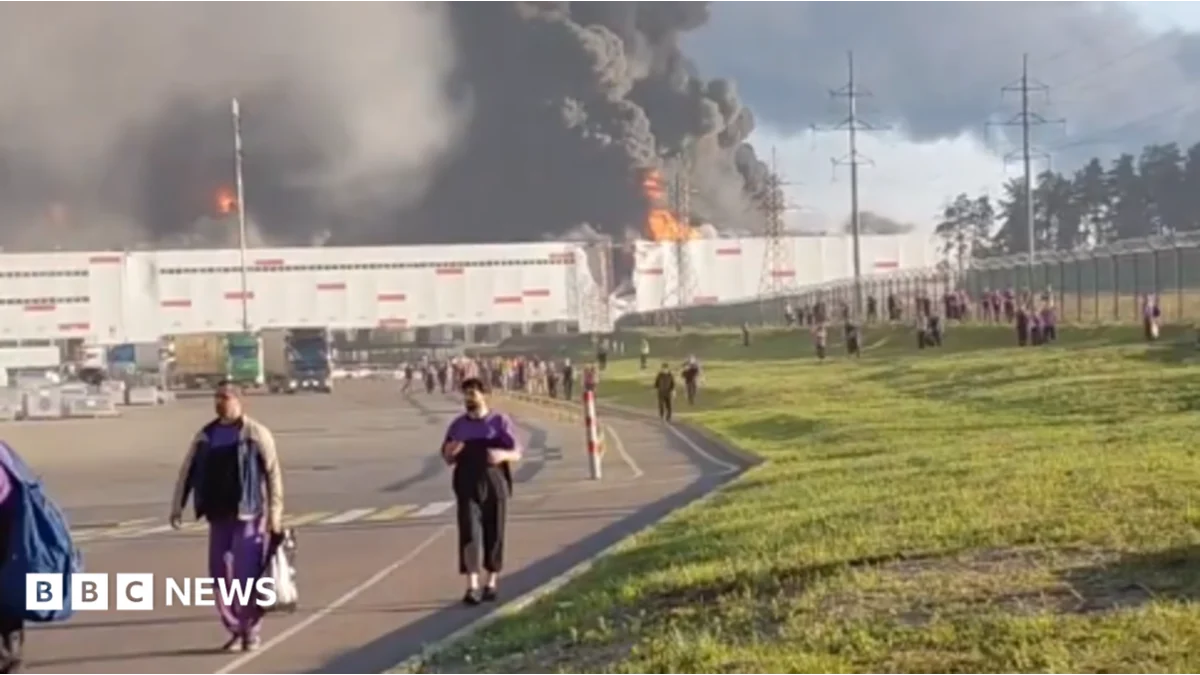
The human toll of the attacks was immediate and severe. Eyewitness accounts and unverified imagery from the scene depicted chaotic and terrifying conditions. Videos circulated online showed colossal flames engulfing one of the vast logistics buildings, with immense plumes of black smoke billowing into the sky. Dozens of workers, many of whom were on the night shift, could be seen scrambling into car park areas in an attempt to flee the inferno. Other clips appeared to capture the moments when warehouse walls disintegrated under the intense heat and explosive force, further illustrating the destructive power of the strikes. Some videos also showed terrified and injured staff attempting to escape as explosions continued to rock the facilities.
Evgeniy Pervyshov, the governor of the Tambov region, provided a grim update via Telegram, confirming the deaths of "seven people working the night shift… on the spot." He detailed that 25 individuals had been injured in the Tambov attack, with seven of them in serious condition, primarily suffering from shrapnel wounds. Governor Pervyshov described the incident as the "largest and most inhumane" attack on the Tambov region in terms of both the number of drones deployed and the resulting casualties, highlighting the unprecedented nature of the assault on his jurisdiction.
In the Moscow region, Governor Andrei Vorobyov reported that eight of those injured in the Elektrostal Wildberries warehouse strike were in "serious condition." These details paint a stark picture of the immediate and tragic consequences for the civilian workforce caught in the crossfire of the conflict. The nature of the injuries, predominantly shrapnel wounds, suggests significant explosive force and fragmentation, typical of drone-carried munitions.
Chronology of Escalation and Retaliation
These Ukrainian drone strikes occurred in the immediate aftermath of a deadly wave of Russian attacks across Ukraine. Overnight into Wednesday, 14 people were killed in various Russian assaults on Ukrainian cities and communities. President Zelensky explicitly framed Ukraine’s operations as a direct response to these "Russian strikes on our civilian infrastructure and on our cities and communities," emphasizing a retaliatory posture. This tit-for-tat dynamic has become a defining characteristic of the conflict, with both sides increasingly targeting each other’s rear areas and critical infrastructure.
The intensification of long-range drone attacks by Ukraine on Russian territory, particularly on economically vital and strategically relevant sites, marks a discernible shift in Kyiv’s operational strategy. This includes not only logistics hubs but also a sustained campaign against Russia’s energy infrastructure, which has been ongoing for several months.
Russian Defense and Broader Energy War Context
Russian authorities claimed significant success in intercepting the incoming drone formations. Governor Pervyshov reported that 28 drones were shot down on approach to the Tambov region. Meanwhile, Governor Vorobyov stated that a total of 48 drones were intercepted and downed across the Moscow region overnight. Despite these reported interceptions, some drones evidently penetrated air defenses, reaching their intended targets and causing substantial damage and casualties.
Beyond the Wildberries warehouses, the Moscow region also saw another significant incident: a Russian oil depot was struck by a falling drone, an event Governor Vorobyov described as having "the most serious consequences." Zelensky separately confirmed that Ukraine had indeed struck "an oil facility." This aligns with Ukraine’s broader campaign to cripple Russia’s critical energy infrastructure. Kyiv has recently intensified these long-range drone attacks, aiming to disrupt Russia’s capacity to produce and export fossil fuels, which are a primary source of financing for its full-scale invasion.
Ukrainian officials have asserted that these strikes have had a considerable impact, claiming earlier this month that nearly 43% of Russia’s oil refining capacity had been "disabled" as a result. While the BBC has noted that it has not independently verified this figure, the consistent targeting of these facilities underscores the strategic importance Ukraine places on disrupting Russia’s energy complex. Ukraine maintains that Russian oil and gas facilities are legitimate military targets because Moscow relies heavily on fossil fuel exports to fund its war efforts, which commenced in February 2022.
The efficacy of these strikes has even drawn a rare public admission from Russian President Vladimir Putin last month, who acknowledged that fuel shortages had been caused by Ukrainian attacks. In response to these pressures, Putin signed into law a bill in early July aimed at boosting supplies to the domestic fuel market, indicating the tangible economic and logistical strain these attacks are imposing on Russia. Firefighters, emergency services, and the Ministry of Emergency Situations continue to work at the scene of the various incidents, as stated by Governor Vorobyov on Telegram, though he did not provide detailed information on the level of damage at the oil depot.
Implications and Analysis
The drone attacks on Wildberries warehouses and the oil depot carry multifaceted implications. Strategically, they demonstrate Ukraine’s evolving capability to project power deeper into Russian territory, using advanced drone technology to target infrastructure far from the front lines. This capability not only aims to disrupt military logistics and economic stability but also to exert psychological pressure on the Russian populace and leadership, bringing the reality of the conflict closer to ordinary citizens.
The selection of Wildberries, a prominent consumer-facing enterprise, as a target sends a clear message about the potential reach of Ukrainian strikes and the willingness to impact civilian-linked economic assets if they are perceived to have dual-use military relevance. This could lead to increased scrutiny of large commercial facilities in Russia for their potential role in supporting the war economy, directly or indirectly.
Economically, the disruption to a major retailer like Wildberries could have ripple effects on Russia’s supply chains, consumer confidence, and overall economic stability. While the immediate impact might be localized, sustained attacks on key logistics nodes could strain Russia’s ability to maintain normal economic functioning, particularly given existing international sanctions. The targeting of oil facilities, a cornerstone of Russia’s economy, further exacerbates financial pressures on Moscow, potentially limiting its capacity to fund its military operations.
From a geopolitical perspective, these strikes could intensify calls for improved air defense systems within Russia and potentially prompt further retaliatory measures against Ukraine. The international community, while generally condemning attacks on civilian infrastructure, may also view these strikes through the lens of Ukraine’s right to self-defense against an invading force, especially given Kyiv’s explicit claims of dual-use facilities. Humanitarian organizations, however, are likely to express concern over any civilian casualties, regardless of the stated military justification.
The consistent and expanding nature of Ukraine’s drone campaign signifies a shift towards asymmetric warfare, leveraging technological innovation to compensate for numerical disadvantages in traditional military assets. As the conflict grinds on, such strikes are poised to become an increasingly central element of Ukraine’s strategy to degrade Russia’s war-making capabilities and maintain pressure on the Kremlin. The attacks underscore the brutal reality that the war’s reach is no longer confined to the battlefields of Ukraine but extends deeply into the heart of the Russian homeland, impacting both its military-industrial complex and its civilian economy.

Related Posts

Zambia on Edge: Opposition Leader Arrested Amid Allegations of Insurrection Plot and Election Tensions
Rescuers search for survivors of powerful Indonesia earthquake

