US Marine Corps Unveils New Medium Landing Ship Design to Bolster Littoral Operations and Indo-Pacific Strategy
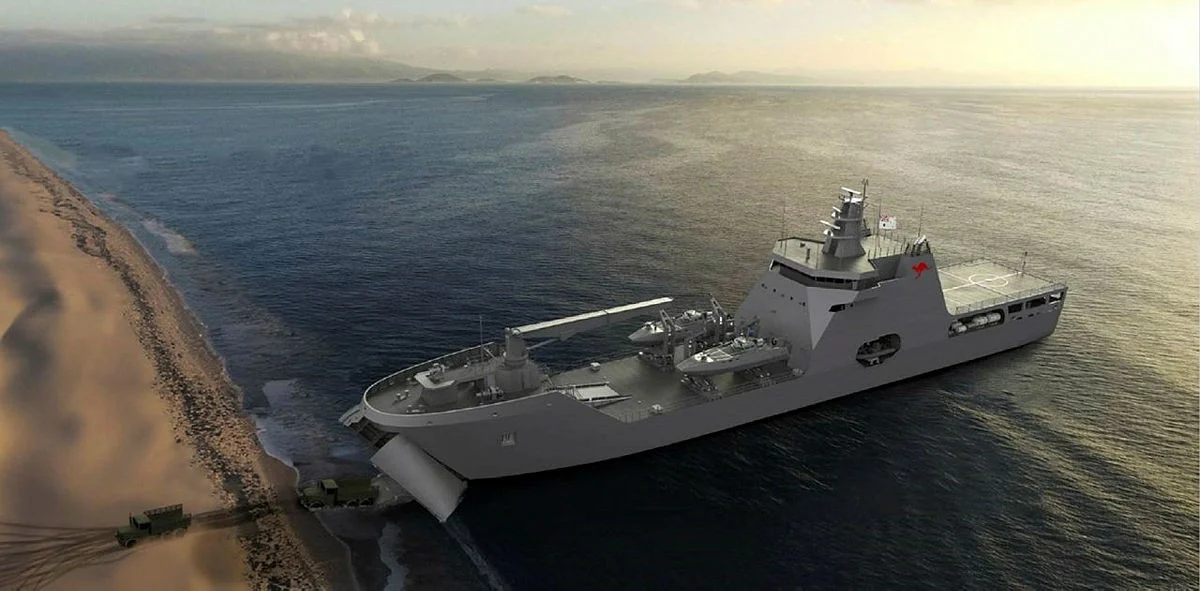
The United States Marine Corps has officially released a detailed visual presentation showcasing the design and operational capabilities of the Medium Landing Ship (LSM), a pivotal vessel intended to redefine how the service moves personnel, heavy equipment, and essential supplies across contested maritime environments. This new class of vessel is engineered specifically to navigate shorelines and deliver payloads directly to beaches, bypassing the need for established deep-water ports or vulnerable pier infrastructure. The announcement marks a significant milestone in the military’s shift toward distributed maritime operations, particularly in the Indo-Pacific theater, where traditional large-scale naval logistics face increasing threats from long-range precision weaponry.
Design Genesis and Technical Specifications
The design for the LSM is fundamentally based on the Damen Shipyards Group’s Landing Ship Transport 100 (LST-100), a proven maritime platform that has been adapted to meet the rigorous requirements of the U.S. Navy and Marine Corps. According to official technical briefings and the recently released video, the vessel measures approximately 100 meters in length and is optimized for both endurance and agility.
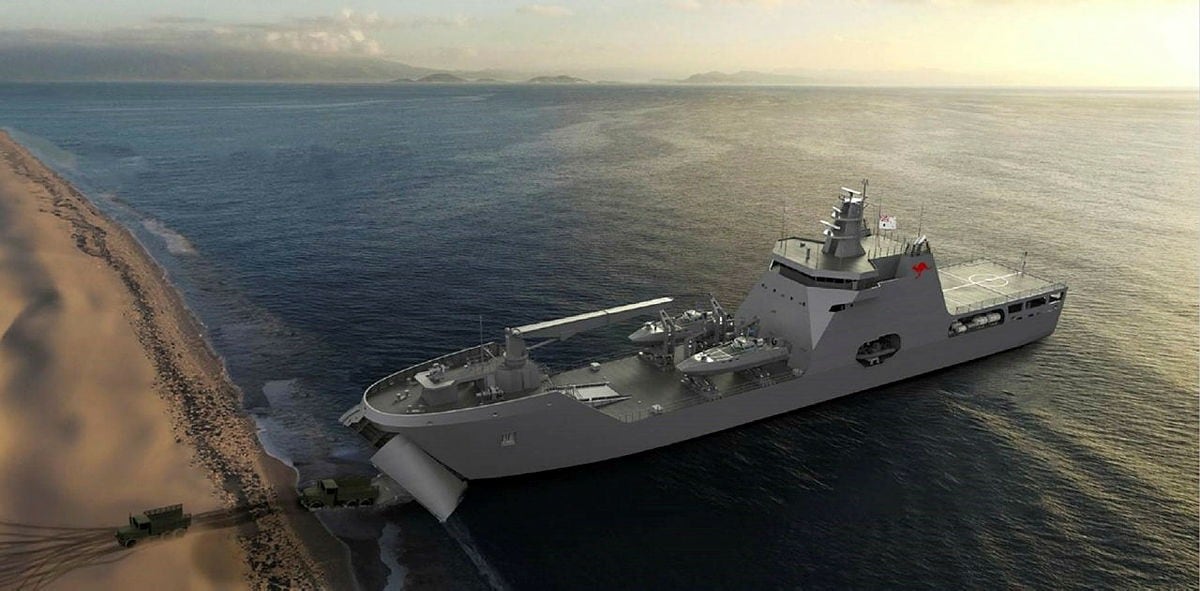
Key performance metrics for the LSM include an operational range of 3,400 nautical miles, allowing it to transit significant distances between island chains without frequent refueling. The ship’s primary advantage lies in its ability to beach itself. This "stern-first" or "bow-on" landing capability allows the LSM to deliver over 800 tons of cargo directly onto unimproved shorelines. This cargo capacity is specifically tailored to transport the Marine Corps’ most critical modern assets, including Joint Light Tactical Vehicles (JLTVs), amphibious combat vehicles, and long-range fires assets such as the Navy/Marine Expeditionary Ship-Interdiction System (NMESIS).
Beyond its transport capacity, the LSM features an integrated flight deck. This deck is designed to support a variety of rotary-wing aircraft and, crucially, unmanned aerial systems (UAS). The inclusion of UAS capabilities allows the ship to serve as a localized intelligence, surveillance, and reconnaissance (ISR) hub, providing organic over-the-horizon awareness for the embarked forces as they transition from sea to land.
The McClung-Class: A New Era of Intratheater Logistics
The Marine Corps has designated this new fleet as the McClung-class, framing it as a vital supplemental asset rather than a replacement for the larger, traditional amphibious warfare ships like the LHA (Landing Helicopter Assault) or LPD (Landing Platform Dock) classes. The service emphasized that the LSM is not intended for the high-intensity, large-scale amphibious assaults characteristic of 20th-century warfare. Instead, the McClung-class is designed for "intratheater logistics and maneuver."
In a statement accompanying the design reveal, the Marine Corps clarified that the LSM provides the essential mobility required to enable the larger amphibious fleet. While massive amphibious ships remain the "power projection" backbone of the Navy, their size makes them easy to track and difficult to maneuver in shallow, island-dotted regions. The LSM, by contrast, can hide among the "clutter" of coastal geography, moving smaller units of Marines—often referred to as Littoral Regiments—between islands to establish temporary bases or "expeditionary advanced bases."
Strategic Alignment and the Indo-Pacific Context
The timing of the LSM design approval and its subsequent unveiling is closely tied to the escalating geopolitical competition in the Indo-Pacific. The U.S. Department of Defense has increasingly focused on countering the expansionist maritime strategy of the People’s Republic of China, which has invested heavily in "anti-access/area denial" (A2/AD) capabilities.
The LSM is a cornerstone of the Marine Corps’ "sea denial strategy." By utilizing these ships to establish a forward presence, American forces can occupy critical terrain along the "First Island Chain." Once landed, these mobile units can deploy anti-ship missiles and sensors to strike adversarial vessels, effectively closing maritime chokepoints and deterring aggressive maneuvers. The ability to move these land-based strike assets rapidly from one island to another via the LSM creates a "shell game" for enemy targeting systems, significantly increasing the survivability of U.S. forces in a high-end conflict.
The Golden Fleet and the Trump-Class Influence
The development of the LSM has been integrated into a broader naval expansion effort known as the "Golden Fleet" initiative. This concept, which gained traction under the Trump administration, envisions a massive revitalization of American naval power. Central to this vision is the "Trump-class" battleship, a concept announced in December 2025. While the LSM represents the "low end" of the fleet—focused on stealth, mobility, and logistics—the Trump-class battleships are intended to represent the "high end," providing massive firepower and hull strength.
The LSM is viewed as the logistical connective tissue for the Golden Fleet. For the larger, more combat-heavy vessels to operate effectively in contested waters, they require a distributed network of fuel, ammunition, and sensors that the LSM class is uniquely qualified to provide. Navy leadership approved the final LSM design in December 2025, signaling a commitment to this bifurcated fleet structure of "massive power" supported by "distributed agility."
Readiness Challenges and Internal Navy Pressure
The push for the LSM also stems from a burgeoning readiness crisis within the U.S. Navy’s existing amphibious fleet. A comprehensive report released in early 2025 highlighted a troubling decline in the availability of traditional amphibious ships. Maintenance delays, aging hulls, and a lack of spare parts have resulted in readiness rates dropping below the minimum levels required for global contingency response.
In several recent instances, Marine Expeditionary Units (MEUs) have faced deployment delays or have been forced to deploy on "split-phased" schedules because large amphibious ships were stuck in dry dock. The LSM is seen as a way to alleviate some of this pressure. By taking over the "day-to-day" transport and littoral maneuvering missions, the LSM allows the Navy to reserve its limited number of large amphibious warships for high-priority missions and major exercises, potentially extending the service life of the existing fleet.
Critical Analysis and International Reactions
Despite the strategic enthusiasm from the Marine Corps, the LSM and the broader Golden Fleet initiative have faced significant scrutiny. Military analysts in China have been quick to dismiss the proposed "Trump-class" battleships as "anachronistic targets," arguing that in an age of hypersonic missiles and swarming suicide drones, large, heavy-armored ships are easier to track and destroy.
Domestic critics have also voiced concerns. A recent analysis by the Center for Strategic and International Studies (CSIS) questioned the financial and temporal viability of the Golden Fleet. The CSIS report suggested that the cost of developing a new class of battleship could siphon funds away from more critical technologies, such as undersea warfare and autonomous systems. Furthermore, the analysis noted that the development timelines for such massive ships often span decades, whereas the threat in the Indo-Pacific is immediate.
However, the LSM itself has received a more favorable reception from analysts. Most experts agree that the Marine Corps desperately needs a "middle-weight" connector. The current inventory of Small Landing Craft (LCU/LCAC) lacks the range for inter-island transit, while the large L-class ships are too valuable to risk in the "weapons engagement zone" of an adversary.
Timeline and Future Outlook
With the design now finalized and approved, the Navy is expected to move toward the procurement phase in the coming fiscal cycles. The current plan involves the acquisition of between 18 and 35 LSMs, depending on budget allocations and the evolving requirements of the Marine Littoral Regiments.
The first of the McClung-class ships is expected to begin construction shortly, with initial sea trials projected for the late 2020s. As the Marine Corps continues to transition away from its previous role as a second land army and returns to its maritime roots, the LSM will serve as the primary vehicle for that transformation.
The success of the LSM program will likely depend on three factors: the ability of the defense industrial base to produce the ships at scale, the integration of unmanned technology onto the platform, and the political stability of the funding for the "Golden Fleet" concept. As it stands, the McClung-class represents a gamble on a more mobile, distributed, and lethal future for the U.S. Navy and Marine Corps—one where the ability to land on a beach without a pier may be the difference between deterrence and defeat.

Related Posts
Pentagon Forges Landmark Seven-Year Agreements with Boeing and RTX to Accelerate Standard Missile-3 Production and Stabilize Defense Supply Chains
Boeing Unveils Ultra Low-Cost Seeker to Enhance Missile Inventory and Combat Cost Challenges in Modern Warfare