Istanbul Court Faces Criticism Over Restricted Access to Trial of Mayor Ekrem İmamoğlu and Municipal Officials
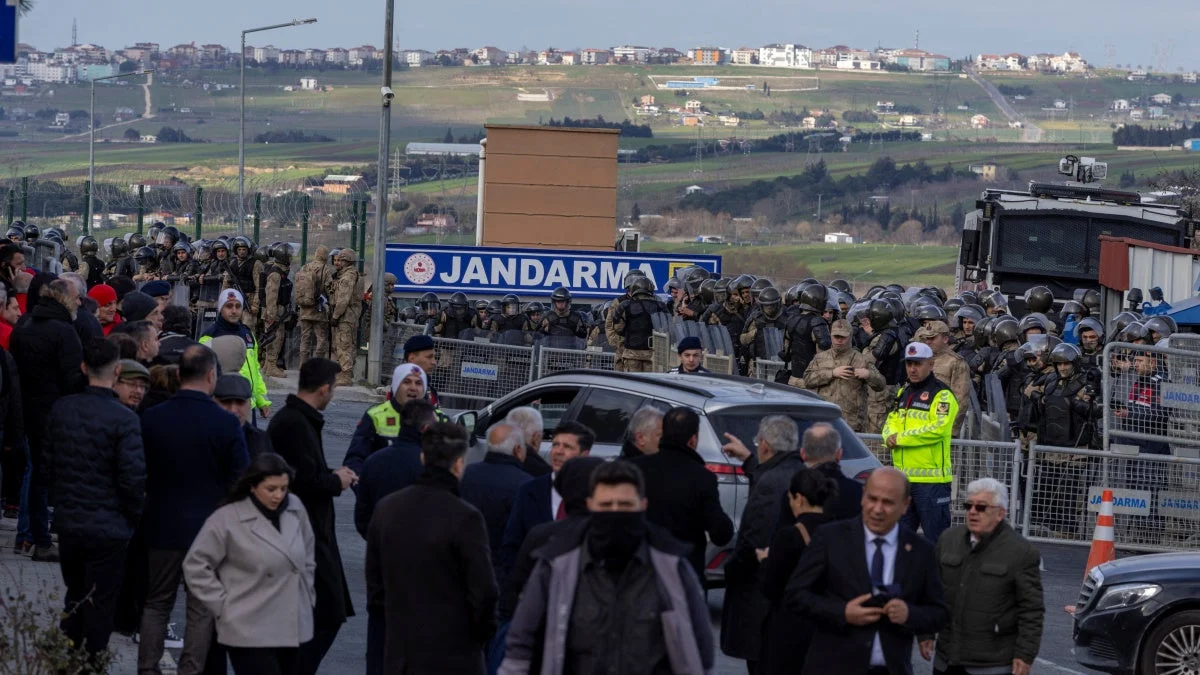
Human Rights Watch issued a stern warning on March 23, 2026, regarding the ongoing trial of Istanbul Mayor Ekrem İmamoğlu and 406 other defendants, citing arbitrary restrictions that have hindered the ability of journalists, legal observers, and the public to monitor the proceedings. The trial, which began on March 9, 2026, involves high-ranking municipal officials and political figures facing charges of corruption and membership in a criminal organization—allegations that international observers and domestic opposition leaders characterize as politically motivated attempts to sideline one of the country’s most prominent political figures. The Istanbul 40th Assize Court, currently presiding over the case at the high-security Marmara Prison campus in Silivri, has come under fire for creating a "blind spot" for the media and excluding the public from what is arguably the most significant judicial process in modern Turkish history.
The case centers on Mayor İmamoğlu, a leading figure in the Republican People’s Party (CHP) and a frequent challenger to the administration of President Recep Tayyip Erdoğan. The indictment alleges that İmamoğlu led a criminal enterprise within the Istanbul Metropolitan Municipality (IBB), using municipal resources for illicit purposes. However, Human Rights Watch and other advocacy groups argue that the proceedings lack transparency and fail to meet the basic standards of a fair and public trial. Benjamin Ward, the deputy Europe and Central Asia director at Human Rights Watch, emphasized that the fundamental principle of justice being seen to be done is being compromised by the court’s logistical and administrative decisions.
Background: A Pattern of Legal Pressure
The 2026 trial is widely viewed by political analysts as the culmination of years of legal pressure against Ekrem İmamoğlu. His political rise began in 2019 when he won the Istanbul mayoral race twice in a single year—first in March and again in a June re-run after the initial results were annulled. Since then, his administration has faced a series of investigations, including a 2022 conviction for "insulting" public officials, which carried a potential political ban.
This latest corruption trial involves a massive scope, with 407 defendants including district mayors, municipal advisors, and civil servants. Among the co-defendants are Resul Emrah Şahan and Mehmet Murat Çalık, the mayors of Istanbul’s Şişli and Beylikdüzü districts, respectively. The prosecution’s narrative suggests a systemic infiltration of the municipality by a "criminal organization," with Şahan specifically labeled as a "special member." These charges, if proven, could not only lead to long prison sentences but would effectively dismantle the leadership of the CHP in Turkey’s most populous and economically vital city ahead of the 2028 general elections.
Chronology of the March 2026 Proceedings
The first two weeks of the trial have been defined by procedural friction and disputes over courtroom access. On March 9, the trial opened under heavy security, but it was the subsequent sessions that saw a marked escalation in restrictions.
On March 12, the chief judge abruptly ended a hearing early. The catalyst was a dispute regarding the seating of journalists. Members of the press had initially occupied benches reserved for lawyers to better hear the proceedings. When they refused the judge’s order to move to a remote corner at the back of the hall, the session was adjourned. This move followed an incident where a reporter attempted to ask Mayor İmamoğlu a question as he was being led out of the room.
The tension reached a peak on March 16. Before the session could even begin, the chief judge postponed the hearing because three CHP Members of Parliament—who are also licensed lawyers—refused to vacate the lawyers’ benches at the front of the court. The judge insisted they move to the public gallery at the rear. Later that day, the court issued a formal written order drastically limiting attendance. The new rules permitted only the defendants, a maximum of three lawyers per defendant, one relative per defendant, and accredited media. This order effectively barred the general public and independent legal observers who were not representing a specific defendant.
During the sessions on March 17 and 18, the courtroom saw an increased presence of gendarmes and even tighter controls. While some CHP officials were eventually admitted after lengthy negotiations, the "public" nature of the trial remained largely symbolic, with many rows of seating left intentionally empty while observers were kept outside the gates.
The Logistics of Silivri: A Barrier to Justice
The choice of venue has also been a point of contention. The hearings are held at the Marmara Prison campus in Silivri, located approximately 70 kilometers from the center of Istanbul. Known for hosting high-profile political trials, the Silivri complex is designed for maximum security rather than public accessibility.
The courtroom itself is described as the size of a sports hall, a layout that creates significant acoustic and visual challenges. The judges and prosecutors sit on an elevated dais at one end, with 107 defendants in pretrial detention positioned directly in front of them, flanked by gendarmes. The media and public are relegated to a small enclosure at the very back.
Journalists have filed formal petitions requesting to be moved from this "blind spot." From their current position, they can only hear testimony that is relayed through the PA system. However, crucial interactions—such as off-microphone sidebars between judges and defendants or hushed consultations between lawyers—are entirely inaudible. The use of large video screens provides some visual aid, but reporters argue that the lack of direct proximity prevents them from accurately capturing the demeanor of the participants and the nuances of the legal arguments.
Legal Analysis and Constitutional Requirements
The restrictions imposed by the Istanbul 40th Assize Court appear to conflict with both domestic and international legal standards. Under the Turkish Constitution, court hearings are required to be open to the public. Article 141 explicitly states that "court hearings shall be open to the public," and any decision to hold a closed-door session must be strictly justified by concerns of "public morality or public security."
Furthermore, a 2023 ruling by the Turkish Constitutional Court reaffirmed that the principle of a public trial is a constitutional safeguard that cannot be curtailed by administrative convenience. International law, specifically Article 6 of the European Convention on Human Rights (ECHR)—to which Turkey is a signatory—guarantees the right to a "fair and public hearing." The European Court of Human Rights has long held that public scrutiny is a necessary protection against the potential for judicial arbitrariness.
"Imposing arbitrary restrictions on access to this case undermines confidence in the proceedings and violates the requirement under Turkish and international law to conduct justice in public," said Benjamin Ward of HRW. He noted that the abundance of empty space in the Silivri courtroom contradicts the court’s implied justification that seating limits are necessary for order.
Broader Implications for Turkish Democracy
The trial of Ekrem İmamoğlu is viewed by many as a litmus test for the independence of the Turkish judiciary. As the mayor of a city that accounts for roughly one-third of Turkey’s GDP, İmamoğlu’s political fate has direct implications for the country’s economic and political stability. If the court continues to restrict the flow of information from the trial, it risks fueling perceptions that the judiciary is being used as a tool for political engineering.
The targeting of journalists is another facet of this concern. Over the past year, several reporters covering the investigations into CHP-run municipalities have faced legal challenges or harassment. By forcing journalists into a "blind spot" in the courtroom, the authorities are effectively limiting the public’s right to be informed about a case that involves the alleged mismanagement of public funds and the integrity of elected officials.
As the defense of district mayors Resul Emrah Şahan and Mehmet Murat Çalık begins in the final week of March, the focus remains on whether the court will relax its restrictions. The defense teams have argued that the exclusion of the public serves only to isolate the defendants and prevent the dissemination of their rebuttals to the state’s allegations.
Conclusion
The proceedings at Silivri represent a critical juncture for Turkey’s legal landscape. The tension between the court’s desire for "orderly" proceedings and the constitutional mandate for transparency has reached a breaking point. For justice to be served, the trial of Ekrem İmamoğlu and his 406 co-defendants must not only be fair in its final verdict but also transparent in its process.
Human Rights Watch and other international monitors continue to call for the immediate lifting of arbitrary seating restrictions, the reinstatement of access for independent legal observers, and the provision of adequate facilities for the press. In a case of such immense public interest, the "blind spot" at the back of the courtroom is more than a logistical hurdle; it is a significant barrier to the democratic accountability of the judicial system. The world continues to watch Silivri, but the question remains how much of the truth will be allowed to reach the public ear.

Related Posts
Human Rights Watch Calls for Investigation into Death of Detainee Following Removal from Najaf Hospital by Iraqi Drug Police
Human Rights Watch Urges UN Security Council to Extend Lebanon Peacekeeping Mission Amid Escalating Conflict and Humanitarian Crisis