The Strategic Integration of Autonomous Electric Platforms and Advanced Ballistic Counter-Drone Systems in Modern Attritional Warfare
The landscape of modern land warfare has undergone a fundamental transformation since the onset of the conflict in Ukraine, primarily driven by the proliferation of low-cost, high-precision surveillance and strike drones. This technological shift has effectively rendered the traditional maneuver warfare of the 20th century—characterized by large-scale armored thrusts and infantry advances—nearly impossible to execute without incurring catastrophic losses. In this environment, where small, cheap quadcopter drones provide constant overhead surveillance, any movement on the battlefield is immediately detected and targeted. Consequently, the development of an effective, cost-efficient counter-unmanned aerial system (C-UAS) has become the primary tactical priority for military commanders. While conventional air defense systems remain vital for intercepting cruise missiles and larger aircraft, they are prohibitively expensive and logistically ill-suited for the thousands of small drones saturating the front lines.
The Evolution of Drone Dominance and the Kinetic Response
The current stalemate in Eastern Europe is largely a result of "transparent battlefield" dynamics. Small unmanned aerial vehicles (UAVs), often costing less than $1,000, are capable of spotting armored columns miles away, allowing artillery units to strike with pinpoint accuracy before the vehicles can reach their objectives. Soldiers on foot are similarly vulnerable, as First-Person View (FPV) kamikaze drones can hunt individual infantrymen with terrifying efficiency. To break this deadlock, a nation must be able to "clear the skies" of these tactical pests.
The United States defense industrial base has responded with a system that combines legacy ballistic power with 21st-century sensing technology. The solution centers on the 30mm chain gun, specifically the M230 Linkless variant traditionally mounted on the AH-64 Apache attack helicopter. When integrated with the Mobile–Acquisition, Cueing and Effector (M-ACE) sensor suite developed by Northrop Grumman, this hardware transforms from an offensive aerial weapon into a sophisticated ground-based C-UAS platform.
The M-ACE system operates by detecting incoming drones via a portable sensor array and automatically slewing the 30mm gun toward the target. What makes this system revolutionary in the C-UAS space is its use of programmable airburst ammunition. Rather than requiring a direct hit on a small, fast-moving quadcopter—an incredibly difficult feat—the system calibrates the shells to detonate in the air near the target. The resulting cloud of shrapnel can dismantle entire swarms of drones simultaneously. This kinetic approach is far more reliable than electronic jamming, which can be bypassed by frequency-hopping or autonomous terminal guidance.
Chronology of Counter-Drone Development and Deployment
The journey of the 30mm C-UAS platform from a concept to a battlefield reality has been rapid.
- 2021–2022: Initial testing of the M230LF (Lightweight) Bushmaster chain gun on civilian and light tactical vehicles by Northrop Grumman demonstrated the viability of mounting heavy firepower on mobile, non-standard platforms.
- Early 2023: As the drone threat in Ukraine escalated, the U.S. Department of Defense began exploring rapid-export options. In May 2023, reports surfaced that U.S.-made counter-drone trucks were being prepared for shipment to Kyiv.
- Late 2023: Australia joined the effort, announcing the delivery of the "Slinger" system. Developed by Electro Optic Systems (EOS), the Slinger utilizes the same 30mm chain gun technology and has been praised for its ability to track and engage drones at ranges exceeding 800 meters.
- 2024–2025: The U.S. Army and Marine Corps officially began fielding production-level units of similar systems, such as the Marine Air Defense Integrated System (MADIS), acknowledging that the threat of small drones is no longer confined to proxy wars but is a central feature of near-peer conflict.
- Present Day: While these systems have proven effective, the operational bottleneck remains the vulnerability of the crews operating the vehicles. Current deployments often utilize standard civilian pickups or lightly armored trucks, which provide little protection against the very artillery and mines that the drones are used to coordinate.
The Technical and Logistical Failure of the Civilian Cybertruck
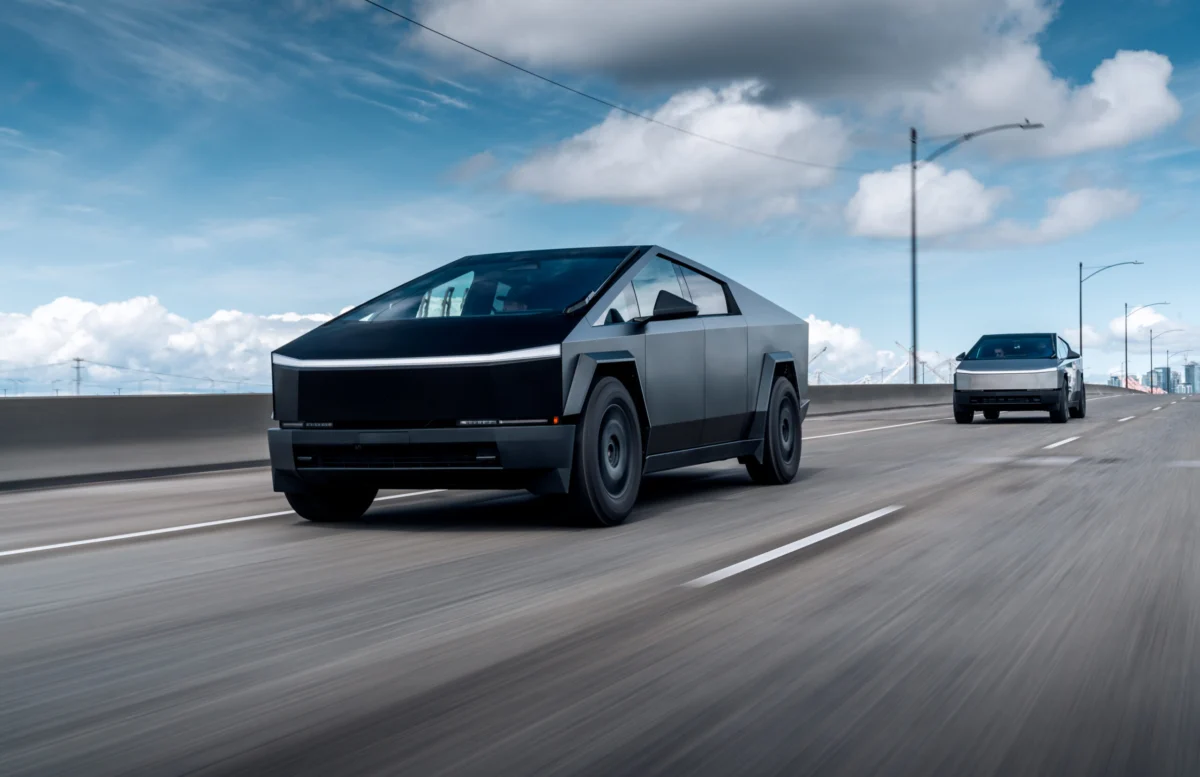
To address the vulnerability of human crews, military analysts have increasingly looked toward unmanned ground vehicles (UGVs). However, purpose-built military UGVs are expensive and difficult to mass-produce. This has led to the unconventional proposal of utilizing the Tesla Cybertruck as a remote-operated combat platform.
The proposal gains traction when viewed through the lens of Tesla’s recent commercial performance. By early 2026, it became clear that the Cybertruck had failed to meet the lofty expectations set by CEO Elon Musk. While Musk initially projected sales of 250,000 units annually, data from 2025 indicated a staggering 92% shortfall, with barely 20,000 units sold. This commercial "flop" has left a massive surplus of inventory, with over 10,000 unsold vehicles reportedly sitting in dealership lots and holding areas.
The civilian market’s rejection of the Cybertruck stems from several widely publicized issues: poor outward visibility, mechanical failures such as sticking accelerator pedals, dysfunctional windshield wipers, and concerns regarding the vehicle’s structural safety in standard traffic accidents. Furthermore, the vehicle’s "stainless steel" aesthetic and the political polarization surrounding the Tesla brand have limited its appeal. However, in a military context, the very features that make the Cybertruck a poor consumer product become irrelevant or even advantageous.
The Cybertruck as a Low-Cost Unmanned Ground Vehicle
The primary advantage of the Cybertruck in a combat zone is its potential for remote operation. By utilizing Tesla’s existing "Full Self-Driving" (FSD) architecture—modified for remote teleoperation—the Ukrainian military could deploy M-ACE-equipped Cybertrucks to the front lines without putting human drivers at risk.
When compared to existing military UGVs, the economic case is compelling. The Estonian-made THeMIS UGV and the U.S.-made Textron Ripsaw M5 are the current gold standards for unmanned platforms capable of carrying 30mm autocannons. However, these systems are prohibitively expensive; the Ripsaw M5’s civilian variant starts at nearly $300,000, and military versions, equipped with sensors and armor, can cost several million dollars per unit. In contrast, a Cybertruck can be procured for approximately $80,000.
Furthermore, the logistical benefits of an Electric Vehicle (EV) on the battlefield are significant:
- Acoustic Stealth: EVs operate with significantly less noise than diesel engines, allowing them to reposition at night without alerting enemy acoustic sensors.
- Thermal Signature: The lack of a hot internal combustion engine makes the Cybertruck much harder to detect for Russian forces utilizing thermal imaging cameras. This "thermal stealth" is critical in a war where heat-seeking munitions and thermal-equipped drones are ubiquitous.
- Mechanical Simplicity: With fewer moving parts than a traditional drivetrain, the maintenance requirements for an EV fleet are theoretically lower, provided the charging infrastructure—likely powered by portable solar or ruggedized generators—is in place.
Strategic Implications and Official Responses
While there has been no official confirmation from the Ukrainian Ministry of Defense regarding a formal request for Cybertrucks, the interest in autonomous and remote systems is well-documented. Ukrainian officials have repeatedly called for "drones for the land" to match their success with aerial and maritime drones.
The integration of a Cybertruck-based C-UAS system would offer several strategic advantages. First, it would provide a mobile "bubble" of protection for infantry units, allowing them to move through drone-saturated zones with a significantly higher survival rate. Second, the ability to mass-produce these units—leveraging Tesla’s Austin "Gigafactory," which is already geared for high-volume output—could allow Ukraine to saturate the front lines with counter-drone capabilities faster than Russia can produce new FPV drones.
Military analysts suggest that such a deployment would "defang" the primary tool of Russian reconnaissance. If Russian Orlan-10 and Lancet drones are consistently intercepted by autonomous 30mm chain guns, the Russian artillery advantage is neutralized, as they lose their "eyes" in the sky. This could buy essential time for European allies to ramp up ammunition production and for Ukraine to reorganize its offensive strategies.
Conclusion: A Backup Plan for Misplaced Investment
The intersection of Tesla’s commercial struggle and Ukraine’s existential need for advanced technology presents a unique, albeit unconventional, opportunity. The Cybertruck, despite its flaws as a civilian vehicle, possesses the structural rigidity, power capacity, and software foundation to serve as a formidable autonomous weapons platform.
By mounting the Northrop Grumman M-ACE system onto a surplus of unsold Cybertrucks, the West could provide Ukraine with a cutting-edge, remote-operated defense network at a fraction of the cost of traditional military hardware. As the war continues to evolve into a contest of technological attrition, the ability to repurpose civilian industrial failures into military successes may become a deciding factor on the battlefield. For Tesla, providing a fleet for the defense of Ukraine could serve as the ultimate "backup plan" for a vehicle that has otherwise struggled to find its place on the road. For Ukraine, it could be the key to reclaiming the skies and, eventually, its territory.

Related Posts
Trump Signs Executive Order Restricting Defense Contractor Reliance on Chinese Critical Minerals and Supply Chains
Doodle Labs Scales Global Manufacturing Footprint Amid Surging Demand for Resilient Drone Communication Systems in Ukraine