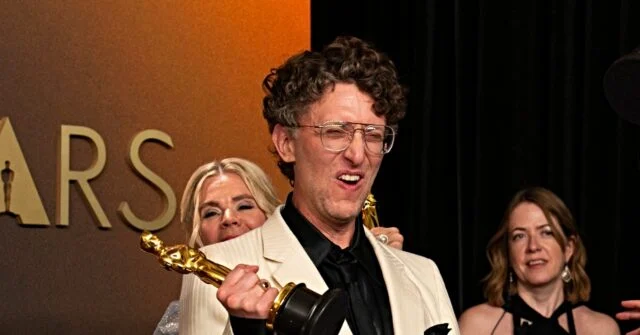
David Borenstein Uses Oscar Platform to Deliver Scathing Political Critique, Drawing Parallels Between Russia and US Governance
Oscar-winning director David Borenstein used his moment in the global spotlight on Sunday night to deliver a potent and unfiltered political critique, railing against governments he accused of committing murder on the streets and unnamed oligarchs who "take over the media." The Copenhagen-based American filmmaker had just claimed the Academy Award for Best Documentary Feature for his film, Mr Nobody Against Putin, a poignant and harrowing account of a primary school teacher’s clandestine efforts to document the systematic indoctrination of his pupils to support Russia’s invasion of Ukraine. His acceptance speech quickly pivoted from an acknowledgment of his victory to a broader condemnation of complicity in the face of eroding democratic values, drawing stark parallels between the events depicted in his film and what he perceives as alarming trends in the United States.
The Film: A Glimpse into Autocracy
Mr Nobody Against Putin emerged as a compelling frontrunner in a highly competitive category, distinguished by its unique perspective on a conflict that continues to shape global geopolitics. The film centers on Pavel Talankin, a primary school teacher who, from his classroom in Russia, bravely recorded the state-mandated curriculum designed to instill unwavering support for the war in Ukraine among impressionable young minds. Talankin, now living in exile in Europe, shared the honors with Borenstein, serving as a powerful symbol of individual resistance against state-sponsored narratives. The documentary provides an intimate, often disturbing, look at the mechanisms of propaganda and thought control within an authoritarian system, revealing how a generation is being shaped by official ideology. The film’s production was fraught with peril, relying on covert footage and the immense personal risk taken by Talankin and his collaborators. Its critical acclaim leading up to the Oscars underscored its timely relevance, resonating with audiences and critics who recognized its urgent message about the fragility of truth and the power of information in an era of widespread disinformation. The film not only highlights the plight of ordinary citizens caught in geopolitical conflicts but also serves as a stark warning about the insidious nature of state control over education and media.
The Acceptance Speech: Unfiltered Critique
Bathed in the glare of the public spotlight, Borenstein wasted no time in articulating his profound concerns. "Mr Nobody Against Putin was about how you lose your country," he declared, his voice cutting through the typical celebratory atmosphere of the Oscars. "What we saw when working with this footage is that you lose it through countless small little acts of complicity." This core message framed his subsequent accusations, which directly targeted powerful institutions. He continued, "When we act complicit when a government murders people on the streets of our major cities. When we don’t say anything when oligarchs take over the media and control how we can produce it and consume it. We all face a moral choice. But luckily even a nobody is more powerful than you think."
Borenstein’s reference to "government murders people on the streets of our major cities" was deliberately broad, allowing for various interpretations but clearly intended to evoke instances of state-sanctioned violence or excessive force, particularly within a domestic context. While he did not specify particular incidents, such rhetoric often aligns with criticisms leveled against police brutality or other forms of state violence perceived by segments of the public. This provocative statement immediately injected a highly charged political dimension into the awards ceremony, a platform historically known for both artistic celebration and occasional political declarations.
His condemnation of "oligarchs taking over the media" addressed a growing global concern about media consolidation and its potential impact on journalistic independence and diverse public discourse. The concentration of media ownership in the hands of a few powerful entities, often with significant financial or political interests, raises questions about the ability of the press to serve as an unbiased watchdog. Critics argue that such consolidation can lead to homogenized news coverage, suppression of dissenting viewpoints, and a weakening of the democratic function of the Fourth Estate. Borenstein’s choice of the term "oligarchs" further amplified the sense of powerful, unelected individuals wielding disproportionate influence over public information.
Drawing Direct Parallels: The American Landscape
The most striking aspect of Borenstein’s speech was his explicit effort to draw "unsubtle parallels" between the autocratic environment depicted in his film and recent actions he claims to observe within the United States. This direct comparison aimed to jolt his audience into recognizing what he perceives as similar threats to democracy and civil liberties at home.
One specific reference concerned the work of U.S. Immigration and Customs Enforcement (ICE) in cities like Minneapolis, where the agency has conducted operations to apprehend undocumented immigrants. Borenstein’s mention of ICE highlights ongoing debates surrounding immigration policy, border enforcement, and the treatment of non-citizens within the U.S. Critics of ICE operations often point to concerns about due process, family separations, and the social impact of raids on communities. Minneapolis, like many major U.S. cities, has been a focal point for activism and debate over immigration enforcement, with some local officials and advocacy groups calling for more compassionate approaches or limits on federal agency actions. Borenstein’s inclusion of this issue served to underscore his broader argument about state power and its potential for perceived overreach against vulnerable populations.
The director also raised concerns over the potential ownership of both CBS and CNN by David Ellison following a hypothetical Paramount-Warner Bros. merger. This specific scenario, while speculative at the time of his speech, points to the broader anxieties surrounding media consolidation. Paramount Global, which owns CBS, and Warner Bros. Discovery, which owns CNN, are two of the largest media conglomerates in the world. A merger between them would create an even more dominant entity, potentially consolidating significant portions of news, entertainment, and information dissemination under a single corporate umbrella. David Ellison, known for his involvement in Skydance Media, represents the type of influential figure whose control over vast media empires can raise questions about editorial independence, diversity of content, and market competition. Data on media ownership illustrates this trend: in the 1980s, roughly 50 corporations controlled the majority of U.S. media outlets; by the 2000s, this number had reportedly shrunk to just six, encompassing television, radio, print, and digital platforms. This concentration fuels fears that a handful of individuals or corporations could exert undue influence over public discourse, shaping narratives and potentially limiting access to diverse perspectives.
Backstage Clarifications: Trump and the Speed of Change
Borenstein further elaborated on his provocative comparisons backstage in the Oscars’ press room, specifically naming former President Donald Trump. He revealed a significant aspect of his collaborative experience: "One interesting thing about working with a team of Russians throughout this process has been my desire, as an American, to constantly compare the situation in America to Russia." However, he noted, "a lot of my Russian colleagues and friends always said, ‘No, it’s not the same situation. It’s actually happening quicker in America than it’s been happening in Russia. Trump was moving a lot quicker than Putin in his early years.’ So that’s kind of all I have to say to that."
This statement offered a chilling perspective, particularly from individuals with direct experience living under an increasingly authoritarian regime. The comparison between Trump and Putin, while often debated, typically centers on perceived challenges to democratic norms, press freedom, and institutional checks and balances. Vladimir Putin’s early years in power (starting in 2000) saw a systematic consolidation of control, including the dismantling of independent media, the weakening of opposition parties, and the tightening grip of the state apparatus. Donald Trump’s presidency (2017-2021) was marked by frequent attacks on the media, challenges to electoral processes, and a rhetoric that often divided rather than united. Borenstein’s Russian colleagues’ observation suggests a concern that the pace of democratic erosion or the erosion of established norms might be accelerating at an alarming rate in the U.S., perhaps even faster than what they witnessed in Russia’s initial descent into autocracy. This perspective underscores the global anxiety among those who monitor democratic health and the potential for a rapid shift in political landscapes.
A History of Political Statements at the Oscars
Borenstein’s speech, while sharp and direct, is far from an anomaly in the history of the Academy Awards. The Oscars stage has frequently served as a powerful platform for social and political commentary, often sparking controversy and igniting public debate. Memorable instances include Marlon Brando’s refusal of his Best Actor award in 1973 in protest of Hollywood’s portrayal of Native Americans, with Sacheen Littlefeather delivering his message. Vanessa Redgrave faced both cheers and jeers in 1978 for her speech addressing "Zionist hoodlums." In more recent times, Michael Moore used his 2003 Best Documentary Oscar for Bowling for Columbine to denounce President George W. Bush and the Iraq War, leading to a mixed reaction from the audience. Joaquin Phoenix delivered a powerful speech in 2020 on issues ranging from veganism to systemic injustice. These moments reflect a tension inherent in the Oscars: while primarily an artistic celebration, its immense global reach makes it an irresistible forum for artists to voice their convictions, often challenging the status quo and pushing boundaries. The Academy itself generally maintains a stance of allowing freedom of expression, though such speeches invariably generate divided reactions among the audience, industry, and the wider public.
Reactions, Implications, and the Broader Discourse
David Borenstein’s Oscar speech is expected to ignite significant discussion across political divides and within the entertainment industry. Supporters will likely laud his courage and moral clarity, viewing his words as a necessary call to action against threats to democracy and human rights. They will see his use of the platform as a responsible exercise of his artistic and civic voice, drawing attention to critical issues that often go unaddressed in mainstream discourse. Conversely, critics may accuse him of politicizing an artistic event, of engaging in hyperbole, or of unfairly comparing the U.S. to Russia without sufficient nuance. Such reactions often argue that award ceremonies should remain focused on artistic achievement, separate from political agendas.
Beyond immediate reactions, Borenstein’s speech holds several broader implications. It will undoubtedly amplify the visibility of Mr Nobody Against Putin, further drawing attention to the realities of the Russia-Ukraine conflict and the insidious nature of propaganda. His comments will also contribute to ongoing debates about media ethics, the dangers of media consolidation, and the state of civil liberties in Western democracies. By explicitly naming figures and institutions, Borenstein has invited scrutiny and discussion on specific policy areas, such as immigration enforcement and corporate mergers. The "nobody" theme of his speech, echoing the title of his film, reinforces the idea that individual actions, even seemingly small ones, can have profound impacts, challenging cynicism and encouraging civic engagement. In a fragmented global landscape, Borenstein’s use of a premier cultural platform serves as a powerful reminder of the interconnectedness of global political struggles and the enduring responsibility of citizens to challenge complicity and uphold democratic values. His impassioned plea has ensured that the conversation will extend far beyond the glittering halls of the Dolby Theatre, echoing in political commentaries, news analyses, and public discourse for days to come.

Related Posts
Democratic Candidates Must Moderate to Win General Elections, Says Rep. Greg Stanton
Lisa Demuth Secures Republican Gubernatorial Nomination in Minnesota, Defeating Trump-Endorsed Mike Lindell