
The US’s critical minerals club threatens an equitable clean energy transition
The reconfiguration of these supply chains is driven by an urgent need to decouple from Chinese dominance in the processing and refining of rare earth elements, cobalt, lithium, and nickel. However, the dual-use nature of these minerals—essential for both electric vehicle (EV) batteries and advanced munitions—has led to a policy framework that increasingly favors the military-industrial complex and the digital economy over the mass-market deployment of renewable energy technologies.
The Strategic Shift: Defense and Digital Dominance
The core of Washington’s current strategy lies in the fortification of the defense and digital sectors. Modern warfare and the next generation of telecommunications are increasingly mineral-intensive. For example, a single F-35 fighter jet requires approximately 920 pounds of rare earth materials, while the massive data centers required to power generative AI models demand vast quantities of copper, aluminum, and specialized cooling components made from critical alloys.
By formalizing a trading bloc with "like-minded" partners—including Australia, Canada, the European Union, Japan, and the Republic of Korea—the U.S. is effectively creating a "closed-loop" system for these materials. While this ensures that the Pentagon and Silicon Valley have a steady stream of inputs, it creates a supply-side squeeze for the cleantech industry. Solar panel manufacturers and EV battery startups are finding themselves outbid by defense contractors who operate under "cost-plus" contracts and national security mandates that prioritize availability over price.
A Chronology of Critical Mineral Policy (2022–2026)
The current state of the minerals trading bloc is the result of a multi-year legislative and diplomatic push:
- June 2022: The U.S. Department of State announces the Minerals Security Partnership (MSP) to bolster critical mineral supply chains, initially focusing on investment in mining projects that meet high Environmental, Social, and Governance (ESG) standards.
- August 2022: The Inflation Reduction Act (IRA) is signed into law, providing massive subsidies for domestic mineral processing and stipulating that a percentage of battery components must originate from the U.S. or its Free Trade Agreement (FTA) partners.
- May 2023: At the G7 summit in Hiroshima, leaders agree to a "Resilient and Inclusive Supply-chain Enhancement" (RISE) scheme, further narrowing the focus to "trusted" partners.
- 2024–2025: The U.S. signs a series of "Critical Minerals Agreements" with non-FTA countries, such as Japan and several African nations, to circumvent IRA restrictions while maintaining a tight grip on supply.
- March 2026: Washington officially formalizes the "Strategic Minerals Bloc," a tiered membership system that grants the U.S. military and high-tech sectors first-right-of-refusal on mineral outputs from member nations.
Supporting Data: The Scale of Mineral Demand
The demand for critical minerals is projected to reach unprecedented levels by 2030, but the distribution of these resources is becoming increasingly lopsided. According to data from the International Energy Agency (IEA) and recent market analysis:
- Lithium: Demand is expected to grow nine-fold by 2040. However, current production forecasts show a 15% deficit starting in 2027 if military stockpiling continues at its current rate.
- Cobalt: The Democratic Republic of Congo (DRC) remains the source of 70% of the world’s cobalt. While 15% of this is currently used for military and aerospace alloys, that figure is expected to rise to 25% by 2028 as drone production scales globally.
- Rare Earth Elements (REEs): China still controls nearly 90% of global REE refining. The U.S. bloc’s efforts to build domestic refining capacity have seen a 40% increase in capital expenditure, but 60% of this new capacity is earmarked for permanent magnets used in defense and high-performance computing, not wind turbines.
Impact on the Global South: The Case of the DRC and South Africa
The formation of this trading bloc has profound implications for mineral-rich nations in the Global South, particularly the Democratic Republic of Congo and South Africa. These nations are caught between the desire to profit from the transition and the pressure to align with Washington’s security-first agenda.
In the DRC, artisanal mining remains a critical yet controversial source of cobalt. The U.S. bloc’s insistence on "clean" supply chains often excludes these small-scale miners, potentially driving them into the arms of less-regulated buyers or further entrenching poverty. Conversely, South Africa has used its G20 presidency to push for "local value-addition." Pretoria argues that African nations should not merely be exporters of raw materials but should house the processing plants and battery factories themselves.
"The era of digging and shipping must end," stated a high-ranking South African trade official during a recent bilateral meeting. "If Washington wants our minerals for its defense systems, it must invest in our industrialization, not just our mines."
Official Responses and Reactions
The international community is divided on the merits of this security-focused bloc.

The U.S. Department of Defense (DoD): A Pentagon spokesperson defended the strategy, stating, "National security is the bedrock upon which all other goals, including the energy transition, must be built. Without a secure supply of critical minerals, we cannot guarantee the defense of the networks that manage our energy grids or the systems that protect our borders."
Climate Policy Advocates: Environmental groups have expressed alarm. "We are seeing a ‘militarization’ of the energy transition," said a lead analyst at a prominent D.C.-based climate think tank. "If we divert the lithium and nickel needed for 10 million EVs into a few thousand advanced weapons systems and AI servers, we will miss our 1.5-degree Celsius targets. The climate does not wait for geopolitical maneuvering."
European Union: Brussels remains a wary partner. While the EU has joined the MSP, its "Critical Raw Materials Act" emphasizes "circularity" and recycling more heavily than the U.S. approach. European officials have privately expressed concerns that Washington’s aggressive stockpiling could drive up prices for European automakers, who are already struggling to compete with Chinese EV imports.
Broader Implications: The Cleantech Risk Analysis
The risk of diverting resources away from cleantech is not merely a theoretical concern; it is a burgeoning economic reality. As the U.S. trading bloc prioritizes digital and military sectors, three primary risks emerge for the green transition:
1. Cost Escalation for Renewables
The price of batteries is the single largest factor in the adoption of electric vehicles and grid-scale storage. If the military-industrial complex absorbs the lowest-cost mineral supplies, the "green premium"—the extra cost of choosing clean technology over fossil fuels—will remain high, deterring mass-market adoption in developing economies.
2. Supply Chain Fragmentation
The world is moving toward a bifurcated supply chain: a U.S.-led bloc and a China-led bloc. This fragmentation prevents the economies of scale that historically drive down costs in the tech sector. For cleantech, which requires global deployment to be effective against climate change, this "mineral iron curtain" could be catastrophic.
3. Innovation Stagnation
With R&D funding in the U.S. increasingly tilted toward "defense-critical" applications, innovation in alternative battery chemistries (such as sodium-ion or solid-state batteries) may be prioritized for their military utility (energy density, temperature resistance) rather than their commercial viability or recyclability.
Conclusion: A Delicate Balancing Act
Washington’s minerals trading bloc represents a paradigm shift in how natural resources are viewed in the 21st century. By shoring up supplies for the digital and military sectors, the U.S. is addressing immediate concerns of technological sovereignty and national defense. However, the cost of this security may be a slower, more expensive path to net-zero.
The challenge for policymakers moving forward will be to ensure that "national security" does not become a vacuum that sucks the oxygen out of the climate movement. Without a concerted effort to include cleantech mandates within these mineral agreements—and to support the industrial aspirations of mineral-rich nations—the very stability that Washington seeks to protect could be undermined by the accelerating impacts of a warming planet. The "Strategic Minerals Bloc" may secure the weapons and computers of tomorrow, but it must not do so at the expense of the habitable world they are meant to defend.

Related Posts
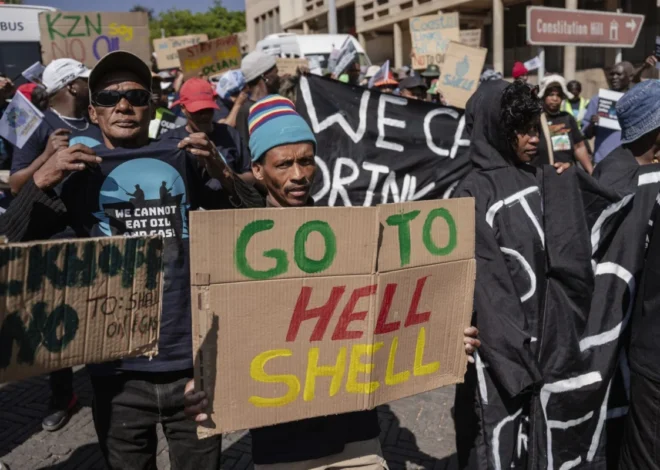
Constitutional Court of South Africa Bars Shell Oil Exploration in Landmark Victory for Environmental and Community Rights

The Battle for Saldanha Bay: South Africa’s Ambitious Ocean Economy Strategy Faces Legal and Environmental Reckoning