
Mexican President Claudia Sheinbaum Declares End to Diplomatic Frost with Spain Amidst Historic Reconciliation and Global Ideological Divide.
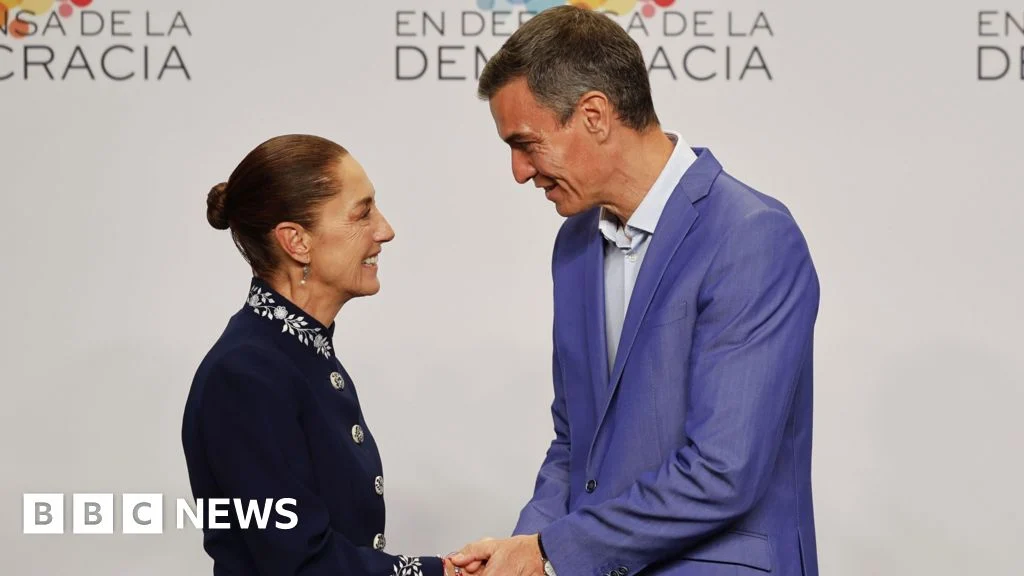
Mexican President Claudia Sheinbaum has emphatically stated that there is "no diplomatic crisis" with Spain, signalling a potential turning point in a relationship that has been strained for years over the historical legacy of the Spanish conquest of Mexico. Her comments, made upon her arrival at the "In Defence of Democracy" summit in Barcelona on Saturday, underscore a palpable shift towards rapprochement, marked by recent gestures from both sides acknowledging the complex and often painful shared history. This diplomatic overture unfolded against a backdrop of stark ideological contrasts, as left-leaning leaders convened in Barcelona to counter the rise of illiberalism, while a simultaneous gathering of far-right leaders in Milan rallied against immigration and European Union bureaucracy.
Historical Grievances and a Call for Apology
The relationship between Mexico and Spain, two nations bound by language, culture, and a deeply intertwined past, has been punctuated by periods of both close alliance and significant tension. The most recent period of diplomatic frost began in 2019 under Sheinbaum’s predecessor, Andrés Manuel López Obrador. López Obrador initiated a formal demand for Spain to issue an apology for the human rights violations and atrocities committed during its 16th-century conquest of Mexico. This unprecedented request reignited a centuries-old debate about historical responsibility and the enduring impact of colonialism.
The Spanish conquest, led by Hernán Cortés, commenced in 1519 and culminated with the fall of Tenochtitlan, the Aztec capital, in 1521. This period was characterized by brutal warfare, the systemic dismantling of indigenous civilizations like the powerful Aztec empire, and the introduction of European diseases to which native populations had no immunity. It is estimated that millions of indigenous people perished due to fighting, forced labour, and epidemics such as smallpox, leading to a catastrophic demographic collapse. Beyond the immediate violence, the conquest ushered in three centuries of colonial rule, during which Mexico’s vast natural resources were exploited, indigenous cultures suppressed, and a new societal hierarchy established. For many Mexicans, particularly those identifying with indigenous heritage, the conquest remains a profound wound, symbolizing injustice and the loss of sovereignty.
López Obrador’s demand for an apology was rooted in a broader political platform that sought to uplift Mexico’s indigenous peoples and reclaim a sense of national pride and historical justice. He argued that acknowledging the historical abuses was not about rewriting history, but about fostering genuine reconciliation and mutual respect in the present day. His request, however, was initially met with resistance from Madrid, which maintained that historical events should be viewed through the lens of their own time and that contemporary governments should not be held accountable for actions taken five centuries ago. This impasse led to a significant deterioration in diplomatic communications.
The strained relations reached a nadir when, in an unusual diplomatic move, Sheinbaum’s administration opted not to invite Spain’s King Felipe VI to her inauguration in 2024. In a reciprocal gesture of disapproval, Spain subsequently declined to send any high-level representative to the ceremony, underscoring the depth of the diplomatic chasm that had opened between the two nations.
A New Chapter: Signs of Rapprochement
Despite the years of strained dialogue, recent months have witnessed a series of significant gestures indicating a determined effort to mend fences. These overtures suggest a mutual recognition of the need to move beyond historical grievances without dismissing them entirely.
A pivotal moment occurred in March when King Felipe VI, while visiting an exhibition on indigenous Mexican women in Madrid, made an unprecedented public acknowledgment of the abuses committed during the conquest. "There are things that, when we study them, with our present-day criteria, our values, obviously cannot make us feel proud," the monarch stated, adding that there had been "a lot of abuse" during the subjugation of the territory that would become Mexico. This marked the first time a Spanish monarch had publicly and explicitly recognized the darker aspects of Spain’s colonial past in relation to Mexico, a statement that resonated deeply and was widely interpreted as a significant step towards reconciliation. The King’s words, delivered with a tone of solemn reflection, offered a diplomatic olive branch that had been absent for years.
This royal acknowledgment was preceded by other positive signals. In October of the previous year, Spain’s Foreign Minister José Manuel Albares garnered significant praise from Sheinbaum’s government when he spoke of the "pain and injustice" inherent in the countries’ shared history. Such language, acknowledging suffering rather than merely historical fact, was seen as a crucial shift in Spain’s diplomatic discourse.
Adding to the momentum, it emerged that a month prior to King Felipe’s statement, President Sheinbaum had extended an invitation to the Spanish monarch to attend the upcoming Fifa World Cup, which Mexico will co-host with the United States and Canada. According to the Spanish royal palace, Sheinbaum expressed that the global sporting event would provide "a timely opportunity to evoke the depth and unique character of the ties between Mexico and Spain." This invitation, coming from the Mexican President herself, signified a clear desire to foster renewed engagement and leverage a high-profile international event to underscore cultural and diplomatic unity.
President Sheinbaum’s declaration in Barcelona that there was "no diplomatic crisis" further solidified this narrative of thawing relations. Her immediate meeting with Spanish Prime Minister Pedro Sánchez, co-chair of the "In Defence of Democracy" summit, cemented the perception of a new, more constructive chapter. While Sánchez himself did not publicly comment on the state of bilateral relations, Spain’s economy minister, quoted by Reuters, affirmed that Sheinbaum’s presence was "a very important and positive sign of a rapprochement between the two countries." This visit marks the first by a Mexican president to Spain in eight years, underscoring its symbolic and substantive importance.
The "In Defence of Democracy" Summit in Barcelona
President Sheinbaum’s visit to Barcelona was primarily for the "In Defence of Democracy" summit, a gathering of left-leaning leaders aimed at addressing a perceived global rise in illiberalism and threats to democratic principles. This was the fourth iteration of the initiative, reflecting a growing concern among progressive governments about the erosion of democratic norms and the increasing polarization of political landscapes worldwide.
Spanish Prime Minister Pedro Sánchez, co-chairing the summit, articulated the urgency of their mission: "Democracy cannot be taken for granted." He warned against "attacks on the multilateral system, one attempt after another to challenge the rules of international law, and a dangerous normalisation of the use of force." Sánchez’s remarks highlighted the multifaceted challenges facing democratic governance, from the spread of disinformation and the rise of authoritarian tendencies to geopolitical conflicts that undermine international cooperation.
Echoing these concerns, Brazilian President Luiz Inácio Lula da Silva, another prominent co-chair, delivered a scathing critique of the current international architecture, particularly the United Nations Security Council. Lula asserted that the Security Council was "not working" and that its five permanent members – the United States, China, Russia, France, and the United Kingdom – which wield veto power, had effectively become "lords of war." He argued vehemently against the notion that any single nation, regardless of its power, should unilaterally dictate international rules, advocating instead for a more equitable and representative global governance structure. "No president of any country in the world, however powerful, has the right to keep imposing rules on other countries," Lula declared, advocating for a multilateral system based on genuine dialogue and shared responsibility.
A tangible outcome of the Barcelona summit was a joint statement from the leaders of Brazil, Mexico, and Spain, announcing an agreement to increase humanitarian aid deliveries to Cuba. This initiative underscores a shared concern for the humanitarian crisis unfolding in the Caribbean nation and demonstrates a collective commitment to regional solidarity and assistance, particularly from countries with historical ties to Latin America. The humanitarian situation in Cuba has been exacerbated by various factors, including the long-standing U.S. embargo, internal economic challenges, and the impacts of global events, leading to shortages of food, medicine, and essential goods.
A Stark Ideological Counterpoint: The Far-Right in Milan
The Barcelona summit’s focus on defending democracy and multilateralism stood in stark contrast to a concurrent gathering of far-right leaders in Milan, Italy. Thousands of supporters of the "Patriots for Europe" party, a right-wing grouping within the European Parliament, convened for a rally that championed nationalist agendas, stricter immigration policies, and a reduction in EU bureaucracy.
Key figures at the Milan rally included Jordan Bardella, leader of France’s far-right Rassemblement National (RN); Italy’s Deputy Prime Minister Matteo Salvini, who organized the event; and Geert Wilders, who leads the Dutch far-right PVV party. These leaders represent a growing populist and nationalist movement across Europe that has gained significant traction in recent elections, fueled by anxieties over immigration, economic globalization, and perceived overreach by the European Union.
Bardella articulated the core tenets of their platform, stating that immigration and the "ever-increasing regulations imposed by the European Commission and the European Union on European industry and on the economies of the eurozone" would be central to their discussions. The rally served as a platform to project a unified front against what they describe as the "Brussels bureaucrats" and to advocate for greater national sovereignty. Salvini, addressing the crowd, declared, "In Europe, the Alliance of Patriots is the only true adversary for the Brussels bureaucrats who serve a few businessmen and warmongers." This rhetoric underscores a deep-seated Euroscepticism and a desire to reshape the future of the European Union along more nationalistic lines.
The simultaneous occurrence of these two ideologically opposed summits—one advocating for enhanced democracy and multilateral cooperation, the other championing national sovereignty and challenging established international norms—highlights the profound ideological fault lines that characterize contemporary global politics.
Broader Implications and the Path Forward
The declaration of "no diplomatic crisis" by President Sheinbaum is more than a simple statement; it signifies a conscious decision by both Mexico and Spain to prioritize future cooperation over past grievances. While the historical debate surrounding the conquest will undoubtedly persist in academic and cultural spheres, the political leadership in both countries appears ready to navigate these complex issues with greater nuance and mutual respect. This shift holds significant implications for bilateral trade, investment, and cultural exchange. Spain remains a key European investor in Mexico, and strong diplomatic ties are essential for fostering continued economic partnership and leveraging the deep cultural affinity between their peoples.
For Mexico, a rapprochement with Spain aligns with its broader foreign policy goals of strengthening ties with Europe and diversifying its international partnerships. For Spain, re-establishing robust relations with Mexico, a leading economy and cultural powerhouse in Latin America, is vital for its continued influence in the Ibero-American sphere.
The Barcelona summit, by bringing together leaders like Sheinbaum, Sánchez, and Lula, underscored a collective commitment to progressive values and multilateral solutions in a fragmented world. Their focus on defending democratic institutions, addressing global inequalities, and advocating for a reformed international order presents a clear ideological counter-narrative to the rising tide of nationalism and illiberalism epitomized by the Milan rally. The joint statement on Cuban aid further demonstrates a practical application of their shared commitment to humanitarian principles and regional stability.
In conclusion, President Sheinbaum’s assertive declaration of a revitalized relationship with Spain marks a significant diplomatic milestone. It reflects a maturing approach to historical reconciliation and underscores a desire to forge a forward-looking partnership. This development unfolds within a dynamic global political landscape, where the concurrent gatherings in Barcelona and Milan vividly illustrate the ongoing ideological contest for the future direction of international relations and governance. The path ahead for both Spain and Mexico, and indeed for the broader international community, will likely involve continued efforts to balance historical justice with contemporary cooperation, all while navigating the powerful currents of competing political philosophies.

Related Posts
Zambia on Edge: Opposition Leader Arrested Amid Allegations of Insurrection Plot and Election Tensions
Rescuers search for survivors of powerful Indonesia earthquake

