
Lebanon’s Southern Front: Paramedics Navigate Abandoned Cities Amidst Escalating Conflict and Contested Claims Over Health Facilities
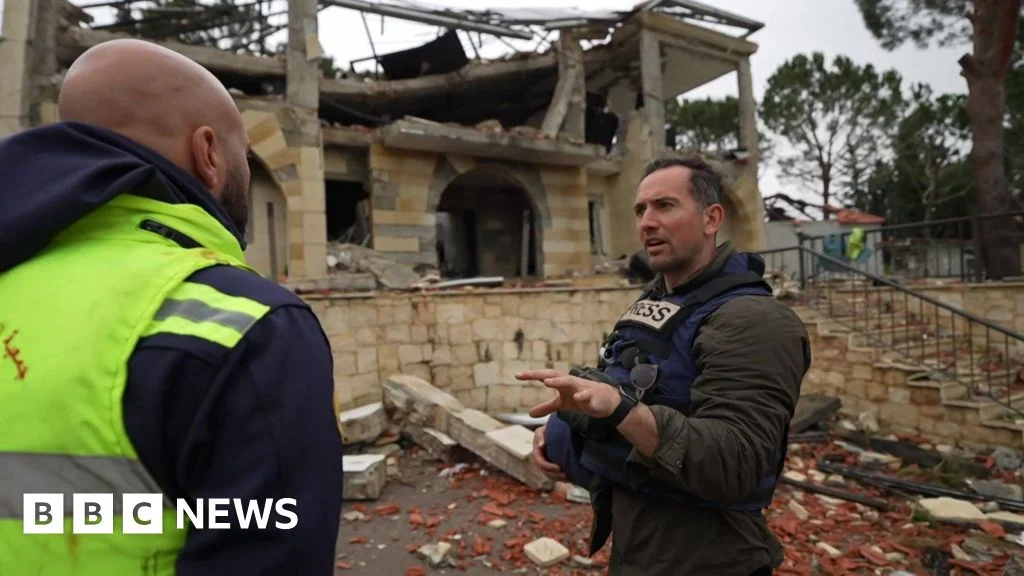
The harrowing reality of escalating conflict in southern Lebanon is brought into stark focus through the experiences of emergency medical personnel, as detailed by the BBC’s Middle East correspondent Hugo Bachega, who joined paramedics on duty in Nabatieh. Once a bustling urban center, Nabatieh now stands largely abandoned, a ghost town testament to the widespread displacement gripping the region. This scene is replicated across a swathe of southern Lebanon, where civilian life has been decimated by continuous cross-border hostilities.
A City in Ruins: Nabatieh’s Desperate Plight
Nabatieh, historically a vibrant commercial and administrative hub in southern Lebanon, has been transformed by the ongoing conflict into a desolate landscape. Streets once teeming with shoppers and daily life are now eerily quiet, punctuated only by the distant sounds of artillery and the urgent sirens of ambulances. The departure of residents is not merely a precautionary measure but a stark necessity, as the city and surrounding areas have been subjected to repeated strikes, rendering daily existence untenable and profoundly dangerous. The paramedics operating in this environment face immense challenges, not only in reaching those in need but also in navigating an urban fabric scarred by destruction and devoid of its usual lifeblood. Their shifts are a testament to relentless bravery, as they work under the constant threat of being targeted, their vehicles and stations no longer perceived as sanctuaries but potential flashpoints.
The correspondent’s report from Nabatieh paints a grim picture of an emergency service stretched to its breaking point. At one ruined ambulance station, a paramedic recounted the tragic loss of a colleague, killed by an Israeli strike while speaking on the phone to his wife. This incident underscores the profound personal cost of the conflict and highlights the extreme dangers faced by medical professionals. Such narratives are not isolated; they are part of a broader pattern of casualties among humanitarian and medical workers, which international organizations have repeatedly condemned. The destruction of medical infrastructure, combined with the loss of trained personnel, severely cripples the capacity to respond to civilian casualties, further exacerbating the humanitarian crisis.
The Unfolding Humanitarian Crisis and Widespread Displacement
The human toll of the conflict extending from the Israel-Gaza war is particularly acute in southern Lebanon. Since the initial escalation in October 2023, and especially following significant intensification by March of the subsequent year, a staggering one in five people in Lebanon have been forced to abandon their homes. This equates to hundreds of thousands of individuals displaced internally, predominantly from villages and towns along the southern border. Many have sought refuge in safer areas further north, straining the resources of host communities and exacerbating Lebanon’s pre-existing economic and social crises.
The displacement crisis is multifaceted. Families often leave with little more than the clothes on their backs, forced to abandon livelihoods, homes, and community networks. Access to essential services such as healthcare, education, and clean water becomes precarious for the displaced. United Nations agencies, including OCHA and UNHCR, have repeatedly highlighted the urgent need for humanitarian assistance, including shelter, food, and medical supplies, for these populations. The cumulative impact of successive conflicts, coupled with a severe economic downturn that began in 2019, has left Lebanon’s infrastructure and public services in a state of fragility, ill-equipped to handle such a massive influx of displaced persons. The destruction of agricultural land and critical infrastructure in the south further compounds the long-term recovery challenges, threatening food security and economic stability for an already vulnerable nation.
Contested Claims: Health Facilities in the Crosshairs
A recurring and deeply contentious aspect of the conflict involves allegations regarding the use of civilian infrastructure, particularly health facilities and ambulances, for military purposes. Israel maintains that some ambulances and health facilities in Lebanon are being utilized by Hezbollah, asserting that this practice strips them of their protected status under international humanitarian law. This claim aligns with Israel’s broader operational doctrine in conflicts, where it frequently accuses non-state actors of embedding military assets within civilian areas, thereby complicating targeting decisions and attributing responsibility for civilian casualties. Israeli military spokespersons have consistently stated that they target legitimate military objectives and take precautions to avoid civilian harm, but that Hezbollah’s tactics of operating from within civilian populations or using civilian infrastructure necessitate responses that may inadvertently affect non-combatants.
However, these claims are vehemently denied by Lebanese paramedics and the country’s health ministry. Paramedics on the ground assert that there is no evidence to support Israel’s accusations, emphasizing their unwavering commitment to neutrality and the provision of emergency care to all, regardless of affiliation. The Lebanese Ministry of Public Health has condemned Israel’s allegations, framing them as a pretext for targeting essential civilian infrastructure and medical personnel, which constitutes a grave violation of international humanitarian law. Under the Geneva Conventions, medical facilities, personnel, and vehicles are afforded special protection and must not be targeted. This protection can only be forfeited if they are used to commit "acts harmful to the enemy" outside their humanitarian function, and even then, specific warnings and opportunities to desist must be given. The conflicting narratives underscore a critical challenge in modern warfare: verifying claims and counter-claims in real-time amidst active hostilities, often without independent oversight.
Strategic Flashpoint: Bint Jbeil Revisited
The conflict’s intensity was further highlighted by a significant incident in Bint Jbeil, a town with profound historical resonance in the Israel-Hezbollah conflict. The Israel Defense Forces (IDF) reported on a Sunday that its troops had killed more than 20 Hezbollah fighters operating from a hospital compound in Bint Jbeil. The IDF statement emphasized the precision of their operation and the identification of militants using the medical facility as cover, asserting that this action was a legitimate military response to a direct threat. Bint Jbeil was the scene of fierce and protracted fighting during the 2006 Lebanon War, becoming a symbol of Hezbollah’s resistance and a site of heavy Israeli casualties. Its strategic location, close to the border, continues to make it a focal point of military operations and a contested area. The IDF’s recent claims echo their prior assertions of Hezbollah’s exploitation of civilian infrastructure for military ends.
In direct contradiction, Lebanon’s health ministry swiftly and unequivocally denied the IDF’s claim, accusing Israel of deliberately targeting civilians and medical facilities. The ministry emphasized that any strikes on a hospital compound, regardless of alleged military presence, represent a severe breach of international humanitarian norms and could constitute war crimes. They stressed that medical facilities are intended to save lives, not to be battlegrounds, and that such actions undermine the very fabric of humanitarian protection. This incident in Bint Jbeil exemplifies the profound divergence in narratives between the warring parties, with each side presenting vastly different accounts of events, making independent verification extremely difficult in the immediate aftermath of such operations.
Historical Context and Escalation
The current cross-border hostilities between Israel and Hezbollah are inextricably linked to the broader regional conflict ignited by the October 7, 2023, attacks by Hamas on Israel and Israel’s subsequent military operation in Gaza. Hezbollah, a powerful Lebanese Shiite political party and militant group, formed in the early 1980s with Iranian backing, has historically positioned itself as a defender of Lebanon against Israeli aggression. Its extensive arsenal, including a vast array of rockets and missiles, and its significant influence within Lebanese politics and society, make it a formidable non-state actor.
The 2006 Lebanon War, a 34-day conflict triggered by a cross-border raid by Hezbollah, resulted in widespread destruction in Lebanon, significant casualties on both sides, and a fragile UN-brokered ceasefire (UNSCR 1701). This resolution called for the disarmament of all armed groups in Lebanon and the deployment of the Lebanese Armed Forces to the south, alongside an expanded UNIFIL peacekeeping force. However, Hezbollah maintained its military capabilities and presence in the south, leading to continuous tensions.
Following October 7, Hezbollah initiated limited cross-border attacks, primarily targeting Israeli military positions, in what it described as a show of solidarity with Palestinians in Gaza and a deterrent against a full-scale Israeli invasion of Lebanon. Israel responded with its own strikes, targeting Hezbollah infrastructure and operatives. This tit-for-tat escalation has steadily intensified, moving from border skirmishes to deeper strikes into each other’s territories. The "renewed fighting in March" for which the displacement statistics are cited likely refers to a period of particularly heightened intensity or a cumulative assessment point of the humanitarian impact since the conflict’s onset, underscoring a continuous and dangerous upward trajectory of violence that threatens to spiral into a full-scale regional war.
International Scrutiny and Implications
The ongoing hostilities in southern Lebanon and the attendant humanitarian crisis have drawn significant international concern. Humanitarian organizations such as the International Committee of the Red Cross (ICRC) and Médecins Sans Frontières (MSF) have consistently appealed for the protection of civilians, medical personnel, and healthcare facilities, reminding all parties of their obligations under international humanitarian law. They have highlighted the critical challenges of delivering aid and providing medical care in an active conflict zone, compounded by the destruction of infrastructure and the pervasive fear among local populations.
The conflicting claims regarding the use of health facilities raise serious questions about accountability and the adherence to the principles of distinction and proportionality in warfare. Independent investigations are often called for but are difficult to conduct during active conflict. The United Nations and various human rights organizations have consistently stressed the importance of protecting civilian life and infrastructure, and have urged both Israel and Hezbollah to exercise restraint and de-escalate tensions.
The implications of this protracted conflict are dire for Lebanon. The country’s already fragile economy, reeling from multiple crises, is further destabilized by the war. The destruction of its southern region, a vital agricultural and tourist area, promises long-term economic repercussions. Furthermore, the constant threat of a wider war between Israel and Hezbollah looms large, a prospect that regional and international powers are desperately trying to avert. Such a conflict would not only devastate Lebanon but could also draw in other regional actors, leading to a far broader and more catastrophic conflagration in the Middle East. The humanitarian crisis, the contested narratives over military conduct, and the ever-present specter of escalation underscore the profound instability gripping Lebanon and the broader region.

Related Posts
Zambia on Edge: Opposition Leader Arrested Amid Allegations of Insurrection Plot and Election Tensions
Rescuers search for survivors of powerful Indonesia earthquake

