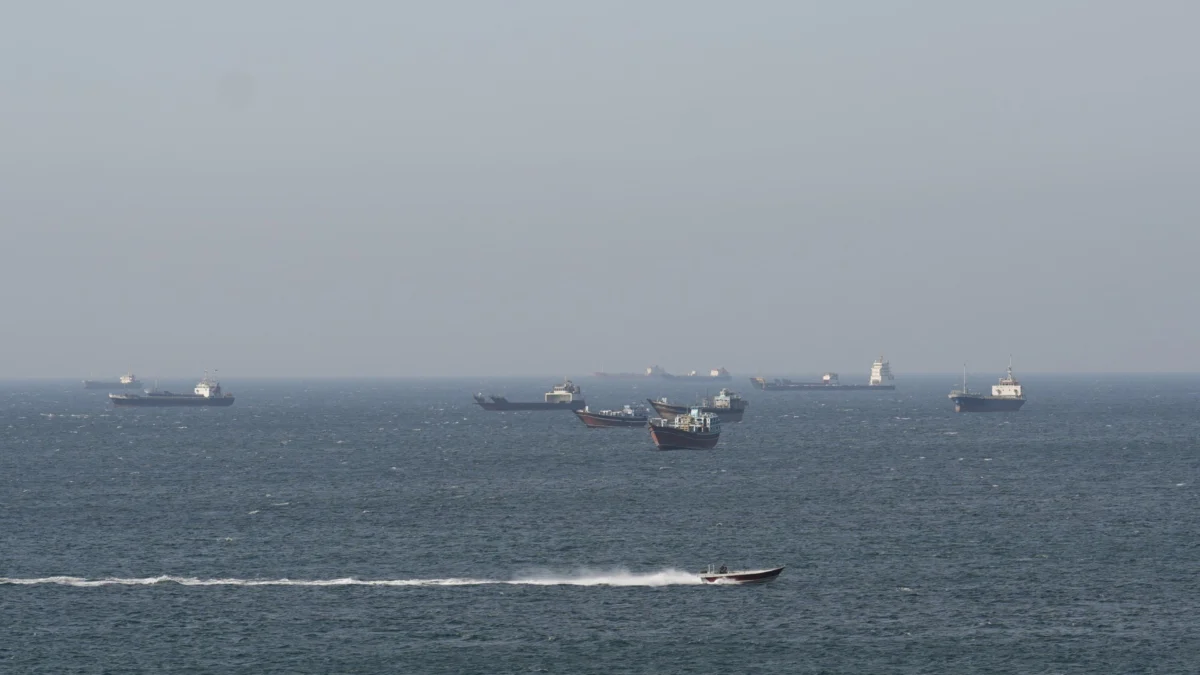
Iran Warns United States Over Strait of Hormuz Tensions, Claims US Retreats After Minesweeper Threat
Tehran, Iran – Iran’s parliament speaker, Mohammad Bagher Ghalibaf, has issued a stern warning to the United States regarding escalating tensions in the strategically vital Strait of Hormuz, asserting that Tehran will impose restrictions on shipping if its own maritime activities continue to face impediments. Ghalibaf’s remarks, delivered in a televised address and reported by Tasnim News Agency, included a dramatic account of an alleged confrontation in the waterway where Iranian forces claimed to have forced a US minesweeper to retreat under threat of engagement. This pronouncement underscores the persistent volatility in a region critical to global energy supplies and highlights the delicate balance of power between Washington and Tehran.
Ghalibaf’s address positioned Iran as the dominant power in the Strait, declaring, "Dear people of Iran, the Strait of Hormuz is under the control of the Islamic Republic." He further elaborated on a specific incident, stating, "We dealt decisively with America’s efforts to clear mines, considering it a violation of the ceasefire, and we advanced to the point of conflict, but the enemy retreated." The speaker then recounted a direct exchange with an American delegation in Islamabad, where he allegedly conveyed a stark ultimatum: "In Islamabad, I told the American delegation that if their minesweeper moves even a little further from its position, we will definitely shoot it. They asked for 15 minutes to give the order to turn back, and they did." He concluded his assertions by emphasizing, "If there is traffic in the Strait today, control of the Strait is in our hands," and dismissed any US declaration of a blockade as "a clumsy and ignorant decision," threatening, "If the US does not lift the blockade, traffic in the Strait of Hormuz will definitely be restricted."
The Strategic Nexus: Understanding the Strait of Hormuz
The Strait of Hormuz is a narrow waterway connecting the Persian Gulf to the Arabian Sea and the broader Indian Ocean. It is arguably the most critical maritime choke point in the world, playing an indispensable role in global energy security. Approximately one-fifth of the world’s total petroleum liquids consumption, or about 21 million barrels per day (b/d), passed through the Strait in 2018, according to the U.S. Energy Information Administration (EIA). This volume includes nearly all crude oil exports from Saudi Arabia, Iran, UAE, Kuwait, and Iraq, as well as nearly all liquefied natural gas (LNG) from Qatar, the world’s largest LNG exporter. Any significant disruption to shipping in the Strait of Hormuz would have immediate and severe repercussions on international oil and gas markets, leading to soaring prices and potential global economic instability.
Geographically, the Strait is about 21 miles (33 km) wide at its narrowest point, with the shipping lanes for inbound and outbound traffic being only two miles (3 km) wide. Iran controls the northern coastline of the Strait, while Oman controls the southern tip, known as the Musandam Peninsula. This geographical configuration grants Iran considerable strategic leverage, which it has historically used as a bargaining chip in response to international pressure, particularly sanctions.
A History of Volatility and Confrontation
Tensions in the Strait of Hormuz are not new but rather a recurring feature of the geopolitical landscape between Iran and the West, particularly the United States. The region has witnessed numerous confrontations and incidents over the past several decades, often peaking during periods of heightened US sanctions or Iranian nuclear program developments.
Key Historical Flashpoints and Context:
- Iran-Iraq War (1980-1988): The "Tanker War" saw both sides attack merchant shipping in the Persian Gulf, leading to significant naval deployments by international powers, including the US, to protect commercial vessels.
- 1988 Operation Praying Mantis: A US naval engagement with Iranian forces following an Iranian mine strike on a US frigate. This was the largest naval surface engagement for the US Navy since World War II.
- Post-9/11 Era and Nuclear Program: As international concerns grew over Iran’s nuclear ambitions, and successive rounds of sanctions were imposed, Iran frequently threatened to close the Strait of Hormuz.
- 2019 Escalation: A particularly tense year saw a series of attacks on oil tankers in the Gulf of Oman, the downing of a US surveillance drone by Iran, and the seizure of a British-flagged tanker by Iranian forces. These incidents brought the region to the brink of wider conflict. The US responded by increasing its military presence and forming an international maritime security initiative, Operation Sentinel (later IMX/CE 2022), to protect shipping.
- Ongoing Sanctions: The US withdrawal from the Joint Comprehensive Plan of Action (JCPOA) in 2018 and the subsequent re-imposition of stringent sanctions on Iran’s oil exports have severely impacted the Iranian economy. Iran views these sanctions as economic warfare and has repeatedly warned that if it cannot export its oil, then no other country in the region should be able to either. This forms the fundamental backdrop to Iran’s threats regarding shipping restrictions.
The specific "ceasefire" mentioned by Ghalibaf is not clearly defined in public reporting related to recent US-Iran maritime activity, suggesting it could refer to a localized de-escalation agreement, an understanding reached during specific diplomatic engagements, or an Iranian interpretation of a period without direct military confrontation. Similarly, US "mine-clearing efforts" are typically part of routine naval operations aimed at ensuring freedom of navigation and safety in international waters, which the US Navy frequently conducts to deter maritime threats. Iran’s characterization of such activities as a violation underscores its assertive stance on perceived infringements of its territorial sovereignty and security interests in the Strait.
The Role of Ghalibaf and Domestic Politics
Mohammad Bagher Ghalibaf is a prominent figure in Iran’s political establishment, known for his hardline views and extensive background in the Islamic Revolutionary Guard Corps (IRGC) before entering mainstream politics. As the speaker of the Majlis (parliament), his statements carry significant weight, reflecting not only the official stance but also often serving to rally domestic support and project strength internationally. His strong rhetoric against the US aligns with the broader conservative faction within Iran, which advocates for a robust defense posture and resistance against perceived foreign aggression.
Such assertive statements are also often designed for a domestic audience, especially during periods of economic hardship caused by sanctions. By portraying Iran as capable of confronting and deterring US military might, leaders like Ghalibaf aim to bolster national pride and deflect criticism regarding internal challenges. The alleged direct confrontation and US retreat narrative, if widely believed internally, would serve this purpose effectively.
International Reactions and Implications
While the original report does not include direct US or international responses, based on historical patterns and diplomatic norms, reactions can be inferred.
- United States: The US would likely deny any specific Iranian claims of a forced retreat and reiterate its commitment to freedom of navigation in international waters, including the Strait of Hormuz, in accordance with international law. US officials would likely condemn any threats to disrupt global shipping and emphasize their dedication to regional stability through deterrence and diplomatic efforts. The US Navy’s Fifth Fleet, based in Bahrain, routinely conducts operations to ensure maritime security and would reaffirm its readiness to protect commercial shipping.
- International Community: Global powers and shipping organizations would likely express deep concern over any escalation of tensions in the Strait. Calls for de-escalation, adherence to international maritime law, and peaceful resolution of disputes would be anticipated. The unimpeded flow of oil and gas through Hormuz is a global economic imperative, making any threat to it a matter of international concern.
- Regional Allies: Countries like Saudi Arabia and the UAE, major oil exporters that rely heavily on the Strait, would likely view Iran’s threats with alarm. They typically support US efforts to ensure freedom of navigation and would probably call for international action to safeguard their energy exports.
Analysis of Implications and Future Outlook
Ghalibaf’s strong warning carries several significant implications:
- Increased Risk of Miscalculation: The direct threat of military action against a US naval asset, even if alleged in the past, significantly raises the stakes. Any future close encounters could quickly escalate due to miscalculation or an unintended incident, potentially triggering a wider conflict that neither side ostensibly desires.
- Economic Fallout: Even the threat of restricting traffic in the Strait can inject volatility into global oil markets. Insurance premiums for vessels transiting the Gulf region often rise during periods of heightened tension, increasing operational costs for shipping companies and ultimately affecting global trade prices. A genuine disruption, however brief, would send oil prices skyrocketing, impacting economies worldwide.
- Challenge to International Law: Iran’s assertion of control over the Strait and its willingness to restrict international shipping challenges the principle of innocent passage under the United Nations Convention on the Law of the Sea (UNCLOS), which grants all vessels the right to transit through international straits for navigation. While Iran is not a signatory to UNCLOS, it generally abides by its provisions for commercial shipping but often asserts greater control in practice, especially regarding military vessels.
- Diplomatic Leverage: The threats can also be seen as a form of diplomatic leverage, aimed at pressuring the US to ease sanctions or return to the negotiating table on terms more favorable to Tehran. By demonstrating its capacity to disrupt global energy flows, Iran seeks to highlight the costs of continued isolation and economic pressure.
- Perpetuation of a Cycle of Distrust: Such confrontational rhetoric perpetuates a cycle of distrust and militarization in the region, hindering efforts towards broader de-escalation and long-term stability. It reinforces the need for robust naval presence and vigilance from international forces.
The latest pronouncements from Iran’s parliament speaker underscore the persistent fragility of peace and security in the Persian Gulf. The Strait of Hormuz remains a critical fault line where geopolitical rivalries, economic pressures, and differing interpretations of international law frequently converge. As long as fundamental disagreements persist between Tehran and Washington, particularly regarding the nuclear program and sanctions, the world will likely continue to witness these high-stakes brinkmanship maneuvers in one of the most vital waterways on the planet. The international community watches closely, advocating for restraint and diplomatic solutions to prevent a potentially catastrophic escalation.

Related Posts
Over 150 Israeli Settlers Storm Al-Aqsa Compound and Perform Prayers, Violating Status Quo Under Police Protection.
UN Report Highlights Over 900 Obstacles Hampering West Bank Aid Amid Escalating Humanitarian Crisis