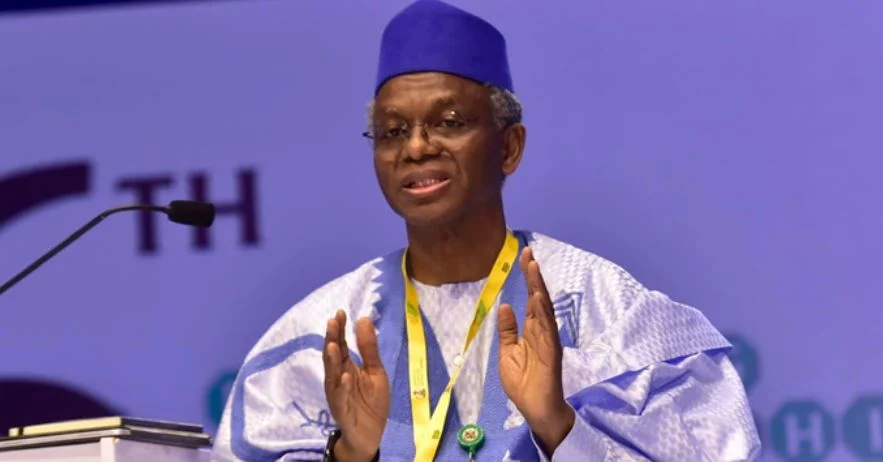
ICPC To Arraign Former Kaduna Governor Nasir El-Rufai Over Money Laundering And Abuse Of Office Allegations On Tuesday
The Independent Corrupt Practices and Other Related Offences Commission (ICPC) has confirmed that former Kaduna State Governor, Nasir El-Rufai, will appear before the Federal High Court in Kaduna today, March 24, 2026, to face formal charges of money laundering, conversion of public property, and unauthorized possession of state assets. The arraignment, which marks a significant escalation in the anti-graft agency’s pursuit of the former governor, comes after weeks of intense public scrutiny and mounting pressure from civil society organizations, political stakeholders, and the legal community regarding the legality of his continued detention.
According to a formal statement released on Monday by the ICPC’s Head of Media and Public Communications, John Odey, Mr. El-Rufai will be arraigned alongside one Joel Adoga in suit number FHC/KD/73/2026. The proceedings are expected to clarify the legal standing of the former governor, who has been held in custody since mid-February following an investigation that spanned multiple anti-corruption agencies.
A Timeline of Detention and Legal Wrangling
The journey toward this Tuesday’s arraignment began in early 2026, triggering a complex series of events that have captivated the Nigerian political landscape. On February 16, 2026, Nasir El-Rufai honored an invitation from the Economic and Financial Crimes Commission (EFCC) regarding various financial investigations linked to his tenure as governor. While he was initially granted administrative bail on February 18, he was immediately apprehended by operatives of the ICPC upon his release from EFCC custody.
For the subsequent weeks, the former governor remained in the custody of the ICPC, a period that drew sharp criticism from various quarters. The African Democratic Congress (ADC) and the Muslim Rights Concern (MURIC) were among the prominent groups that issued public statements condemning the detention. These stakeholders argued that holding a former public official for an extended period without a formal charge sheet violates the fundamental constitutional rights of the individual and undermines the principles of a fair judicial process.
The pressure reached a boiling point last week, as members of Mr. El-Rufai’s family, alongside various political associates, formally demanded that the authorities either charge him before a court of competent jurisdiction or facilitate his immediate release. The ICPC, in its Monday address, maintained that it had strictly adhered to the rule of law, asserting that the delay was a matter of procedural thoroughness rather than an arbitrary exercise of power.
The Scope of the Charges
The legal battle against the former governor is twofold. The primary case, slated for hearing at the Federal High Court, focuses on federal-level financial crimes. The charges include:
- Money Laundering: Allegations regarding the illicit movement and concealment of funds during his administration.
- Conversion of Public Property: Accusations that state assets were diverted or converted for personal use or for the benefit of third parties.
- Possession of Public Property: Unauthorized holding of government assets, which the prosecution alleges falls outside the scope of legal entitlement for a former governor.
In addition to the federal charges, the ICPC has also filed a separate set of charges at the Kaduna State High Court under the case number KDH/KAD/ICPC/01/26. In this instance, Mr. El-Rufai is to be tried alongside one Amadu Sule (LEDA). The state-level charges are reportedly broader in nature, covering:
- Abuse of Office: Allegations that the former governor utilized his executive powers to bypass established procurement laws and administrative protocols.
- Fraud and Intent to Defraud: Claims that specific government contracts and financial transactions were orchestrated with the deliberate intent to deceive the state treasury.
- Conferring Undue Advantage: Accusations that public contracts and benefits were skewed in favor of specific individuals or corporate entities to the detriment of the public interest.
While the ICPC has stated that these charges were filed on March 18, 2026, the specific date for the arraignment in the Kaduna State High Court remains pending, subject to the court’s administrative schedule.
Contextualizing the Investigation
The investigation into Nasir El-Rufai is part of a broader, sustained effort by Nigeria’s anti-graft agencies to audit the financial activities of state governments during the 2015–2023 political cycle. Analysts suggest that the case against the former governor is significant because of his high profile as a former Minister of the Federal Capital Territory and a two-term governor of a major state.
Data from the Auditor General’s reports and various civil society accountability indices have long suggested that state-level procurement processes often lack the necessary transparency to prevent the diversion of funds. The ICPC’s intervention suggests a transition from general oversight to the direct prosecution of individuals who held executive power during the period in question.
Legal experts note that the inclusion of "conversion of public property" as a specific charge indicates that the investigators have likely traced physical assets—such as land, vehicles, or government-owned properties—to the former governor or his associates. Proving these claims will require the prosecution to provide a documented chain of ownership that clearly distinguishes between legitimate executive benefits and the misappropriation of state resources.
Official Stance and Public Reaction
The ICPC has reiterated its commitment to transparency throughout the process. In his statement, Mr. Odey emphasized that the commission had duly served the defendants with the necessary legal documentation. This move is seen as an attempt to neutralize the "trial by media" narrative and satisfy the constitutional requirement that a defendant must be informed of the nature of the accusations against them well in advance of their appearance in court.
Political reactions have been polarized. Supporters of the former governor have largely maintained that the charges are politically motivated, intended to diminish his influence within the ruling party and the wider national political structure. Conversely, good-governance advocates have lauded the development as a "litmus test" for the Nigerian judiciary, arguing that no individual should be considered above the law, regardless of their political history or previous service to the state.
Broader Implications for the Nigerian Judiciary
The trial is expected to have significant implications for the Nigerian political landscape. First, it underscores the increased synergy between federal anti-graft agencies, as evidenced by the handoff from the EFCC to the ICPC. This collaborative approach, if successful, could become the standard for handling high-profile corruption cases moving forward.
Second, the proceedings will serve as a bellwether for the independence of the judiciary under the current administration. As the case progresses, the public will be watching to see how the court balances the state’s interest in recovering potentially looted funds against the defendant’s right to a robust legal defense.
Furthermore, the case of Nasir El-Rufai highlights the evolving nature of accountability in Nigerian governance. The transition from administrative investigation to criminal litigation is a critical phase that requires the prosecution to meet the high threshold of "beyond reasonable doubt." If the ICPC fails to secure a conviction, it could lead to renewed calls for the reform of anti-corruption agencies, which are often accused of pursuing cases without sufficient evidence.
As the Federal High Court in Kaduna opens its doors today, all eyes will be on the courtroom. The presence of the former governor will mark a pivotal moment, signaling the start of a legal marathon that could redefine the boundaries of executive power and accountability in Nigeria for years to come. For the ICPC, the challenge lies in sustaining its case against a formidable legal defense team, while for the defendant, the trial offers the first real opportunity to contest the allegations in a formal, judicial setting. The outcome of these proceedings will undoubtedly resonate through the halls of power, serving as a cautionary tale or a vindication of the anti-corruption crusade.