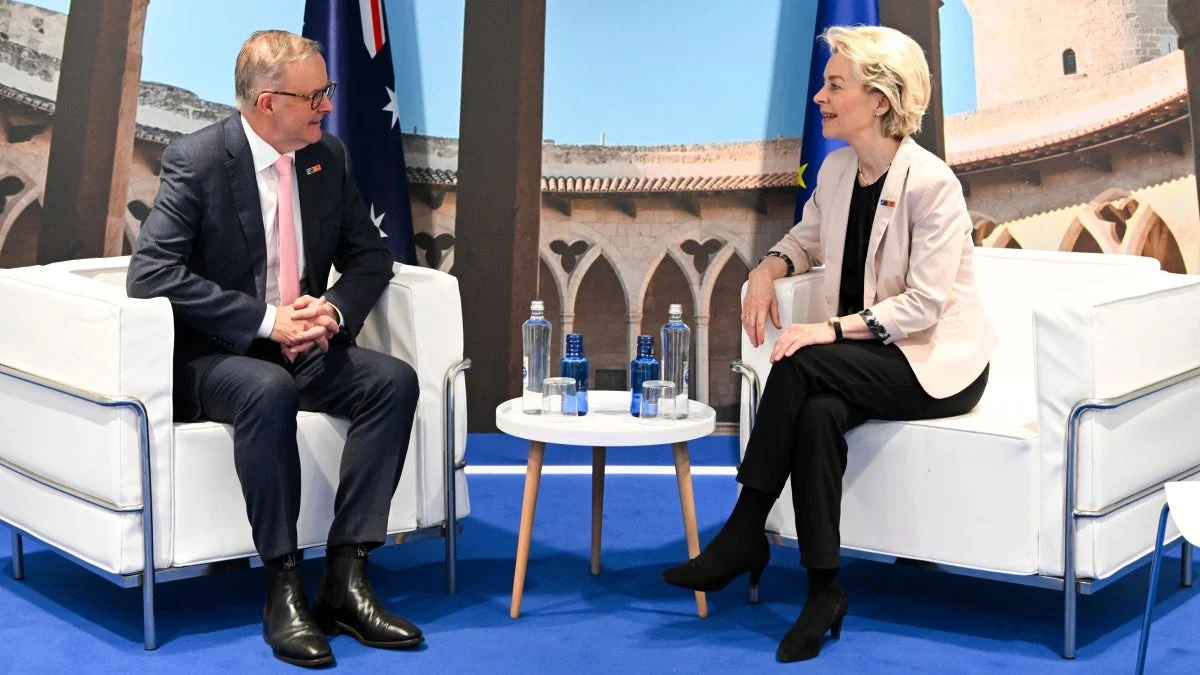
European Union and Australia to Formalize Free Trade Agreement Amid Growing Calls for Stronger Commitment to International Human Rights Standards
European Commission President Ursula von der Leyen and Trade Commissioner Maros Sefcovic are scheduled to arrive in Canberra this week to finalize and sign a landmark free trade agreement (FTA) with Australia, marking a significant milestone in the bilateral relationship between the two jurisdictions. The visit, which comes after years of protracted negotiations and a high-profile collapse of talks in late 2023, signals a strategic pivot by both the European Union and the Australian government to diversify their economic partnerships in an increasingly volatile global landscape. This agreement represents the EU’s third major trade success of the year, following recently concluded pacts with the Mercosur bloc and India, as Brussels continues an aggressive push to secure supply chains and expand market access for its member states.
The signing of the EU-Australia FTA is expected to provide a comprehensive framework for cooperation across various sectors, including digital trade, services, and, most critically, the supply of raw materials. However, the diplomatic achievement is being met with scrutiny from international observers and human rights organizations. Critics argue that while the EU and Australia are intensifying their economic integration, their practical defense of the international rules-based order—the very foundation upon which these treaties are built—has become increasingly inconsistent. The visit occurs against a backdrop of internal EU debates regarding "interest-driven" foreign policy and external pressures from the shifting political climate in the United States and the economic dominance of China.
Historical Context and the Road to Canberra
The journey toward a comprehensive free trade agreement between the European Union and Australia has been characterized by significant hurdles and strategic recalibrations. Negotiations formally began in 2018, with both parties recognizing the potential for a deal to eliminate tariffs on over 90% of traded goods. However, the process hit a major roadblock in October 2023 during the G7 trade ministers’ meeting in Osaka, Japan. At that time, Australian Trade Minister Don Farrell and his EU counterparts failed to reach an agreement, primarily due to disputes over market access for Australian agricultural products, such as beef, sheep meat, and sugar, as well as the EU’s insistence on protecting geographical indications (GIs) for products like prosecco and feta.
The stalemate lasted for several months, with Canberra signaling that it was prepared to walk away from the deal if it did not meet the interests of its domestic producers. The breakthrough that led to this week’s signing ceremony in Canberra is the result of renewed diplomatic efforts and a shared recognition of the geopolitical necessity of the partnership. For the EU, Australia is a vital source of critical minerals—including lithium, cobalt, and rare earth elements—which are essential for Europe’s "Green Deal" and its transition to a carbon-neutral economy. For Australia, the EU represents a high-value market of 450 million consumers, offering a crucial alternative to its heavy economic reliance on China.
Economic Data and Trade Significance
The economic stakes of the new agreement are substantial. Prior to the formalization of the FTA, the EU already ranked as Australia’s third-largest trading partner and its second-largest source of foreign investment. According to data from the European Commission, bilateral trade in goods between the two regions reached approximately €56 billion in 2023, while trade in services accounted for an additional €30 billion.
The FTA is projected to increase trade in goods by up to 33% and services by up to 14%. Key provisions of the deal include:
- Tariff Elimination: The removal of customs duties on the vast majority of Australian exports to the EU, including industrial products and minerals.
- Agricultural Quotas: A compromise on market access for Australian agricultural goods, providing increased quotas for beef and dairy while respecting EU sensitivities.
- Critical Minerals: A dedicated chapter on energy and raw materials designed to ensure non-discriminatory access for EU companies to Australia’s mineral wealth.
- Digital Trade: New rules to facilitate cross-border data flows and reduce "red tape" for digital service providers.
This agreement follows Australia’s recent conclusion of a Comprehensive Economic Partnership Agreement (CEPA) with the United Arab Emirates and ongoing efforts to deepen ties with India. For the EU, the deal complements its strategy of "de-risking" from China by building a network of "like-minded" partners across the Indo-Pacific.
The Debate Over "Interest-Driven" Foreign Policy
Despite the economic promise of the FTA, the visit of President von der Leyen has reignited a debate over the ethical direction of European and Australian foreign policy. Recently, von der Leyen faced significant internal and external criticism following a speech in which she suggested that the European Union can no longer act merely as a "custodian for the old-world order." She advocated for a "more realistic and interest-driven foreign policy," a statement that many interpreted as a signal that the EU might prioritize economic and security interests over the promotion of international law and human rights.
While von der Leyen later sought to clarify her remarks, reaffirming the EU’s "unwavering support" for the rules-based order, human rights advocates point to a growing gap between rhetoric and action. Both the EU and Australia have been accused of maintaining "double standards" in their application of international law. For instance, while both have been vocal in their condemnation of Russia’s invasion of Ukraine, their responses to other global crises have been described as "lukewarm."
Organizations such as Human Rights Watch have highlighted that the pursuit of trade deals with countries like Vietnam and India has often resulted in the overlooking of domestic repression and labor rights violations. Critics argue that by rewarding "low-rights" economic models, the EU and Australia are inadvertently contributing to the erosion of global standards.
Human Rights and Migration Policies
A central point of contention for both jurisdictions is the implementation of migration policies that have been described by legal experts as abusive. The EU’s migration management strategies, which involve partnerships with third countries to prevent arrivals, have faced legal challenges and moral condemnation. Similarly, Australia’s history of offshore detention and its "Sovereign Borders" policy continue to be points of friction with international human rights bodies.
In the context of the new trade agreement, there are calls for both parties to use their economic leverage to advance rights and environmental protections. In Australia, parliamentary recommendations have urged the government to integrate human rights due diligence into its trade framework. In the EU, there is pressure on the Commission to reverse recent deregulation efforts that critics claim have weakened corporate accountability laws.
The situation in the Middle East has also become a focal point for those criticizing the "one-sided" approach of Western powers. There is an increasing demand for the EU and Australia to uphold international law by banning trade with illegal Israeli settlements, following advisory opinions from the International Court of Justice (ICJ). The failure to apply consistent pressure across different geopolitical theaters is seen by many as a threat to the credibility of the international legal system.
Chronology of Key Events Leading to the Canberra Signing
- June 2018: Formal launch of EU-Australia FTA negotiations.
- September 2021: Relations strained following the AUKUS submarine announcement; France briefly recalls ambassadors, slowing trade talks.
- May 2022: Election of the Albanese government in Australia leads to a "reset" in diplomatic relations and renewed momentum for the FTA.
- October 2023: Negotiations collapse in Osaka due to disagreements over agricultural market access and geographical indications.
- January 2024: High-level technical meetings resume to find a middle ground on sensitive agricultural sectors.
- March 2024: EU concludes trade deals with Mercosur and India, increasing pressure on Australia to finalize its own agreement.
- July 2024: ICJ issues advisory opinion on the illegality of settlements, prompting calls for trade restrictions.
- Present: President von der Leyen and Commissioner Sefcovic arrive in Canberra to sign the final treaty.
Official Responses and Strategic Implications
The Australian government, led by Prime Minister Anthony Albanese, has hailed the visit as a "new chapter" in the nation’s economic history. In a preliminary statement, Minister for Trade Don Farrell noted that the agreement would "guarantee Australia’s place in the global supply chain of the future" and provide "unprecedented opportunities for Australian businesses to expand into the heart of Europe."
From the European perspective, the deal is a cornerstone of the "Global Gateway" strategy. A spokesperson for the European Commission stated that the FTA is "not just about trade, but about building a strategic alliance with a partner that shares our values and our vision for a stable Indo-Pacific."
However, the broader impact of this agreement will likely be measured by more than just trade volumes. As global uncertainties rise—fueled by potential shifts in US policy under a second Trump administration and the systemic rivalry with China—the EU and Australia find themselves at a crossroads. They are attempting to balance the immediate need for economic security and resource acquisition with the long-term necessity of maintaining a world governed by laws rather than raw power.
The upcoming signing ceremony in Canberra is a testament to the pragmatism of modern diplomacy. Yet, the true test of the "shared commitment" frequently cited by von der Leyen and Albanese will be whether these economic ties are used to strengthen the international human rights pillar or if they represent a retreat into a more transactional and fragmented world order. As the EU and Australia formalize their partnership, the international community will be watching to see if their actions in the realms of migration, corporate accountability, and international law finally align with their diplomatic rhetoric.

Related Posts

Human Rights Watch Calls for Investigation into Death of Detainee Following Removal from Najaf Hospital by Iraqi Drug Police

Human Rights Watch Urges UN Security Council to Extend Lebanon Peacekeeping Mission Amid Escalating Conflict and Humanitarian Crisis