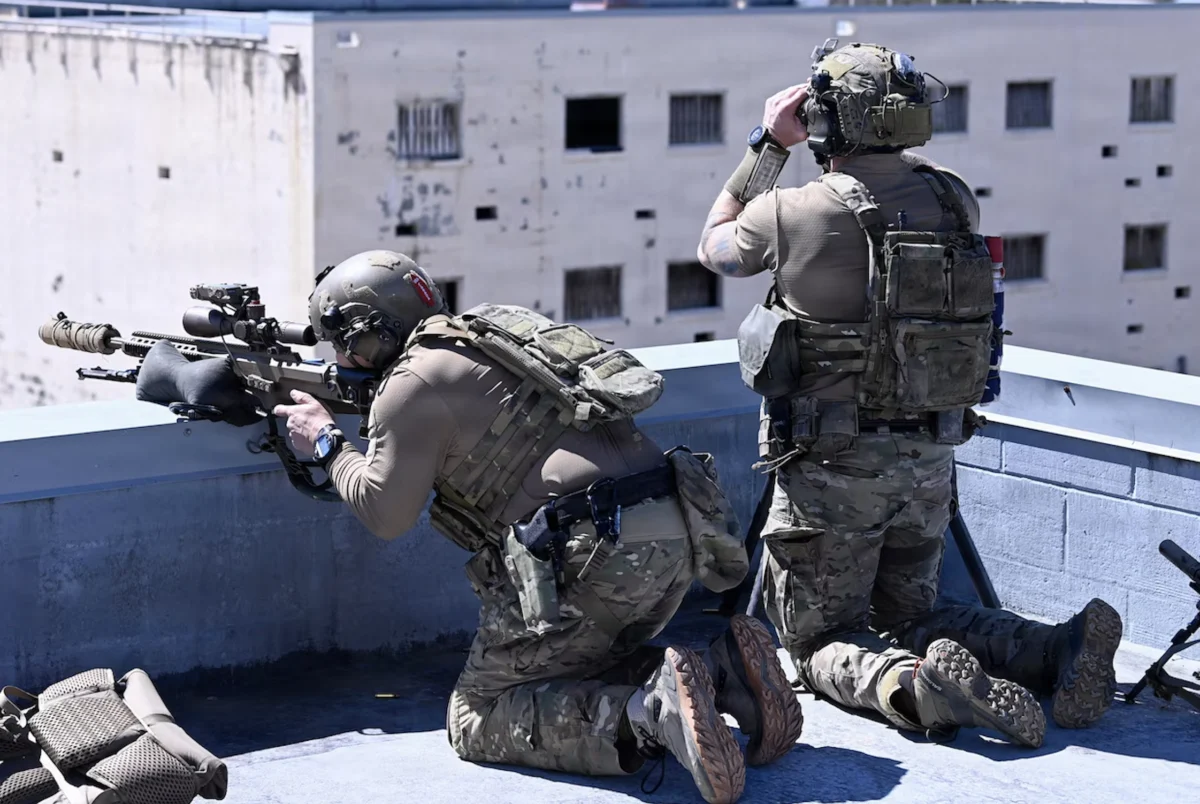
Elite Marksmen Converge at Fort Bragg for the 17th Annual US Army Special Operations Command International Sniper Competition
The United States Army Special Operations Command (USASOC) concluded its 17th annual International Sniper Competition this month, a grueling five-day gauntlet held at Fort Bragg, North Carolina, that gathered the most proficient long-range marksmen from across the globe. From March 15 to March 19, 2026, seventeen elite two-man teams representing a diverse array of domestic special operations units and international partner nations underwent a series of tests designed to push the limits of their physical endurance, mental fortitude, and technical precision. The event serves not only as a contest of skill but as a critical venue for the exchange of tactics, techniques, and procedures (TTPs) among the world’s most specialized combat units.
Tournament Results and Top Performers
As the final scores were tallied following the conclusion of the event on March 19, the host organization emerged victorious. The USASOC team secured the first-place trophy, demonstrating a mastery of the complex variables presented throughout the week. They were followed closely by the team from the Army’s 3rd Special Forces Group (Airborne), also based at Fort Bragg, which took second place.
The narrow margins between the top finishers underscored the high level of parity among the competitors. Participants were drawn from the highest tiers of the military hierarchy, including the Army’s Green Berets and 75th Ranger Regiment, Naval Special Warfare Command (SEALs), Marine Forces Special Operations Command (MARSOC), and specialized units from the U.S. Coast Guard. The international contingent included elite operators from several allied nations, reflecting the global nature of modern special operations and the shared commitment to maintaining a competitive edge in precision fires.
The Rigorous Five-Day Schedule and Chronology
The competition was structured to simulate the unpredictable and high-stakes environment of modern unconventional warfare. The timeline of the event was meticulously planned by the U.S. Army John F. Kennedy Special Warfare Center and School (USAJFKSWCS) to ensure that every facet of the sniper’s craft was evaluated.
- Days 1 and 2: Precision and Stability: The opening stages of the competition focused on fundamental marksmanship and the ability to engage targets at known and unknown distances. Teams were required to navigate various shooting platforms, including rooftops and simulated urban environments, to engage targets with surgical accuracy.
- Day 3: Stress Shoots and Physical Endurance: Mid-week, the intensity shifted toward physical exertion. Competitors were subjected to "stress shoots," where they were required to perform strenuous physical tasks—such as carrying heavy equipment or sprinting between stations—to elevate their heart rates before attempting to stabilize for a long-range shot.
- Day 4: Night Operations and Low-Light Engagements: As the sun set, the challenge transitioned to night operations. Utilizing advanced night vision and thermal optics, teams navigated the darkness to identify and neutralize targets, testing their ability to operate in the "second half of the day" where special operations forces often hold a strategic advantage.
- Day 5: Final Evaluation and Awards: The concluding day featured a series of complex "run-and-gun" scenarios that integrated all previously tested skills. The event culminated in a formal closing ceremony where the winners were recognized for their exceptional performance.
Technical Mastery and Ballistic Challenges
The technical requirements of the competition were formidable. Two-person teams—consisting of a shooter and a spotter—engaged targets at distances ranging from point-blank to 1,200 meters. To put this in perspective, 1,200 meters is nearly three-quarters of a mile, a distance where environmental factors such as humidity, air density, and the rotation of the earth (the Coriolis effect) can significantly alter a bullet’s flight path.
Competitors were required to be proficient in a wide array of weaponry. While the primary focus remained on precision bolt-action and semi-automatic sniper rifles, teams also had to demonstrate lethality with carbines and sidearms. This multi-weapon requirement reflects the reality of modern special operations, where snipers must often transition from long-range overwatch to close-quarters combat during the same mission.
The environmental conditions at Fort Bragg during the third week of March added an extra layer of difficulty. The region’s notorious "Sandhills" weather brought a combination of biting cold, intermittent heavy rain, and shifting wind gusts. These factors did not merely act as inconveniences; they were integral components of the test. Wind, in particular, is the sniper’s greatest adversary, requiring constant communication between the spotter and the shooter to adjust "hold-overs" or "dial-in" corrections on the rifle’s telescopic sights.
The Critical Role of Team Communication
A recurring theme throughout the competition was the necessity of seamless communication between the two team members. In the world of elite sniping, the shooter is only as effective as the data provided by the spotter.
“The weather played a significant role,” noted Timothy Gozelski, a sniper course instructor, during a post-event briefing. “Being in sync with your teammate is equal in importance to communication. To be successful, the two have to talk and be on the same page in everything they do.”
This sentiment was echoed by Richard Cuza, another instructor involved in the design of the courses. He emphasized that under the duress of competition and harsh weather, the ability to transmit clear, concise, and accurate information is what separates the podium finishers from the rest of the pack. The "spotter-shooter" relationship is a partnership built on years of shared training, and the competition at Fort Bragg is designed to stress that bond to its breaking point.
The Educational Foundation: USAJFKSWCS
The competition is hosted annually by the U.S. Army John F. Kennedy Special Warfare Center and School, which serves as the "University of Special Warfare." The school is responsible for the training and education of Special Forces, Civil Affairs, and Psychological Operations soldiers.
The instructors from the Special Forces Sniper Course (SFSC) are the architects of the event. These individuals are among the most experienced snipers in the military, and they utilize the competition to validate the curriculum they teach to the next generation of operators. By observing how the world’s best snipers handle specific challenges, the school can adapt its training programs to meet emerging threats and incorporate new technologies.
Technological Evolution and Historical Context
Now in its 17th year, the International Sniper Competition has witnessed a massive evolution in the technology used by marksmen. When the competition began, snipers relied heavily on manual calculations and fixed-power optics. Today, the field is dominated by ballistic computers, laser rangefinders with integrated atmospheric sensors, and high-definition variable-power scopes.
The 2026 event showcased the latest in "smart" optics and signature reduction technology. As thermal imaging becomes more prevalent among near-peer adversaries, the ability of a sniper team to remain undetected—both visually and thermally—has become a primary focus of the competition’s "stalking" lanes. In these exercises, teams must move through dense terrain to get within range of an observer without being spotted, a task that requires immense patience and specialized camouflage techniques.
Strategic Implications for Joint Force Readiness
Beyond the trophies and bragging rights, the USASOC International Sniper Competition has profound implications for global security and joint force readiness. In an era of Great Power Competition, the role of the sniper has shifted from a purely tactical asset to a strategic one. A single sniper team can provide reconnaissance, direct precision air strikes, and eliminate high-value targets, often providing a disproportionate impact on the battlefield relative to their small footprint.
Army Col. Simon Powelson highlighted the pedigree of the participants, stating, “This competition represents the pinnacle of the sniper craft. These competitors are not just here by chance; they are the product of intense and specialized training within their respective units.”
The presence of international partners is particularly significant. By competing alongside allies from Europe, Asia, and other regions, the U.S. military fosters interoperability. In a future conflict, it is highly likely that U.S. snipers will be operating in the same battlespace as their international counterparts. Establishing common standards and building professional relationships at events like this ensures that these forces can work together effectively when called upon.
Analysis of the Competitive Landscape
The victory by the USASOC and 3rd Special Forces Group teams suggests a continued period of dominance for the Army’s specialized marksmanship programs. However, the participation of the Coast Guard and Marine Corps units indicates a growing emphasis on precision fires across all branches of the U.S. military, including those traditionally focused on maritime or littoral environments.
The inclusion of the Coast Guard is a reminder of the evolving mission set of the service, which includes high-stakes counter-narcotics and counter-terrorism operations where snipers are used to disable the engines of fleeing vessels from helicopters—a skill set that requires extreme precision under intense vibration and movement.
As the 17th International Sniper Competition concludes, the lessons learned at Fort Bragg will be disseminated throughout the special operations community. The data collected on weapon performance, optic reliability, and tactical execution will inform procurement decisions and training doctrine for years to come. For the seventeen teams that competed, the event was more than a contest; it was a validation of their status as the "silent professionals" who stand at the tip of the spear in global defense.

Related Posts
Pentagon Forges Landmark Seven-Year Agreements with Boeing and RTX to Accelerate Standard Missile-3 Production and Stabilize Defense Supply Chains
Boeing Unveils Ultra Low-Cost Seeker to Enhance Missile Inventory and Combat Cost Challenges in Modern Warfare