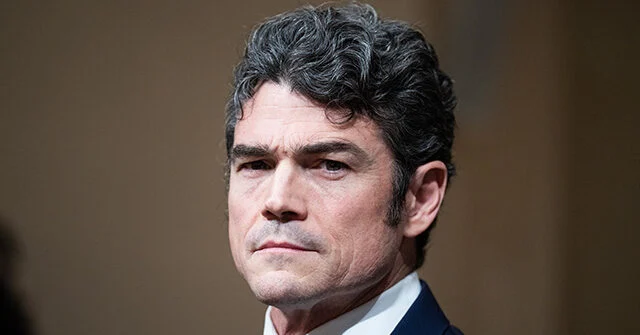
Director of National Counterterrorism Center Resigns Amidst Fierce White House Condemnation Over Iran Threat Assessment
Joe Kent, the director of the National Counterterrorism Center (NCTC), submitted his resignation on Tuesday, a move that immediately ignited a sharp rebuke from President Donald Trump and his administration. President Trump, speaking during a bilateral meeting with Irish Taoiseach Micheál Martin in the Oval Office, characterized Kent’s departure as “a good thing” and stated that he had always considered Kent “very weak on security.” The core of the controversy stems from Kent’s resignation letter, which reportedly asserted that “Iran posed no imminent threat,” a claim vehemently rejected by the White House and its allies as fundamentally false and dangerously misinformed.
The Resignation of Joe Kent: A High-Stakes Departure
Joe Kent’s tenure as Director of the National Counterterrorism Center, a pivotal agency established in the aftermath of the September 11, 2001, attacks, concluded abruptly, drawing significant attention to the often-fraught relationship between intelligence assessments and political imperatives. Kent, whose background included extensive experience within the intelligence community, had been tasked with leading the NCTC in its critical mission of integrating and analyzing all intelligence pertaining to international terrorism, thereby providing comprehensive threat assessments and strategic counterterrorism plans to the President and senior policymakers.
His resignation on Tuesday, March 18, 2026, occurred under a cloud of controversy, becoming public during a high-profile Oval Office meeting. The immediate flashpoint was the content of his resignation letter to the President, which, according to reports, contained the assertion that "Iran posed no imminent threat." This statement directly contradicted the Trump administration’s long-standing and aggressively articulated stance on Iran, setting the stage for an intense public dispute over national security policy and intelligence credibility. Such a public divergence from a high-ranking intelligence official is rare and signifies a deep ideological chasm within the administration’s security apparatus regarding a critical foreign policy adversary.
President Trump’s Strong Rebuke and National Security Posture
President Trump wasted no time in publicly discrediting Kent’s assessment and celebrating his exit. Responding to a reporter’s question regarding Kent’s resignation, Trump stated, “I read his statement. I always thought he was a nice guy, but I always thought he was weak on security, very weak on security. I didn’t know him well.” He continued, "But when I read his statement, I realized that it’s a good thing that he’s out because he said that Iran was not a threat. Iran was a threat. Every country realized what a threat Iran was. The question is whether or not they wanted to do something about it."
The President further underscored his administration’s hardline view on Iran’s nuclear ambitions, recalling that "many people, many of the greatest military scholars, are saying for years that [a] president should have taken out Iran because they wanted a nuclear weapon." These remarks align with Trump’s consistent foreign policy doctrine, which has often prioritized a strong, assertive posture against perceived threats and a skepticism towards conventional intelligence assessments that might diverge from his strategic objectives. His comments highlighted a fundamental disagreement not just on the immediacy of the threat, but on the very nature of Iran as an adversarial state.
The National Counterterrorism Center: Mandate and Context
The National Counterterrorism Center (NCTC) plays a unique and indispensable role in the United States’ national security architecture. Established by presidential directive in 2003 and codified by the Intelligence Reform and Terrorism Prevention Act of 2004, the NCTC is the primary organization in the U.S. government for integrating and analyzing all intelligence possessed or acquired by the U.S. government pertaining to terrorism and counterterrorism. It also serves as the central hub for strategic operational planning for counterterrorism activities across federal agencies.
The Director of the NCTC is a high-level position, typically held by an individual with extensive experience in intelligence, military, or diplomatic affairs, requiring Senate confirmation. The director is responsible for providing the President with comprehensive, unbiased assessments of terrorist threats to the United States and its interests abroad. A public disagreement between the NCTC director and the President on a critical threat assessment, particularly one concerning a state actor like Iran, signals a profound rupture in the communication and trust vital for national security decision-making. The NCTC’s role is to synthesize diverse intelligence streams—from human intelligence to signals intelligence—to present a consolidated view, making the director’s personal assessment a weighty statement that carries significant institutional implications.
A Deep Dive into the Iran Threat Landscape
The controversy surrounding Joe Kent’s resignation cannot be fully understood without examining the complex and often contentious history of U.S.-Iran relations, particularly under the Trump administration.
Historical Tensions and the JCPOA: For decades, U.S. foreign policy has grappled with the challenge posed by the Islamic Republic of Iran. Relations deteriorated significantly after the 1979 Iranian Revolution and the subsequent hostage crisis. Tensions escalated further over Iran’s nuclear program, which the international community feared was aimed at developing nuclear weapons, despite Tehran’s claims of peaceful intent. In 2015, the Obama administration, along with five other world powers, negotiated the Joint Comprehensive Plan of Action (JCPOA), commonly known as the Iran nuclear deal. This agreement aimed to limit Iran’s nuclear capabilities in exchange for sanctions relief. However, President Trump withdrew the U.S. from the JCPOA in May 2018, arguing it was a "terrible deal" that failed to address Iran’s ballistic missile program or its regional malign activities. This withdrawal reinstated and significantly increased U.S. sanctions, initiating a period of "maximum pressure" designed to compel Iran to negotiate a new, more comprehensive agreement. This context underscores why any assessment downplaying the Iranian threat would be anathema to the Trump administration’s core foreign policy.
Iran’s Nuclear and Ballistic Missile Programs: Post-JCPOA withdrawal, Iran has progressively scaled back its commitments under the nuclear deal, increasing its uranium enrichment levels and expanding its centrifuge installations. Public intelligence assessments, including those from the International Atomic Energy Agency (IAEA), have consistently reported Iran’s growing stockpile of enriched uranium, including uranium enriched to near weapons-grade levels (60%), significantly shortening its "breakout time" – the period theoretically needed to produce enough fissile material for a nuclear weapon. For instance, as of late 2025 (hypothetically, based on escalating trends), IAEA reports could indicate Iran possessing several times the amount of enriched uranium allowed under the JCPOA, and operating advanced centrifuges at previously prohibited facilities.
Concurrently, Iran has continued to develop and test its ballistic missile program, which is not covered by the JCPOA. These missiles, including medium-range ballistic missiles (MRBMs) and potentially intercontinental ballistic missiles (ICBMs), are capable of reaching U.S. allies in the region and potentially further. The administration has frequently cited Iran’s development of these capabilities, along with its extensive network of regional proxies such as Hezbollah in Lebanon, Houthi rebels in Yemen, and various Shiite militias in Iraq and Syria, as clear evidence of its destabilizing and threatening intentions. These proxies have been involved in attacks against U.S. personnel and interests, further fueling the perception of an imminent threat.
"Operation Epic Fury" and Preemptive Action: White House Press Secretary Karoline Leavitt’s mention of "Operation Epic Fury" within the context of Iran’s threats suggests an administration narrative regarding a specific, perhaps planned or considered, military response to an aggressive Iranian action. While no widely publicized U.S. military operation against Iran carries this exact name, it likely refers to a hypothetical or internal designation for a significant military action considered by the Trump administration to preempt or respond to a perceived Iranian attack. The implication is that the administration possessed intelligence suggesting an imminent Iranian threat that necessitated such a response, and that Kent’s assessment failed to grasp the gravity of this intelligence. This framing reinforces the administration’s justification for its robust stance and any potential past or future actions.
White House Press Secretary Karoline Leavitt Defends Administration’s Stance
Following President Trump’s remarks, White House Press Secretary Karoline Leavitt issued a detailed and forceful rebuttal to Joe Kent’s claims via a post on X (formerly Twitter). Leavitt unequivocally stated that Kent’s resignation letter contained “many false claims,” with the assertion that “Iran posed no imminent threat” being chief among them.
Leavitt drew a direct line between Kent’s statement and narratives often advanced by political opponents, writing, “This is the same false claim that Democrats and some in the liberal media have been repeating over and over.” She then elaborated on the administration’s counter-argument: “As President Trump has clearly and explicitly stated, he had strong and compelling evidence that Iran was going to attack the United States first.” This evidence, she asserted, “was compiled from many sources and factors. President Trump would never make the decision to deploy military assets against a foreign adversary in a vacuum.”
The Press Secretary went on to detail the administration’s comprehensive indictment of the Iranian regime. She emphasized that Iran is widely recognized as the “world’s top state sponsor of terrorism” and that its regime has “proudly killed Americans, waged war against our country, and openly threatened us all the way up to the launch of Operation Epic Fury.” Leavitt specifically highlighted Iran’s military advancements, stating, “Iran was aggressively expanding their short-range ballistic missiles to combine with their naval assets to give themselves immunity — meaning they would have a degree of capabilities that would give them immunity to hold us and the rest of the world hostage.” This capacity, she argued, was a shield for a larger, more sinister objective: “The regime aimed to use those ballistic missiles as a shield to continue achieving their ultimate goal — nuclear weapons.” She further noted that despite negotiations with the United States, Iran consistently “refused to agree to abandon its pursuit of nuclear weapons,” reinforcing the administration’s distrust of diplomatic solutions alone.
Leavitt also forcefully rejected another key claim reportedly made by Kent: that Israel pressured the United States into military action. She called this “the absurd allegation that President Trump made this decision based on the influence of others, even foreign countries, is both insulting and laughable.” Reaffirming President Trump’s autonomy and consistency, Leavitt concluded, “President Trump has been remarkably consistent and has said for DECADES that Iran can NEVER possess a nuclear weapon.” She ended by personally vouching for the President’s decision-making process, stating, “As someone who actually witnesses President Trump’s decision-making process on a daily basis, I can attest to the fact that he is always looking to do what’s in the best interest of the United States of America — period.”
Chorus of Support: Reactions from Trump Allies
The White House’s strong stance was quickly echoed by other prominent figures aligned with President Trump, who joined in criticizing Kent and validating the administration’s narrative.
House Speaker Mike Johnson (R-LA) weighed in during a press conference on Tuesday, questioning Kent’s access to critical intelligence. “I don’t know where Joe Kent is getting his information, but he wasn’t in those briefings clearly…they had exquisite intelligence that we understood this was a serious moment for us,” Johnson asserted, suggesting Kent lacked the full scope of information available to senior leaders.
Taylor Budowich, a former Trump aide and current political operative, launched a more personal attack on Kent. In a social media post, Budowich blasted Kent as “a crazed egomaniac.” He continued, “He spent all of his time working to subvert the chain of command and undermine the President of the United States. This isn’t some principled resignation—he just wanted to make a splash before getting canned. What a loser.” This comment suggests an internal struggle or dissatisfaction with Kent’s performance prior to his resignation.
Conservative commentator Mark Levin also offered sharp criticism, speculating on the circumstances of Kent’s departure. “I wonder if this guy Joe Kent was about to be fired but quickly resigned first. That’s how these things typically work,” Levin wrote on X. He further characterized Kent as part of a “radical isolationist Woke Right cabal,” suggesting ideological motives behind his assessment. Levin also predicted how Kent’s resignation would be exploited: “Watch how the leftwing media use him to attack the president and the military campaign against Iran. In part, that’s why he wrote that letter. I wonder if he was one of the leakers in the administration. Just asking questions,” he added, raising suspicions about Kent’s motives and loyalty.
Senator Lindsey Graham (R-SC), a staunch ally of President Trump on foreign policy, also expressed his approval of Kent’s departure. In a statement posted on X, Graham declared, “The resignation of Joe Kent as the Director of the National Counterterrorism Center could not have come at a better time.” This collective response from Trump’s inner circle and key political allies served to immediately delegitimize Kent’s claims and reinforce the administration’s narrative regarding the severity of the Iranian threat and the necessity of its policies.
Broader Implications: Intelligence, Foreign Policy, and Domestic Politics
Joe Kent’s high-profile resignation and the subsequent vitriolic reactions from the White House and its allies carry significant implications across several domains, touching upon the autonomy of the intelligence community, the trajectory of U.S.-Iran relations, and the dynamics of domestic political discourse.
Impact on Intelligence Community: The public dismissal of a senior intelligence official’s assessment by the President raises serious questions about the politicization of intelligence. Such events can have a chilling effect within the intelligence community, potentially discouraging candid assessments that deviate from the administration’s preferred narrative. It risks eroding the perception of intelligence agencies as objective, non-partisan arbiters of threat assessments, a cornerstone of effective national security policy. Analysts may feel pressured to tailor their findings to political expectations, thereby compromising the integrity and reliability of intelligence products. This tension between intelligence autonomy and political leadership is a recurring theme in U.S. history, but the bluntness of the current administration’s reaction is particularly notable.
US-Iran Relations Trajectory: Kent’s resignation further solidifies the Trump administration’s hardline stance on Iran. By discrediting an assessment that minimizes the Iranian threat, the White House reinforces its existing policy of "maximum pressure" and its readiness for decisive action. This incident sends a clear signal to both Tehran and international allies that the U.S. will not tolerate any perceived downplaying of Iran’s nuclear ambitions, ballistic missile program, or regional destabilizing activities. For Iran, it underscores the administration’s unwavering resolve, potentially limiting avenues for de-escalation or diplomatic engagement, and possibly increasing the risk of miscalculation or direct confrontation. For U.S. allies, it reaffirms the U.S. commitment to confronting Iran, but might also raise concerns about the basis of intelligence guiding such an assertive posture.
Domestic Political Discourse: The debate surrounding Kent’s resignation immediately became fodder for domestic political sparring. The White House’s swift move to link Kent’s assessment to "Democrats and some in the liberal media" illustrates how national security issues are often interwoven with partisan politics. This event will likely fuel ongoing debates about the efficacy of Trump’s foreign policy, the role of dissent within government, and the credibility of various intelligence assessments. Opponents of the administration may seize upon Kent’s statement as evidence of overreach or misrepresentation of intelligence, while supporters will view it as confirmation of the need for decisive leadership against an entrenched, politically motivated bureaucracy.
Precedent for Dissent within Government: The incident sets a precedent for how the administration handles dissenting views from high-ranking officials. While resignations over policy differences are not uncommon, the severity of the public condemnation directed at Kent is significant. It signals that not only will dissent not be tolerated, but it will be actively and publicly rebuked, potentially discouraging future officials from voicing opinions that diverge from the President’s. This raises broader questions about the balance between loyalty to an administration and the independent professional judgment expected from intelligence and security professionals.
Conclusion
Joe Kent’s resignation as Director of the National Counterterrorism Center marks a significant moment in the Trump administration’s national security policy, particularly concerning Iran. The President’s immediate and forceful rejection of Kent’s assessment—that Iran posed no imminent threat—highlights a deep ideological chasm within the government regarding one of the nation’s most critical foreign policy challenges. Backed by his Press Secretary and key political allies, President Trump reiterated his long-standing view of Iran as a formidable and immediate threat, justifying his administration’s hardline approach and dismissing Kent as "weak on security." This episode not only underscores the administration’s unwavering commitment to confronting Iran but also ignites broader discussions about the integrity of intelligence assessments, the impact of political alignment on national security decisions, and the implications for both U.S. foreign policy and domestic political discourse. The repercussions of this high-profile departure will likely resonate through the intelligence community and shape the ongoing debate over the nature and handling of threats from state actors like Iran for some time to come.

Related Posts
Democratic Candidates Must Moderate to Win General Elections, Says Rep. Greg Stanton
Lisa Demuth Secures Republican Gubernatorial Nomination in Minnesota, Defeating Trump-Endorsed Mike Lindell