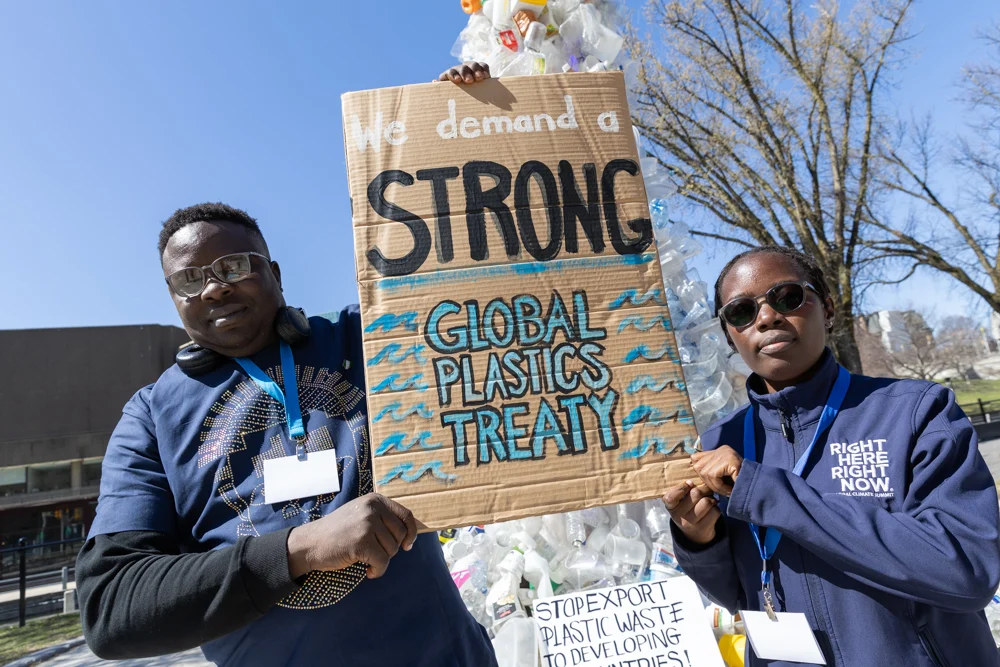
Deep divisions persist as plastics treaty talks restart at informal meeting
The United States government has issued a sharp rebuke against a coalition of European Union member states and Pacific island nations over their insistence on mandatory global caps for plastic production. This diplomatic friction comes at a critical juncture in the Intergovernmental Negotiating Committee (INC) sessions, where delegates from nearly 200 countries are attempting to finalize a first-of-its-kind legally binding international treaty to end plastic pollution. The disagreement underscores a fundamental rift between nations that view the crisis as a waste management failure and those that see it as an inevitable consequence of an oversupply of primary plastic polymers.
While the European Union and the High Ambition Coalition—led largely by Pacific island states like Fiji, Palau, and the Cook Islands—argue that the treaty must include a "north star" target to reduce the total volume of plastic entering the global economy, Washington has characterized such measures as overreach. US negotiators have expressed concerns that rigid production limits could destabilize global supply chains and infringe upon national sovereignty regarding industrial policy. This tension has cast a shadow over the proceedings, raising fears that the final agreement may be significantly watered down to accommodate major petrochemical producers.
The Evolution of the Global Plastic Treaty
The journey toward a global plastic treaty began in earnest in March 2022, when the United Nations Environment Assembly (UNEA-5.2) in Nairobi adopted a historic resolution titled "End Plastic Pollution: Towards an International Legally Binding Instrument." The resolution established the INC with the ambitious goal of completing negotiations by the end of 2024, a timeline that has since been extended as the complexity of the task became apparent.
From the first session in Punta del Este, Uruguay (INC-1), a clear ideological divide emerged. On one side, the "High Ambition Coalition to End Plastic Pollution," co-chaired by Norway and Rwanda, pushed for a comprehensive lifecycle approach. This approach targets everything from the extraction of raw materials (mostly fossil fuels) to the design, use, and disposal of plastic products. On the other side, a group of "Like-Minded Countries," including several major oil-producing nations, argued for a treaty focused strictly on downstream solutions, such as improving recycling infrastructure and waste collection.
The United States has historically occupied a middle ground, but its recent "hit out" against the EU and Pacific states suggests a hardening of its stance against supply-side interventions. By early 2026, as the world moved into what was intended to be the finalization phase, the US reaffirmed its preference for a "bottom-up" structure similar to the Paris Agreement on climate change. Under this model, countries would set their own national targets and action plans rather than adhering to a top-down global mandate on production volumes.
The Growing Plastic Crisis: Data and Projections
The urgency of the negotiations is fueled by increasingly dire environmental data. According to the Organisation for Economic Co-operation and Development (OECD), global plastic production has more than doubled since the turn of the century, reaching approximately 460 million tonnes per year. If current trends continue unabated, this figure is projected to triple by 2060.
Environmental scientists point out that the ecological cost is staggering. Approximately 11 million tonnes of plastic waste enter the oceans every year, a figure that could triple by 2040 without significant intervention. Furthermore, the lifecycle of plastic is deeply intertwined with the climate crisis. Over 99% of plastic is derived from fossil fuels, and the production process is highly energy-intensive. Research suggests that by 2050, the greenhouse gas emissions associated with plastic production, use, and disposal could account for 15% of the global carbon budget allowed under the 1.5°C goal of the Paris Agreement.

Recycling, once touted as the primary solution, has proven insufficient. Globally, only about 9% of plastic waste is successfully recycled, while 19% is incinerated and nearly 50% ends up in sanitary landfills. The remaining 22% is "mismanaged," meaning it is left in open dumps, burned in the open, or leaked into the environment. These statistics have emboldened the EU and Pacific states to argue that the world cannot "recycle its way out" of the problem; rather, the "tap" of production must be turned off.
Pacific Island States: A Fight for Survival
For Pacific island nations, the plastic treaty is not merely a matter of environmental policy but one of national survival. Despite contributing negligible amounts to global plastic production, these islands are on the front lines of the pollution crisis. Ocean currents carry vast quantities of marine debris to their shores, devastating local fisheries, tourism, and fragile coral reef ecosystems.
Representatives from the Pacific Small Island Developing States (PSIDS) have been among the most vocal advocates for a "40 by 40" target—a 40% reduction in primary plastic polymer production by 2040. They argue that without a reduction in the total volume of plastic produced, their waste management systems will remain perpetually overwhelmed.
"We are the world’s unintended landfill," a spokesperson for the Pacific Islands Forum stated during a recent plenary. "To ask us to manage this waste without stopping the flow at the source is like asking us to bail out the ocean with a teaspoon while the tide continues to rise."
The US pushback against these nations has been viewed by some activists as a betrayal of the "Blue Pacific" partnership, a diplomatic initiative intended to strengthen ties between Washington and the region. Critics argue that by prioritizing the interests of the domestic petrochemical industry, the US is undermining the environmental security of its Pacific allies.
The US Rationale and Economic Considerations
The US position is rooted in a complex mix of economic interests and a traditional preference for market-based solutions. The American petrochemical industry is one of the largest in the world, bolstered by the domestic shale gas boom. Major players in the sector have lobbied heavily against production caps, arguing that such measures would increase costs for consumers and hinder the development of essential products in sectors like healthcare, renewable energy, and food safety.
The US State Department has argued that a treaty focusing on production limits would be "unworkable" and would likely fail to gain the necessary domestic political support for ratification. Instead, Washington advocates for "circularity"—an economic model where plastic is kept in use for as long as possible through better design, reuse, and advanced recycling technologies.
"We share the goal of ending plastic pollution by 2040," a US official noted in a briefing following the latest round of disagreements. "However, we believe the most effective path is through innovation, improved waste management, and national flexibility. A global cap on production ignores the diverse economic realities of different nations and could lead to unintended consequences for global trade."

The European Union’s Middle Path and Diplomatic Friction
The European Union, which has already implemented some of the world’s strictest domestic plastic regulations, has sought to bridge the gap between the Pacific islands and the United States, though it remains firmly in the "High Ambition" camp. The EU’s proposal involves a global requirement for countries to report on their plastic production and a gradual phase-down of "problematic and avoidable" plastic products.
The recent friction arose when the EU supported a proposal to include "primary plastic polymers" within the scope of the treaty’s regulatory framework. The US, alongside other major producers, has sought to limit the treaty’s focus to "plastic products" and "plastic waste," excluding the raw chemical building blocks of plastic. This semantic distinction is a major battleground: if the treaty only regulates waste, it cannot legally mandate a reduction in how much new plastic is manufactured.
Broader Implications and the Path to a Final Agreement
The current impasse raises significant questions about the viability of a "legally binding" instrument. If the US and other major producers like China and Saudi Arabia refuse to sign a treaty that includes production caps, the agreement may become a "coalition of the willing" rather than a truly global framework. Conversely, if the treaty excludes production caps, it may be dismissed by the scientific community and environmental NGOs as a failure.
The implications of this standoff extend beyond the environment. The plastic treaty is seen as a test case for how the international community handles "lifecycle" environmental issues that intersect with powerful industrial interests. A weak treaty could set a precedent for future negotiations on chemicals, textiles, and electronics.
Furthermore, the tension highlights a growing divide in international diplomacy. The Pacific states, often grouped with the "Global South," are increasingly assertive in demanding "polluter pays" principles and accountability from the "Global North." The US opposition to their demands reflects a broader challenge in balancing domestic industrial stability with global environmental leadership.
Analysis: Can a Compromise be Reached?
As the 2026 deadline approaches, observers are looking for potential areas of compromise. One possibility is the inclusion of "voluntary global targets" combined with mandatory national reporting. This would allow the EU and Pacific states to claim a victory for production reduction while giving the US the flexibility it requires to avoid a rigid cap.
Another area of negotiation involves the financial mechanism of the treaty. Developing nations are demanding a dedicated fund to help them upgrade their waste infrastructure and transition to plastic alternatives. The US and EU have expressed openness to financial support but differ on how the fund should be structured and who should contribute.
The outcome of these negotiations will define the health of the world’s oceans and the trajectory of the petrochemical industry for decades to come. As the US hits out at its allies over production limits, the world watches to see if diplomacy can overcome the entrenched interests of one of the planet’s most pervasive industries. The "troubled negotiations" described by observers are a reflection of a world grappling with the reality that the convenience of plastic has come at a cost that the planet can no longer afford to pay.

Related Posts
Constitutional Court of South Africa Bars Shell Oil Exploration in Landmark Victory for Environmental and Community Rights

The Battle for Saldanha Bay: South Africa’s Ambitious Ocean Economy Strategy Faces Legal and Environmental Reckoning