
Argentina’s Inflation Could Match or Exceed 2025 Levels, Analysts Predict Amidst Economic Uncertainty
According to the Relevamiento de Expectativas de Mercado (REM), the most comprehensive local survey on economic projections conducted by the Central Bank (BCRA), inflation in Argentina could end the current year at levels equal to or even exceeding those of 2025. This projection casts a shadow of concern over the nation’s economic recovery efforts, even as the government expresses optimism about future stability. The latest REM report, which averages the forecasts of the most accurate forecasters, indicates an expected inflation rate of 31.8% for the year, a slight increase from the 31.5% recorded at the close of the previous year. This projected uptick is attributed to a sustained acceleration in price adjustments that has been observed for months, with analysts anticipating a peak in March, estimated to be between 3% and 3.1%. While a subsequent descent is expected in the coming months, inflation is not projected to fall below 2% until at least August or September, in the most optimistic scenarios.
March Inflation Data and Ministerial Outlook
The official inflation data for March is set to be released shortly, with private consulting firms anticipating a figure exceeding 3%. This sentiment was echoed by the Minister of Economy, Luis Caputo, who attributed the anticipated surge to a decline in money demand linked to the electoral process, a wave of dollarization, and the impact of the Middle East conflict. Despite this short-term inflationary pressure, Caputo projected a significant deceleration in inflation starting in April, coinciding with a recovery in economic activity. He boldly predicted that the upcoming 18 months would likely be the most prosperous for Argentina in decades, dismissing the notion of a trade-off between disinflation and growth and pledging a sustained inflationary slowdown from April onwards.
Minister Caputo Defends Economic Model Amidst Heterogeneous Realities

Minister of Economy Luis Caputo has been actively defending the government’s economic model, acknowledging that its impact is not uniform across all sectors of the economy. In a recent address to private sector leaders, he stated that "reality is heterogeneous" and that "not everyone reacts the same way to the same scenarios." This perspective was articulated at the AmCham Summit 2026, where he used the examples of companies Fate and Lumilagro to illustrate his point. Caputo argued that the current economic framework does not guarantee equal outcomes for all businesses but rather provides correct incentives for those willing to adapt. He emphasized that the difference in results lies in entrepreneurial decisions rather than the external economic environment. This stance seeks to address concerns from various industrial sectors that have voiced apprehension about the model’s impact on their operations.
Historical Context: Inflationary Trends in Argentina
To understand the current projections, it is crucial to examine Argentina’s historical inflation patterns. March has often been a month marked by inflationary pressures due to seasonal factors and the beginning of the academic year. In March 2025, the monthly inflation rate reached 3.7%, the last time it surpassed the 3% threshold. Following this peak, a process of disinflation ensued, bringing the monthly rate down to 1.5% by May of the same year. In early 2026, inflation rates for January and February stood at 2.9%. The current signs of acceleration in March 2026, therefore, are viewed with concern, particularly given the interplay of seasonal influences and global economic factors.
Analysis of March Inflationary Drivers
Recent data from the City of Buenos Aires provides an early indication of national trends. The Consumer Price Index (CPI) in the capital city accelerated to 3% in March, driven primarily by increases in sensitive sectors such as fuels, public utility tariffs (electricity and water), public transportation fares, and education. This figure represents a 0.4 percentage point increase compared to February’s 2.6% and brought the accumulated inflation for the first quarter of 2026 to 8.9%. The year-on-year inflation rate in Buenos Aires reached 32.1%.

Consulting firms have offered their projections for the national inflation figures. Empiria, through analyst Mateo Borenstein, forecasts an inflation rate close to 3.2%, with core inflation estimated around 2.3%. Lorenzo Sigaut Gravina of Equilibra anticipates the index to "start with 3%," propelled by seasonal increases in education and regulated prices like utilities and fuels, which have seen rises exceeding 6%.
Sebastián Menescaldi from EcoGo projects inflation near 3%, noting a shift in the primary drivers. "Unlike in previous months, food is not being the main driver," he stated, pointing instead to sectors such as transportation, communications, and clothing. Similarly, the consultancy LCG estimates a monthly variation between 2.8% and 2.9%, according to economist Melisa Sala.
The firm C&T Asesores Económicos estimated a monthly increase of 2.7% in the Greater Buenos Aires area, slightly above the regional 2.6% in February but below the national 2.9%. Their report indicates that education led the price increases with a 8.7% surge, a typical occurrence at the start of the academic year. Food and beverages, in contrast, saw a more moderate increase of 2.7% after experiencing rates around 4% for the preceding two months. Econviews, led by Miguel Kiguel, reported an increase of 3.4% in a basket of food and beverages during the four weeks leading up to March 27th.
Government Response and Economic Philosophy
President Javier Milei has recently taken to social media to defend his administration’s economic performance. Following a call for "patience" to normalize the economy, he asserted that it is "false that we are doing badly." He questioned whether the dollar would be rising uncontrollably if the country were truly in a dire economic state, referencing historical patterns. Both Milei and Minister Caputo have given numerous interviews in recent weeks to counter the perception of "social bad mood" identified by public opinion pollsters, aiming to dispute the narrative that the economy is performing poorly.
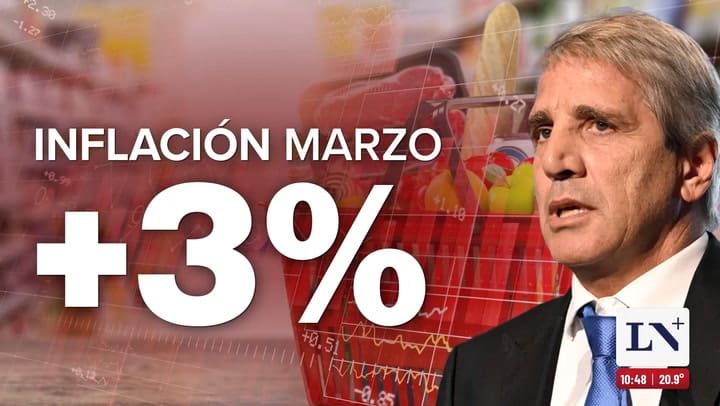
Minister Caputo, speaking at the presentation of a book by consultant Salvador Di Stefano in Rosario, justified the anticipated rise in inflation for March by citing the "shock" of oil prices due to the Middle East conflict and the typical seasonality of the month. He stated that the figure would "surely be above 3%," attributing the increase to factors such as oil-related price hikes affecting domestic flights and transportation, as well as education and seasonal effects. He also noted that the dollarization of the economy in the previous year, coupled with utility tariff increases exceeding general price levels since 2026, had also contributed to inflationary pressures.
Broader Economic Indicators and Concerns
Beyond inflation, other economic indicators present a complex picture. Data from the National Institute of Statistics and Censuses (Indec) reveals a concerning rise in labor informality. In the fourth quarter of 2025, the percentage of workers employed "off the books" reached 43% of the occupied population, up from 42% in the same period of 2024 and 41.4% at the time of Javier Milei’s inauguration. While the Indec survey covers 31 agglomerations representing 13.5 million employed individuals, the informality within these areas accounts for 5.8 million, a figure projected to reach 9 million when extrapolated to the entire population. This trend suggests a widening gap in formal employment and social security coverage.
The president of AmCham Argentina, Mariana Schoua, offered a pragmatic perspective at the AmCham Summit. She highlighted Argentina’s history of economic instability, noting 15 recessions in the last 70 years and a current poverty rate of around 35%. She also pointed out that Argentina exports only 14% of its GDP, significantly lower than comparable economies. Schoua argued that while fiscal deficit correction, inflation deceleration, and macroeconomic normalization are crucial achievements, they are "necessary but insufficient" conditions for sustained prosperity. Her assessment implies that deeper structural reforms and consistent policies are required to foster long-term economic growth and stability.
The projections for inflation in the current year, coupled with ongoing concerns about labor informality and the broader economic policy framework, indicate that Argentina faces a challenging path ahead. While the government expresses confidence in its strategy and anticipates a period of economic improvement, the data and analyses from independent economists and market observers suggest a need for continued vigilance and potential adjustments to navigate the complex economic landscape. The coming months will be critical in determining whether the projected disinflationary trend materializes and whether the Argentine economy can achieve a sustainable path toward growth and stability.

Related Posts

The Electric Vehicle Battery Health Debate Emerges as Argentina’s EV Market Accelerates

President Donald Trump Confirms Secret Departure from Turkey Amidst Assassination Threat