Mark Carney Deflects Blame on Canada Wildfire Failures: ‘Climate Change Is Everyone’s Responsibility’
Prime Minister Carney’s assertions, made during a press conference in Ontario, mark his first public comments since a torrent of outrage erupted in the United States, where millions of people were advised on Thursday to remain indoors to avoid severe health risks from inhaling Canadian wildfire smoke. Simultaneously, deep disillusionment regarding the Canadian government’s perceived inaction is reportedly intensifying among the First Nations communities most directly impacted by the infernos, some of which have seen their entire settlements reduced to ashes with minimal support from Ottawa. The crisis has exposed significant vulnerabilities in Canada’s national emergency response framework and ignited a fierce debate over forest management policies, governmental accountability, and international cooperation on environmental challenges.
Escalation of the Wildfire Crisis
The current wildfire season in Canada, particularly in Ontario, has escalated rapidly, demonstrating an intensity that has overwhelmed provincial resources and generated widespread alarm. By Wednesday evening, authorities in Ontario had documented 136 active wildfires across the province, many of which were burning out of control in remote northern regions. These fires have not only decimated vast tracts of forest but have also directly threatened and, in some cases, obliterated entire communities, with First Nations reserves bearing a disproportionate share of the destruction. The sheer scale and rapid progression of these blazes have been attributed by critics to a confluence of factors, including inadequate forest management practices and environmental conditions potentially exacerbated by a changing climate.
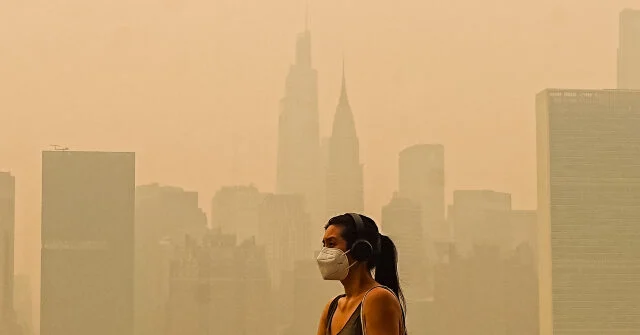
The immediate consequence of these widespread fires has been the unprecedented spread of dense, toxic smoke across vast distances. Beginning earlier in the week and peaking on Thursday, plumes of smoke, laden with particulate matter and harmful pollutants, drifted southwards, blanketing major metropolitan areas across the American Midwest and Northeast. Cities like New York, Chicago, and Detroit experienced air quality levels plummeting to hazardous categories, triggering public health alerts, school closures, and advisories for vulnerable populations to stay indoors. Millions of Americans found themselves grappling with an environmental crisis originating hundreds of miles away, transforming skylines into an apocalyptic haze and sparking a diplomatic firestorm.
A Deep Dive into Canada’s Forest Management and Fire History
Canada, home to some of the world’s most extensive boreal forests, has historically experienced regular summer fire seasons. For centuries, Indigenous communities practiced sophisticated, localized methods of forest management, including controlled burns and the strategic removal of dry, dead tree branches and other combustible material. These traditional practices served to reduce fuel loads, prevent mega-fires, and maintain ecological balance within the forest ecosystems. This intricate knowledge, passed down through generations, effectively managed the natural cycle of forest regeneration and fire prevention.
However, in the past decade, a significant shift in national policy has reportedly seen the Canadian government largely abandon comprehensive federal forest management. Critics, including organizations like the Fraser Institute, point to this policy vacuum as a primary factor contributing to the increased frequency, size, and intensity of recent wildfires. Without consistent, proactive fuel reduction strategies, such as thinning operations and prescribed burns, forests have become denser and accumulated vast amounts of dry biomass, transforming them into tinderboxes susceptible to uncontrollable blazes. The absence of robust federal oversight and investment in these preventative measures has meant that provinces are often left to manage increasingly complex and resource-intensive fire seasons largely on their own.
Further compounding this issue is Canada’s institutional framework for emergency response. Unlike the United States, which operates a robust federal emergency management agency like FEMA, Canada lacks a comparable national emergency response agency and a unified national fire authority. Public Safety Canada (PSC) plays a coordinating role, but the primary responsibility for wildfire suppression and emergency management largely rests with individual provinces and territories. This decentralized approach, while allowing for regional specificities, has been criticized for creating gaps in national coordination, resource allocation, and preparedness, especially when multiple provinces face severe fire events simultaneously. Experts argue that a more integrated federal approach, including dedicated funding, personnel, and equipment, is urgently needed to effectively combat the growing threat of large-scale wildfires. The current crisis has brought these systemic deficiencies into sharp relief, highlighting the urgent need for a national strategy that integrates prevention, response, and recovery efforts across all levels of government.
Mounting Criticism and Diplomatic Tensions
Prime Minister Carney’s response to the crisis has been met with significant domestic and international backlash. During his press conference, he doubled down on the Liberal Party’s established narrative, attributing the fires primarily to "climate change" and deflecting any suggestions that Canadian governmental inaction or policy failures were contributing factors. He specifically addressed the outrage emanating from the United States, shifting responsibility onto America’s alleged shortcomings in combating global warming.
"Now we’re focusing on investing in clean energy," Carney stated in French, "in the United States there’s prohibitions now against clean energy – for example, wind energy is one example." He continued, "Secondly, Canada is maintaining our efforts on the world’s scale and the U.S. is reducing their efforts globally [on climate change], so, yes, climate change is the responsibility of everyone… including the United States." Carney’s comments, however, lacked specific details on how the deployment of wind energy – which itself presents environmental concerns, such as threats to maritime life from massive offshore turbines – would directly mitigate active Canadian wildfires or prevent future blazes. Nor did he elaborate on the specific actions he expected the American government to undertake to fulfill its "responsibility" regarding "climate change" in a manner that would alleviate Canada’s immediate crisis. This rhetorical strategy, while consistent with his party’s messaging, did little to quell the mounting criticism or address the immediate concerns of those affected.
Domestically, the most poignant criticism has come from First Nations communities, many of whom have endured direct and devastating impacts from the fires. Leaders have lamented the profound lack of support from both provincial and federal governments for evacuation, temporary housing, and long-term recovery efforts. Helen Paavola, chief of the Namaygoosisagagun First Nation, voiced her despair to the Canadian newspaper Globe and Mail, stating, "We lost everything." Her entire community was consumed by flames on Monday. Chief Paavola recounted that her requests for evacuation assistance to the provincial Ministry of Natural Resources went unheeded before the fires engulfed the settlement, forcing residents to flee using small boats, paddling away from the advancing inferno. This stark account underscores a systemic failure in emergency preparedness and response for vulnerable populations.
The frustration extends beyond Indigenous communities to other Canadian officials. Lise Vaugeois, a lawmaker from the leftist New Democrat party, expressed her dismay to the Toronto Star, recalling, "Basically I got blown off by the Ministry of Emergency Preparedness, saying somebody in each municipality is in charge and go talk to them." This highlights the fragmented nature of Canada’s emergency response and the perceived bureaucratic hurdles facing those desperately seeking aid.
Across the border, U.S. lawmakers from states heavily impacted by the smoke have increasingly condemned Ottawa’s inaction and are reportedly planning legislative measures. Senator Bernie Moreno (R-OH), sharing graphic images of the smoke engulfing his state, announced on Thursday his intention to draft legislation to sanction Canada, labeling the situation an "atrocity."
A bipartisan group of Michigan Republican lawmakers – including Representatives Jack Bergman, John James, Lisa McClain, and John Moolenaar – previously published a scathing letter to Prime Minister Carney, demanding concrete action and lambasting the Canadian government for its perceived disregard of American pleas for proper forest management. Their letter conveyed a clear sense of betrayal and exasperation: "We were told last year that this would be treated with urgency. It was not," they wrote, recalling previous assurances. "We were told the causes, chronic under-investment in forest thinning, fuel reduction, and prescribed burns, along with inadequate enforcement against arson, were being addressed. They were not, or not adequately enough to matter to the people we represent." The lawmakers pressed Carney for specific details: "What funded, measurable steps has your government taken since last summer to reduce fuel loads and wildfire risk in the provinces responsible for the smoke reaching the American Midwest? What accountability exists for provincial leaders who treat this as someone else’s problem? And what will genuinely be different by this time next year, rather than another season of statements followed by the same result?" These pointed questions underscore the growing international impatience with Canada’s approach to its escalating wildfire problem.
Beyond the Flames: Environmental, Health, Economic, and Political Ripples
The ramifications of Canada’s escalating wildfire crisis extend far beyond the immediate destruction, creating environmental, public health, economic, and political ripples that will be felt for years. Environmentally, the fires release massive amounts of carbon dioxide and other greenhouse gases, contributing to global warming and creating a feedback loop that could exacerbate future fire seasons. The destruction of vast forest ecosystems also leads to significant biodiversity loss, impacting critical habitats for numerous species. Soil erosion, water contamination, and long-term changes to forest composition are additional ecological consequences that will require decades to recover.
From a public health perspective, the cross-border smoke pollution represents a significant crisis. Fine particulate matter (PM2.5) in wildfire smoke can penetrate deep into the lungs, causing acute respiratory problems, exacerbating conditions like asthma and chronic obstructive pulmonary disease (COPD), and increasing the risk of heart attacks and strokes. Vulnerable populations, including children, the elderly, and individuals with pre-existing health conditions, are particularly at risk. The strain on healthcare systems in affected regions, both in Canada and the U.S., during prolonged periods of poor air quality could be immense.
Economically, the costs are staggering. Beyond the direct expenses of firefighting and property damage, there are significant indirect costs. Businesses in affected areas may suffer from reduced productivity due to illness or closures. Tourism industries, particularly in regions known for their natural beauty, could face severe setbacks. The cost of long-term recovery and rebuilding efforts for destroyed communities, especially Indigenous ones lacking resources, will be substantial and prolonged.
Politically, the crisis poses significant challenges for Prime Minister Carney’s Liberal government. Domestically, the criticism from First Nations leaders and opposition lawmakers highlights a perceived failure in governance and emergency preparedness. The government’s consistent deflection of responsibility to "climate change" while allegedly neglecting proactive forest management strategies could erode public trust and have electoral consequences. Internationally, the diplomatic friction with the United States over cross-border pollution and Carney’s confrontational tone risks straining bilateral relations. While cooperation on climate change is often emphasized, the immediate crisis demands practical solutions and shared responsibility for mitigation and response, which Carney’s stance appears to undermine. The situation underscores the urgent need for Canada to re-evaluate its emergency response infrastructure, bolster its forest management policies, and potentially seek enhanced international cooperation to address what is increasingly becoming a shared continental challenge. The debate over climate change versus forest management is complex; while a warming climate can create conditions conducive to fires, effective land management remains a critical tool in mitigating their intensity and spread. The ongoing crisis serves as a stark reminder of the interconnectedness of environmental policy, public health, and international relations.

Related Posts
Democratic Candidates Must Moderate to Win General Elections, Says Rep. Greg Stanton

Lisa Demuth Secures Republican Gubernatorial Nomination in Minnesota, Defeating Trump-Endorsed Mike Lindell