Inside the Panopticon of Madison Square Garden: How James Dolan Built a Private Intelligence Agency
For years, visitors to Madison Square Garden, Radio City Music Hall, and the Sphere in Las Vegas have operated under the assumption that the venue’s security presence is limited to ticket verification and standard bag checks. However, internal reports, legal filings, and testimony from former employees reveal that MSG Entertainment has evolved into a sophisticated, quasi-governmental surveillance operation. Orchestrated by owner James Dolan and his security chief, John Eversole, this apparatus does not merely protect property; it tracks, catalogs, and blacklists individuals deemed threats to the organization’s reputation, ranging from political protesters and lawyers to private citizens who have never set foot in a Dolan-owned facility.

The Anatomy of the Surveillance State
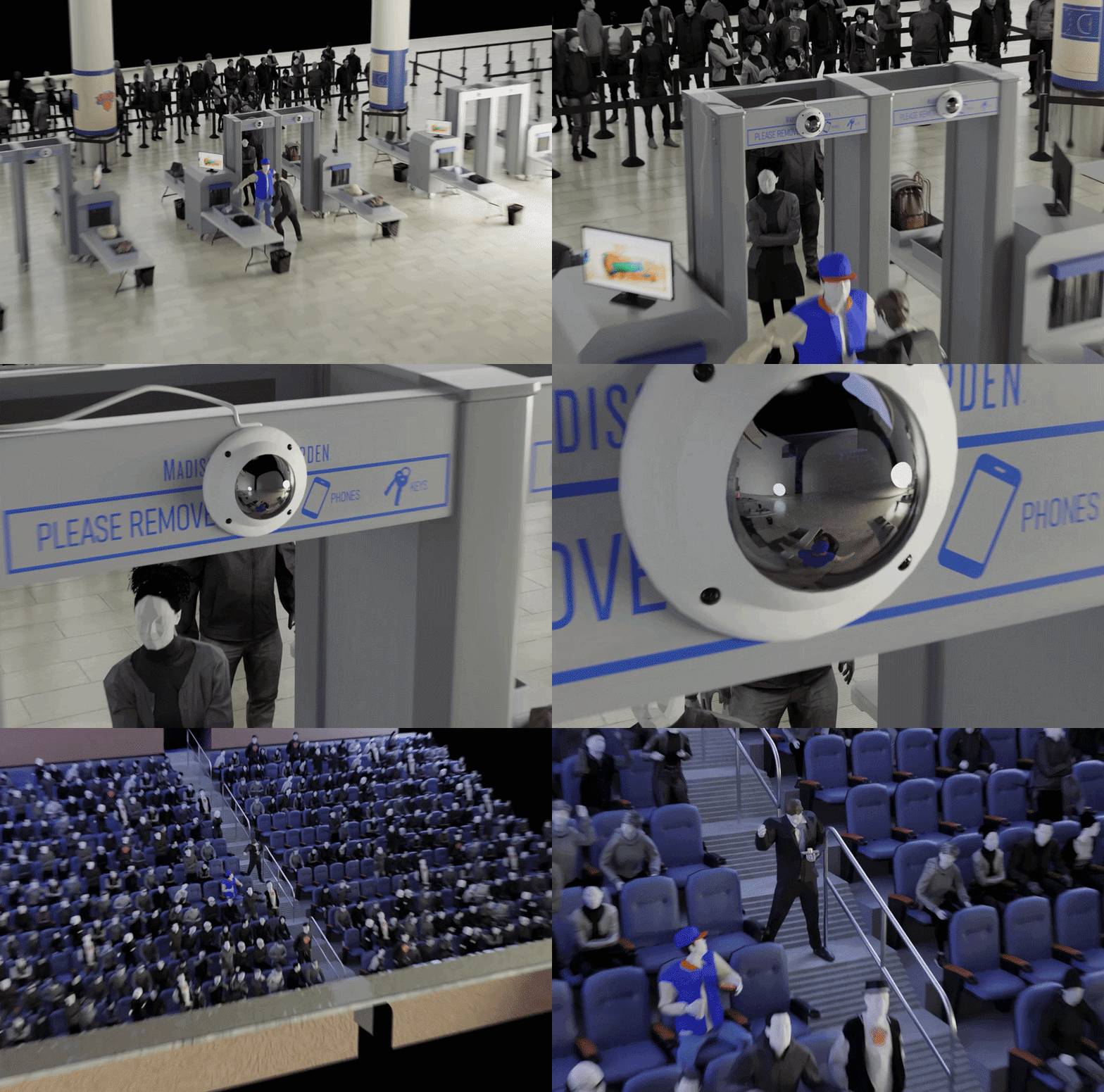
The foundation of this operation rests on advanced biometric data collection. Since at least 2018, MSG has integrated facial recognition technology into its entry systems. The deployment relies on Xtract One technology—specialized metal detectors equipped with high-resolution cameras that capture images of patrons "between the temples" to ensure a clear facial scan. This data is then processed through eConnect, a software platform originally designed for casino security, which creates "watch lists" of individuals.

According to former staff members, this is not a passive security measure. Instead, the security team—often referred to by insiders as the "Intel team"—conducts extensive open-source intelligence gathering, or "work-ups," on targeted individuals. This includes scouring social media for critical comments, scraping data from law enforcement databases, and even monitoring the personal lives of those who have challenged the company. The surveillance is often persistent, with logs detailing a person’s every movement within the arena, from bathroom visits to conversations with staff, down to the second.

Chronology of Control: From Paranoia to Policy
The culture of suspicion at Madison Square Garden has deep historical roots. As far back as 2001, reports emerged of staff fearing their office phones were bugged, a climate that has only intensified under Dolan’s leadership. The pivot toward aggressive, tech-enabled enforcement accelerated in 2018 with the hiring of John Eversole, a former Oracle senior director of global investigations.

Under Eversole, the security department shifted from reactive physical protection to proactive, and often controversial, surveillance. By 2021, as New York City emerged from the height of the Covid-19 pandemic, this apparatus was fully operational. A central target of this scrutiny was Nina Richards, a trans woman and frequent Knicks fan. Lawsuits filed by former employees, including Donnie Ingrasselino, allege that Richards was placed on a watchlist solely due to her gender identity, with Eversole allegedly ordering staff to monitor her movements to keep her away from team personnel. Despite Richards posing no security threat, the internal surveillance reports on her activities were exhaustive, documenting her social interactions and movements throughout the arena during pride-themed events.

The reach of this system expanded well beyond the arena floor. The company’s security arm has been accused of attempting to function as an unauthorized police force, monitoring protests in the surrounding Manhattan streets and, in one instance, allegedly dispatching investigators to follow a state liquor authority official to his home in Queens.
.JPG)
Data, Liability, and the "Lawyer Ban"
The most visible manifestation of this policy has been the systematic banning of attorneys whose firms are involved in litigation against MSG. Estimates suggest that between 900 and 1,500 lawyers have been placed on a "blacklist," preventing them from attending games or concerts. While some of these bans have been modified through legal intervention, the policy remains a cornerstone of the organization’s defensive litigation strategy.

The implications for data privacy are profound. While the company maintains that these technologies are standard tools for preventing mass-casualty events, privacy advocates and legal scholars argue that the "biometric drift net" is being used for corporate retribution. The integration of social media scraping—where images are pulled from Instagram or X (formerly Twitter) to populate internal databases—represents a significant expansion of the surveillance capitalism model. It effectively weaponizes a customer’s public digital footprint against them the moment they walk through a venue’s doors.

Official Responses and the Corporate Defense
MSG Entertainment has consistently rejected allegations of impropriety. In statements responding to reporting on these practices, company spokespeople have characterized the claims as "false, misleading, and unverified," often citing the nature of the lawsuits as the work of "rapacious litigators." In court filings, Garden attorneys have argued that the surveillance and intelligence-gathering methods employed are common practices for major corporations facing high-stakes security threats.

The company maintains that its security protocols are designed to ensure the safety of players, staff, and fans in an era where live venues are potential targets for violence. They argue that facial recognition is an essential component of modern venue management, comparing it to basic identity verification that has become ubiquitous in travel and finance.

Implications for the Sports and Entertainment Industry
The practices at Madison Square Garden are increasingly being viewed as a blueprint for the broader entertainment industry. As stadiums and arenas across the United States move toward "frictionless" entry—where fans pay for food and drinks with a facial scan—the amount of personal data being centralized by private entities is reaching unprecedented levels.

Industry experts note that the "Dolan model" of a private intelligence agency is becoming an attractive prospect for owners of major sports franchises who wish to insulate their organizations from public criticism and legal pressure. When private security forces are empowered to conduct electronic surveillance, monitor public protests, and influence local law enforcement, the boundary between corporate management and civil authority becomes increasingly blurred.

The case of MSG highlights a critical tension in 21st-century commerce: the trade-off between the desire for efficient, high-tech security and the preservation of individual privacy. For now, the Garden stands as a pioneer in this new landscape, demonstrating that with sufficient capital and a willingness to leverage advanced surveillance, a private entity can exercise a level of control that mirrors, and in some cases exceeds, the reach of public law enforcement. As other venues follow suit, the question remains whether the convenience of biometric entry is worth the surrender of one’s digital and physical anonymity.

Related Posts

Digital Trojan Horses: The Growing National Security Risk of Foreign Software in Military-Targeted Mobile Applications
ACLU of Massachusetts Launches Comprehensive Legal Toolkit to Combat Secret Police Surveillance Tactics