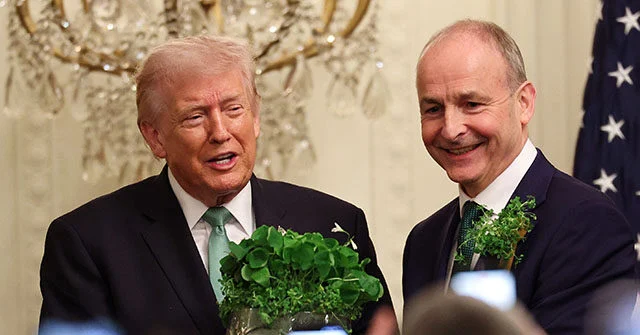
Irish Taoiseach Gives Trump Shamrock Bowl in St. Patrick’s Day Tradition
A Time-Honored Tradition: The Shamrock Ceremony
The presentation of the shamrock bowl is more than a mere courtesy; it is a powerful symbol of the deep-rooted friendship between Ireland and the United States, a tradition that dates back decades. While the exact origins of a formal White House shamrock presentation are often attributed to President Harry S. Truman in 1952, the tradition gained significant momentum and regularity during the Kennedy administration, given President John F. Kennedy’s proud Irish heritage. Each year, the Taoiseach (Irish Prime Minister) travels to Washington D.C. for St. Patrick’s Day, bringing with him a bowl of shamrocks, typically presented in an exquisite Waterford Crystal bowl, symbolizing the green isle and the nation’s patron saint.
The shamrock itself holds immense cultural significance in Ireland, often associated with St. Patrick, who is said to have used its three leaves to explain the Holy Trinity to pagan Irish. In a secular context, it has become a ubiquitous national emblem, representing Ireland’s verdant landscapes and resilient spirit. The act of presenting these shamrocks at the White House transforms a simple botanical gesture into a profound act of cultural diplomacy, reaffirming a shared heritage and mutual respect that transcends political shifts and global challenges. Over the years, this ceremony has seen various U.S. presidents and Irish Taoiseachs participate, each adding their own commentary on the evolving yet constant nature of the bilateral relationship. It serves as a visual testament to the continuous dialogue and cooperation between the two democracies.
The Day’s Diplomatic Engagements: A Packed Schedule
The shamrock presentation culminated a day of intensive diplomatic activity. The morning began with a bilateral meeting between Taoiseach Martin and President Trump. Such meetings typically cover a broad spectrum of topics crucial to both nations. Discussions often include the ongoing peace process in Northern Ireland, a matter where the United States has historically played a vital guarantor role, especially through the Good Friday Agreement. Economic cooperation, trade relations, foreign direct investment, and global challenges such as climate change, international security, and multilateralism are also standard items on the agenda. For Ireland, its relationship with the European Union and the implications of Brexit often feature prominently, given the potential impact on its economy and the border with Northern Ireland.
Following the bilateral meeting, the leaders, joined by key political figures from both sides, proceeded to the U.S. Capitol for the annual "Friends of Ireland" luncheon. This event, traditionally hosted by the Speaker of the House of Representatives, is a bipartisan gathering attended by prominent Irish-American members of Congress, senators, and other dignitaries. The luncheon serves as a crucial forum for fostering legislative support for U.S.-Ireland relations, discussing issues pertinent to the Irish diaspora, and celebrating the vast contributions of Irish Americans to the fabric of the United States. It underscores the powerful role that the Irish-American community plays in shaping U.S. foreign policy and maintaining strong ties with their ancestral homeland. The informal setting allows for networking and relationship-building among political leaders from both countries, strengthening the personal connections that often underpin robust diplomatic relationships.
Taoiseach Martin’s Address: Celebrating Heritage and Future
During the East Room ceremony, Taoiseach Micheál Martin delivered poignant remarks, framing the shamrock presentation within the broader narrative of Irish migration and the pursuit of the American dream. "Today, I will present this bowl of shamrock in memory of all the brave Irish men and Irish women who came here and who believed in the American promise of life, liberty, and the pursuit of happiness, in tribute to all that they contributed and built here, and in celebration of all that we will do and achieve together in the next 250 years," Martin stated.
His words resonated deeply, connecting the symbolic gesture to the millions of Irish immigrants who sought refuge, opportunity, and a new beginning on American shores. From the Great Famine in the mid-19th century to subsequent waves of economic migration, Irish people arrived in the U.S. with dreams of a better life, often facing hardship and discrimination but ultimately contributing immeasurably to the nation’s growth and character. Martin’s invocation of "life, liberty, and the pursuit of happiness"—the fundamental ideals enshrined in the U.S. Declaration of Independence—highlights how Irish immigrants embraced these principles and helped shape American society in their pursuit.
Furthermore, Martin emphasized the ceremony’s timing, noting its particular significance as the United States approached its 250th anniversary. "The people of the United States inspired the world with their determination to build a nation on the timeless ideals of liberty, democracy and equality. For Irish people, both here and back home, these were noble ideals to which they rallied to in incredible numbers," he said. He underscored the historical ties, pointing out that "more than one in four soldiers in the Continental Army in the American Revolution were Irish." This statistic, often cited in historical discussions, illustrates the early and profound involvement of Irish immigrants and their descendants in the very founding of the United States, fighting for the ideals of self-determination that would later inspire movements for independence in Ireland itself. This shared history of striving for freedom forms a powerful undercurrent in the enduring U.S.-Ireland relationship.
President Trump’s Remarks: Acknowledging Irish-American Contributions
Speaking before Taoiseach Martin, President Donald Trump also offered a robust tribute to the "Irish-American patriots" and their indelible mark on the nation. His remarks highlighted a range of contributions, both grand and foundational, that often go unrecognized in daily discourse. "Americans of Irish heritage gave us the steamboat, the modern submarine, the Model T automobile, and many, many other things," he proclaimed, listing inventions and innovations that reshaped American life and industry.
Indeed, the contributions are extensive. While the steamboat’s primary inventor, Robert Fulton, was of Anglo-Irish descent, the broader spirit of innovation among Irish-Americans is undeniable. John Philip Holland, born in Liscannor, County Clare, is widely credited with developing the first submarine to be formally commissioned by the U.S. Navy. Henry Ford, whose father was of Irish ancestry, revolutionized automotive manufacturing with the Model T, making automobiles accessible to the masses.
Trump continued, "They designed the White House — that I didn’t know — the Empire State Building — that I didn’t know — and the New York City subway system, which is — when it’s operated properly — the best in the world," he added, drawing laughs from the audience with his characteristic asides. The White House, the iconic residence of the U.S. President, was indeed designed by James Hoban, an Irish architect from County Kilkenny. The Empire State Building, a marvel of Art Deco architecture and engineering, was designed by the firm Shreve, Lamb and Harmon, but its construction, like many monumental projects in New York City, relied heavily on the labor of Irish immigrants and their descendants, who formed a significant part of the workforce that literally built America’s skylines and infrastructure. Similarly, the vast and complex New York City subway system was constructed through immense effort, with Irish immigrant laborers forming a critical component of its workforce, digging tunnels and laying tracks under arduous conditions.
President Trump concluded his tribute by characterizing Irish Americans as "fighters and thinkers and doers and winners," a concise encapsulation of the grit, intelligence, and determination that have defined the community’s journey and achievements in the United States. These remarks, while delivered in a ceremonial context, serve to acknowledge the profound impact of the Irish diaspora on every aspect of American society, from its founding principles to its technological advancements and architectural grandeur.
Deepening Bilateral Ties: Economic and Cultural Dimensions
Beyond the historical narratives and ceremonial gestures, the U.S.-Ireland relationship is robustly supported by strong contemporary economic and cultural ties. The United States remains Ireland’s largest trading partner and a critical source of foreign direct investment (FDI). American companies have invested billions in Ireland, particularly in the pharmaceutical, technology, and financial services sectors, drawn by Ireland’s skilled workforce, pro-business environment, and its status as a gateway to the European Union. Conversely, Ireland is a significant source of FDI into the U.S., with Irish companies supporting tens of thousands of American jobs across various states. This reciprocal economic relationship fosters prosperity in both nations.
Culturally, the connections are equally vibrant. Irish music, dance, literature, and language continue to thrive in Irish-American communities across the U.S., passed down through generations. St. Patrick’s Day itself, celebrated with unparalleled enthusiasm in cities like New York, Boston, and Chicago, is a testament to the enduring influence of Irish culture on American life. Academic exchanges, tourism, and diaspora organizations further strengthen these people-to-people connections, ensuring that the bonds extend far beyond government-level diplomacy.
Politically, the U.S. has consistently supported peace and stability in Northern Ireland, playing a vital role in brokering the Good Friday Agreement in 1998. This sustained engagement reflects a shared commitment to democratic values and conflict resolution. Both nations often align on international issues, advocating for human rights, multilateral cooperation, and sustainable development on the global stage.
Implications and Broader Context
The annual St. Patrick’s Day celebration at the White House, culminating in the shamrock presentation, holds significant diplomatic implications. It serves as a powerful example of "soft power"—the ability to attract and co-opt rather than coerce—through cultural exchange and shared heritage. Such events reinforce alliances without formal treaties, building goodwill and understanding at both leader and public levels. For the U.S. administration, it provides an opportunity to engage with an important European ally and to appeal to the significant Irish-American voter base, recognizing their historical and ongoing contributions. For Ireland, it elevates its profile on the world stage, offering direct access to the U.S. President and key policymakers, which is invaluable for a smaller nation navigating complex global politics.
The continuity of this tradition, despite changes in leadership in both countries, underscores the foundational strength of the relationship, which transcends partisan politics. It signals that regardless of who occupies the Oval Office or the Taoiseach’s residence, the U.S.-Ireland bond remains a priority. The event also symbolizes the broader immigrant experience in America, celebrating a community that has successfully integrated while maintaining its unique cultural identity.
In essence, the St. Patrick’s Day shamrock ceremony is far more than a simple exchange of pleasantries. It is a carefully orchestrated diplomatic ritual, rich with historical resonance and contemporary relevance, affirming a partnership forged in shared ideals, sustained by mutual interests, and continually renewed through generations of intertwined destinies. The humble shamrock, presented with dignity and ceremony, encapsulates the enduring spirit of friendship between two nations bound by history, heritage, and a shared vision for the future.

Related Posts
Department of Homeland Security Reports Steady 2,000 Daily Migrant Arrests Amidst Intense Political Scrutiny and Calls for Greater Enforcement
Federal Building in New York City Targeted by Incendiary Device, Suspect in Custody Following Incident at 26 Federal Plaza