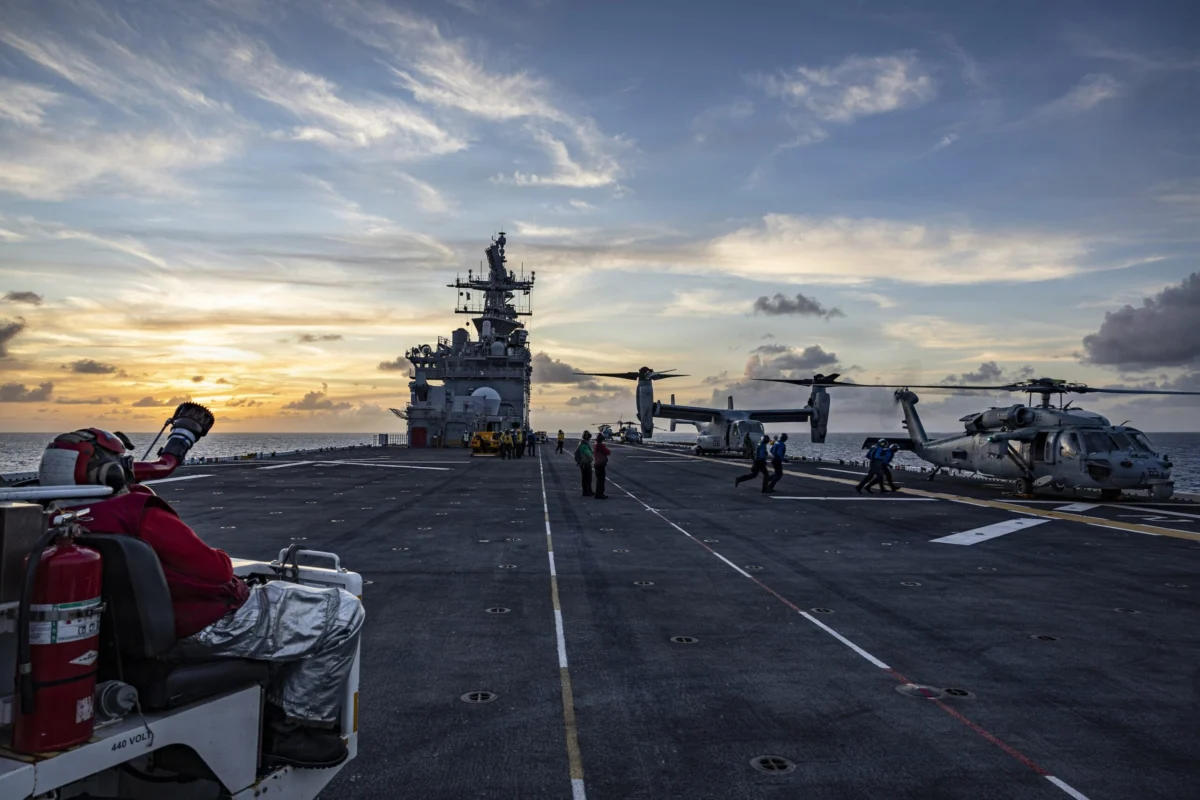
US Navy taps Gecko Robotics to help remedy maintenance headaches
The United States Navy has officially entered into a strategic partnership with Pittsburgh-based technology firm Gecko Robotics to integrate advanced artificial intelligence and robotic systems into its fleet maintenance protocols. This initiative, formalized through a five-year, $54 million indefinite delivery, indefinite quantity (IDIQ) contract, represents a significant shift in how the sea service manages the structural integrity and operational availability of its surface vessels. The agreement aims to mitigate the chronic maintenance delays that have hampered naval readiness for over a decade, specifically targeting 18 ships assigned to the U.S. Pacific Fleet in its initial phase. By deploying wall-climbing robots and sophisticated data-analytics platforms, the Navy intends to transition from a reactive maintenance posture to a predictive one, ensuring that the fleet remains capable of meeting global security demands.
The Technological Shift: Robots and Predictive AI
At the core of this partnership is Gecko Robotics’ proprietary technology, which combines hardware and software to provide a comprehensive view of a vessel’s physical condition. The company utilizes a fleet of specialized drones and "wall-climbing" robots equipped with ultrasonic transducers and high-definition sensors. These robots are capable of traversing the vertical and curved surfaces of a ship’s hull, decks, and internal tanks, capturing millions of data points regarding metal thickness, corrosion levels, and weld integrity.
Historically, these inspections were performed manually by human technicians using handheld tools. Manual inspections are not only time-consuming but are often limited by human physical constraints, such as the inability to access tight spaces or the subjective nature of visual assessments. According to Gecko Robotics, their robotic evaluations are up to 50 times faster and significantly more accurate than traditional methods. In one notable instance cited by the company, a single robotic evaluation and digital rendering of a flight deck successfully eliminated over three months of potential maintenance delay days by identifying structural vulnerabilities before they led to catastrophic failure.
The data gathered by these robots is fed into an AI-driven software platform that creates a "digital twin" of the ship. This allows naval engineers to visualize the rate of degradation over time and predict when specific components will require repair. This predictive capability is essential for the Navy’s goal of reducing "unplanned work," which occurs when shipyards discover unexpected damage after a vessel has already been opened up for scheduled repairs. Unplanned work is a primary driver of cost overruns and schedule slippage in naval maintenance.
A Crisis of Readiness: The Context of the Navy’s Struggle
The decision to lean heavily on automation comes at a precarious time for the U.S. Navy. For several years, the service has struggled to balance a high operational tempo with a shrinking and aging fleet. In late 2024, the Chief of Naval Operations (CNO), Admiral Lisa Franchetti, established a high-stakes goal known as the "North Star" objective: achieving an 80% readiness rate for the Navy’s fleet by 2027. This means that at any given time, four out of every five ships should be fully mission-capable and ready to deploy.
However, historical data and recent reports suggest a steep uphill climb. A December 2024 report from the Government Accountability Office (GAO) provided a sobering look at the readiness of the Navy’s amphibious warfare ships—vessels critical for Marine Corps operations. Between 2011 and 2020, the readiness rate for these ships averaged just 46%. The situation worsened in mid-2025, when readiness reportedly plummeted to 41%.
These statistics are not merely bureaucratic metrics; they have real-world operational consequences. The dip in readiness in 2025 resulted in a five-month gap in Marine Expeditionary Unit (MEU) deployments. This lack of available shipping forced the Marine Corps to alter training schedules and limited the United States’ ability to respond to crises or conduct presence missions. Furthermore, the shortage of mission-ready ships strained resources during a critical push by the Trump administration to counter illicit drug trafficking in the Caribbean and Latin America, where amphibious ships often serve as primary platforms for interdiction efforts.
Strategic Leadership and the 80 Percent Mandate
Following Admiral Franchetti’s tenure, her successor, Admiral Daryl Caudle, has maintained the 80% readiness target as the service’s primary focus. Caudle has been vocal about the necessity of modernizing the Navy’s industrial base and maintenance infrastructure. In a December 2025 editorial for Military Times, Caudle emphasized that the Navy cannot afford to remain tethered to 20th-century maintenance practices in a 21st-century security environment.
"Readiness is not a budget line—it is a promise to the American people that their Navy will never arrive late to a fight," Caudle wrote. He argued that achieving the 80% goal requires a multi-pronged approach: shortening maintenance cycles, increasing the availability of spare parts, improving training pipelines, and implementing targeted technological upgrades across the fleet. The contract with Gecko Robotics is a direct manifestation of this strategy, seeking to use "unfair advantages" in technology to reclaim operational days lost to the shipyard.
Jake Loosararian, co-founder and CEO of Gecko Robotics, echoed these sentiments, stating that the partnership is designed to give the Navy a decisive edge. "Readiness isn’t just a metric, it’s all that matters," Loosararian said. "This growing partnership is about unfair advantages Gecko is deploying to our Navy; and how prediction, through our robotics and AI products, ensure our brave men and women are the most advantaged in the world in their fight to defend freedom."
Chronology of the Navy’s Maintenance Modernization
The path to the current $54 million contract has been marked by several years of testing and incremental adoption:
- 2011–2020: The Navy experiences a steady decline in amphibious ship readiness, with rates hovering below 50% due to aging hulls and shipyard bottlenecks.
- 2021–2023: The Navy begins small-scale pilot programs with various tech firms, including Gecko Robotics, to test the efficacy of robotic hull inspections on destroyers and assault ships.
- Late 2024: CNO Admiral Lisa Franchetti officially unveils the 80% readiness goal for 2027, prioritizing fleet availability as the Navy’s top administrative objective.
- December 2024: The GAO releases a critical report highlighting the severity of maintenance backlogs and the impact on Marine Corps deployments.
- August 2025: Readiness rates hit a record low of 41%, leading to significant gaps in MEU deployments and prompting calls for emergency intervention in maintenance procedures.
- December 2025: Admiral Daryl Caudle reaffirms the 80% mandate and calls for a "revolution" in how the Navy sustains sea power.
- January 2026: The Navy formalizes the $54 million IDIQ contract with Gecko Robotics to begin work on 18 ships in the U.S. Pacific Fleet.
Broader Implications and Fleet-Wide Impact
The focus on the U.S. Pacific Fleet (PACFLT) for the initial rollout of this technology is a strategic choice. The Indo-Pacific remains the primary theater of concern for U.S. national security, particularly regarding the need to deter potential aggression in the South China Sea and the Taiwan Strait. In this region, the "tyranny of distance" means that ships must often operate far from major repair hubs. The ability to conduct high-fidelity inspections and predictive maintenance while forward-deployed—or to minimize the time spent in dry dock once they return—is vital for maintaining a credible deterrent.
Furthermore, the success of this program could serve as a blueprint for the rest of the Department of Defense. The Navy’s maintenance challenges are mirrored in the Air Force’s aging bomber fleet and the Army’s ground vehicle maintenance cycles. If Gecko Robotics can prove that AI and robotics can successfully move the needle on naval readiness, similar contracts are likely to follow across other branches of the military.
There is also an economic dimension to this modernization. The $54 million investment is seen as a cost-saving measure in the long run. By identifying corrosion or structural fatigue early, the Navy can perform "surgical" repairs rather than massive, fleet-wide overhauls. This reduces the consumption of raw materials, lowers labor costs, and, most importantly, keeps the Navy’s most expensive assets—its ships—in the water rather than in the yard.
Analysis of Future Challenges
While the integration of AI and robotics offers a promising solution, several challenges remain. The first is the "culture of data." For predictive maintenance to work, the Navy must be willing to trust the algorithms and adjust its rigid maintenance schedules based on robotic findings. This requires a shift in mindset for shipyard commanders and maintenance officers who have relied on manual checklists for decades.
Secondly, there is the issue of shipyard capacity. While robots can speed up the inspection process, the actual repair work still requires skilled human labor and dry-dock space. The U.S. currently faces a shortage of both. If the robots identify more problems more quickly, the Navy must ensure it has the industrial capacity to actually perform the repairs identified by the AI.
Finally, the 2027 deadline for the 80% readiness goal is rapidly approaching. With the current readiness rate for some classes of ships still below 50%, the Navy is essentially attempting to double its operational availability in less than two years. The partnership with Gecko Robotics is a bold attempt to bridge this gap, but the service will likely need to continue aggressive investments in technology and personnel to turn Admiral Franchetti’s vision into a reality.
As the first of the 18 Pacific Fleet ships undergo robotic evaluation under this new contract, the eyes of the Pentagon will be on the results. If the promised "50 times faster" efficiency holds true, it may represent the beginning of a new era in naval sustainment—one where silicon and steel work in tandem to keep the American fleet ready for the challenges of an increasingly volatile global landscape.

Related Posts
Trump Signs Executive Order Restricting Defense Contractor Reliance on Chinese Critical Minerals and Supply Chains

Doodle Labs Scales Global Manufacturing Footprint Amid Surging Demand for Resilient Drone Communication Systems in Ukraine