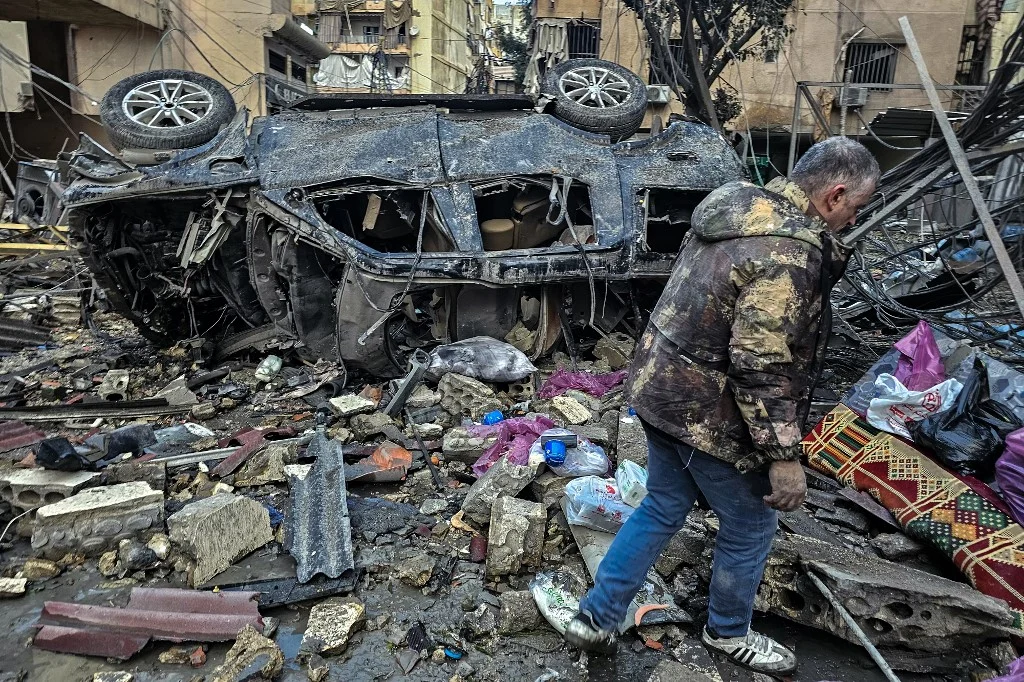
In photos: Aftermath of overnight Israeli strikes on Beirut’s southern suburbs
Immediate Aftermath and Civilian Impact
The strikes, which reportedly commenced shortly after midnight local time, illuminated the night sky with explosions and sent shockwaves across the Lebanese capital. Eyewitness accounts spoke of multiple impacts, loud enough to be heard across wide swathes of Beirut. Firefighters were dispatched to several sites, working tirelessly to extinguish fires that erupted in the wake of the bombings, particularly in residential or mixed-use areas. The photos from the scene captured the grim reality: plumes of smoke still rising from devastated buildings, rescue workers in helmets and reflective gear navigating treacherous piles of concrete and twisted metal, and ordinary citizens, some visibly distraught, examining the ruins of what were once their neighborhoods. While initial reports did not immediately confirm casualty figures, the scale of the destruction suggested a high likelihood of injuries or fatalities, a grim echo of past conflicts that have repeatedly plagued the region. Local medical facilities were reportedly on high alert, preparing to receive potential casualties as search and rescue operations continued into the morning. The humanitarian toll extended beyond immediate physical harm, encompassing displacement, psychological trauma, and significant material losses for affected families and businesses.
Background of Escalating Tensions
These latest airstrikes on Beirut’s southern suburbs arrive amidst a deeply volatile and rapidly escalating regional conflict, explicitly referenced by the broader news coverage from which this update originates: an ongoing "Iran war" and Israel’s concurrent announcement of "limited targeted ground operations" in southern Lebanon. The southern suburbs of Beirut, often referred to as the "Dahiya," have long been considered a stronghold for Hezbollah, the powerful Shiite political party and armed group. This area has been a frequent target for Israeli military action, particularly during periods of heightened tension, as Israel views it as a central hub for Hezbollah’s command and control, weapons storage, and operational planning. The conflict between Israel and Hezbollah is deeply rooted in decades of animosity, characterized by cross-border skirmishes, proxy engagements, and major confrontations, most notably the 2006 Lebanon War.

The current escalation, described as an "Iran war," signifies a significant widening of the conflict beyond the traditional Israel-Hezbollah dynamic. It suggests a direct or indirect confrontation involving Iran, likely through its regional proxies, including Hezbollah. Israel’s declaration of "limited targeted ground operations" in southern Lebanon indicates a shift from aerial bombardment and missile strikes to direct military incursions, a move that dramatically raises the stakes and risks a full-scale regional conflagration. The airstrikes on Beirut, therefore, cannot be viewed in isolation but rather as an integral part of this broader, multi-front conflict, potentially serving as a pre-emptive measure, a punitive strike, or an attempt to degrade Hezbollah’s capabilities in conjunction with the ground operations further south.
Chronology of a Crisis
The events leading up to the March 16, 2026, airstrikes have been a grim progression of hostilities. For several weeks, if not months, prior, the Israel-Lebanon border had seen a dramatic increase in cross-border fire, including rocket launches from Lebanon into northern Israel and retaliatory Israeli artillery and aerial strikes. These exchanges were themselves an escalation from an already tense standoff.
- Early 2026: Reports indicated a significant build-up of military forces on both sides of the Blue Line, the de facto border between Lebanon and Israel. International diplomatic efforts to de-escalate tensions largely failed to yield concrete results, as both sides maintained maximalist positions.
- February 2026: A series of major incidents, including a significant rocket barrage from Lebanon targeting Israeli population centers and a subsequent Israeli deep strike into Lebanese territory, marked a critical turning point. This period saw increased rhetoric from both Israeli and Iranian officials, signaling a potential for wider conflict.
- Early March 2026: Israel announced the commencement of "limited targeted ground operations" in specific areas of southern Lebanon, ostensibly to dismantle Hezbollah’s military infrastructure and push its forces away from the border. This move was met with immediate condemnation from the Lebanese government and vows of fierce resistance from Hezbollah.
- March 15-16, 2026 (Overnight): The airstrikes on Beirut’s southern suburbs occurred during this critical phase of the ground operations. Military analysts suggest these strikes could have been intended to disrupt Hezbollah’s logistical support for its fighters in the south, target command centers, or reduce its retaliatory capabilities against Israeli cities. They also serve as a stark reminder of Israel’s ability to strike deep within Lebanese territory.
- Morning, March 16, 2026: The immediate aftermath described above, with emergency services responding and the international community beginning to react to the dramatic escalation.
Strategic Implications and Supporting Data
The choice of Beirut’s southern suburbs as a target underscores several strategic considerations for Israel. The Dahiya is not merely a residential area; it is a complex urban environment where Hezbollah has deeply embedded its military and logistical networks. Intelligence reports, often cited by Israeli officials, claim that underground tunnels, weapons caches, and command centers are integrated within the civilian infrastructure, presenting significant operational challenges and raising concerns about civilian casualties.

Data from previous conflicts indicates that strikes in such areas often result in a high ratio of civilian harm to military gains, a point frequently highlighted by international human rights organizations. For instance, in the 2006 conflict, similar areas sustained heavy damage, leading to significant displacement and a humanitarian crisis. The type of damage observed in the recent photos—collapsed multi-story buildings and widespread debris—suggests the use of precision-guided munitions designed to destroy reinforced structures, consistent with targeting hardened military assets. However, the proximity to civilian homes invariably leads to collateral damage.
The timing of these airstrikes, concurrent with ground operations, suggests a coordinated military strategy. Air superiority allows for softening targets, disrupting enemy movements, and providing cover for ground forces. By striking Beirut, Israel might be aiming to:
- Degrade Hezbollah’s strategic depth: Disrupting its ability to resupply or reinforce units engaged in combat in southern Lebanon.
- Impose a cost: Signalling to Hezbollah and its Iranian patrons that continued aggression will lead to significant damage across Lebanon.
- Pressure the Lebanese government: To exert control over Hezbollah, though the Lebanese state’s capacity to do so is severely limited.
Conversely, such strikes risk further galvanizing Hezbollah’s support base and provoking broader retaliation, potentially drawing more regional actors into the fray.
Official Responses and International Reaction
As the full scope of the overnight strikes became clear, responses from various parties began to emerge, albeit initially inferred given the rapidly unfolding situation.

- Israeli Government: While no immediate official statement directly confirming the Beirut strikes was available at the time of this report, Israeli military sources, speaking on background, were expected to reiterate Israel’s commitment to defending its borders and citizens. Any public statement would likely emphasize that the targets were legitimate military objectives belonging to Hezbollah, aimed at neutralizing threats to Israeli security within the context of the ongoing "Iran war" and "limited targeted ground operations" in southern Lebanon. They would likely accuse Hezbollah of deliberately embedding military assets within civilian areas, thus holding the organization responsible for any civilian casualties.
- Lebanese Government: Lebanese authorities were anticipated to issue a strong condemnation of the Israeli aggression, characterizing the strikes as a flagrant violation of Lebanese sovereignty and international law. The Lebanese Ministry of Foreign Affairs was expected to call for an urgent meeting of the UN Security Council and appeal to the international community to intervene and halt Israel’s "escalation." Emphasis would be placed on the civilian toll and the humanitarian consequences for Beirut’s residents, with calls for international aid to assist those affected.
- Hezbollah: Hezbollah’s media arm and leadership would likely issue defiant statements, vowing retaliation and emphasizing their resilience. They would portray the strikes as a sign of Israeli desperation and a targeting of the Lebanese people, aiming to rally domestic and regional support. Specific threats of counter-attacks against Israeli targets, both military and civilian, would be anticipated, further fueling the cycle of violence.
- International Community: The United Nations Secretary-General’s office was expected to release a statement expressing grave concern over the escalating violence, calling for an immediate cessation of hostilities, and urging all parties to exercise maximum restraint. Major powers such as the United States and European Union nations would likely issue statements calling for de-escalation and protection of civilians. While the US would likely reaffirm Israel’s right to self-defense, it would also likely express concern over the humanitarian impact and the broader regional destabilization. Russia and China might offer more pointed criticism of Israeli actions, aligning with their established foreign policy positions in the region. Humanitarian organizations would undoubtedly condemn the targeting of populated areas and call for adherence to international humanitarian law.
Broader Impact and Implications for Regional Stability
The overnight Israeli airstrikes on Beirut’s southern suburbs, particularly when viewed in the context of a wider "Iran war" and active Israeli ground operations in southern Lebanon, carry profound implications for regional stability.
Firstly, these strikes signify a dangerous expansion of the conflict. Moving beyond the immediate border skirmishes to target the heart of the Lebanese capital, a major urban center, risks drawing the conflict deeper into civilian areas and escalating its intensity. This could potentially trigger a wider regional confrontation, drawing in other actors such as Iranian-backed militias in Syria and Iraq, or even direct Iranian involvement.
Secondly, the humanitarian crisis in Lebanon, already grappling with a severe economic downturn and political instability, stands to worsen dramatically. Large-scale displacement, destruction of infrastructure, and increased pressure on already strained public services could lead to a catastrophic situation. The photos of the destruction in Beirut serve as a stark visual reminder of the human cost of such conflicts.
Thirdly, the political ramifications for Lebanon are immense. The Lebanese government, a fragile coalition, is often caught between the demands of its international partners and the powerful influence of Hezbollah. Escalations like these further erode the state’s authority, deepen internal divisions, and complicate any efforts towards political reform or economic recovery. The strikes could also inflame public sentiment against all involved parties, increasing anti-Western sentiment and further destabilizing the country.

Finally, the prospect for any future peace or de-escalation efforts becomes increasingly dim. Each round of strikes and retaliation hardens positions, deepens grievances, and makes dialogue more challenging. The current trajectory points towards a prolonged and destructive conflict with unpredictable consequences for the entire Middle East. The international community faces an urgent imperative to exert maximum diplomatic pressure to halt this dangerous escalation before it spirals into an unmanageable regional catastrophe. The images from Beirut’s southern suburbs are not just snapshots of destruction; they are a dire warning of a region teetering on the brink.

Related Posts
Over 150 Israeli Settlers Storm Al-Aqsa Compound and Perform Prayers, Violating Status Quo Under Police Protection.
UN Report Highlights Over 900 Obstacles Hampering West Bank Aid Amid Escalating Humanitarian Crisis