
Prepare for turbulence – how a prolonged Middle East conflict could reshape how we fly
Once a modest desert stopover for pioneering long-haul flights connecting the British Empire, Dubai has spectacularly transformed into a pivotal global aviation hub. Its gleaming Dubai International Airport (DXB) processed over 92 million international passengers in 2024, eclipsing major rivals like London Heathrow and solidifying its status as the world’s busiest airport for international traffic. Alongside Abu Dhabi and Doha, these three Gulf airports collectively manage over 3,000 flights daily, predominantly operated by regional giants Emirates, Etihad, and Qatar Airways, forming the beating heart of an interconnected world. However, the escalating conflict in the Middle East has cast a long shadow over this meticulously constructed edifice, threatening to profoundly reshape the landscape of global air travel.
The immediate fallout from the conflict has been dramatic. Following initial US-Israeli strikes on Iran in late February and subsequent retaliatory actions, the region’s airspace, some of the busiest globally, was paralyzed. This led to aircraft grounding, forced turn-backs for airborne flights, and the stranding of hundreds of thousands of passengers across Dubai, Abu Dhabi, and Qatar. Many of these travellers were merely transiting, caught in a rapidly unfolding geopolitical crisis that rendered their carefully planned journeys impossible. Beyond the immediate disruption to air traffic, a more insidious threat emerged: fuel supply. The Strait of Hormuz, a critical choke point through which a significant portion of the world’s oil and refined products, including jet fuel, passes, faced potential blockades from Iran. This prospect sent tremors through the energy markets, causing jet fuel prices to double since the conflict’s inception and prompting some carriers to immediately scale back their flight schedules.
While these short-term operational challenges and cost escalations dominate immediate industry concerns, raising the specter of higher airfares for consumers in the coming months, the more profound question revolves around the long-term viability of the highly successful "Gulf model" of aviation. This innovative model has been credited with democratizing long-distance travel, making it more accessible and affordable for millions. Its potential disruption carries serious implications for airlines, passengers, and the broader economies of Middle Eastern nations that have strategically diversified their futures around robust air connectivity.
The Genesis and Dominance of the Gulf Aviation Model
To understand the magnitude of the current crisis, it’s essential to appreciate the meteoric rise of Gulf aviation. Dubai’s journey from a humble desert outpost, serving as a refuelling stop for luxury flying boats in the 1930s and later for propeller-driven airliners in the 1960s, to a modern marvel of connectivity is a testament to strategic vision and audacious investment. The region’s geographical centrality emerged as its unparalleled advantage. Positioned almost equidistant from major population centres in Europe, Africa, and Asia, the Gulf states found themselves ideally situated to become the ultimate global crossroads.
"Within three hours flying time of the Gulf, you have the Middle East, the Indian subcontinent, verging on China. It’s a huge market," explains James Hogan, former chief executive of Etihad Airways, who spearheaded the airline’s rapid expansion from 2006 to 2017. This strategic location allowed Gulf carriers to develop a unique aviation model, distinct from the traditional "hub-and-spoke" systems prevalent in Europe and North America or pure "point-to-point" flying.
The Gulf model effectively combined the convenience of point-to-point travel with the economies of scale offered by a hub system. Passengers could fly from diverse origins like Boston to Bali or Amsterdam to Antananarivo with a single, seamless connection in the Gulf. This was facilitated by meticulously timed "banks" of flights, where 90 to 100 aircraft would arrive within a one-hour window, allowing passengers to quickly transfer to onward journeys an hour or two later.

The Gulf carriers, as relative newcomers to the global aviation scene, also benefited from starting with a "clean sheet of paper," as Hogan describes it. This allowed them to invest heavily in modern, fuel-efficient fleets – initially favouring the long-range, high-capacity Boeing 777, and later the Airbus A380 superjumbo for its ability to transport over 500 passengers to and from congested airports with limited slot availability. This enabled them to offer a superior service proposition that legacy carriers, burdened by older fleets and entrenched operational structures, struggled to match.
Andrew Charlton, managing director of Aviation Advocacy consultants, highlights how Gulf carriers capitalized on market gaps. "The Middle East was suddenly in exactly the right place for the emerging market, which was well east of the Atlantic," he notes, referring to the rapid economic growth in China and India, which European and American carriers initially underestimated. The result was an unprecedented expansion of long-haul capacity, driving down airfares globally and fundamentally altering how people travelled across continents. John Grant, a senior analyst at OAG, aptly summarizes its efficiency: "It is a hugely efficient, very effective operation that sees 90-100 flights arriving in a one-hour time window and then departing somewhere else an hour or two later."
Chaos in the Departure Halls: The Immediate Impact of Conflict
The well-oiled machinery of the Gulf hubs ground to a halt with alarming speed following the eruption of direct hostilities. On late February, airspace over Iran, Iraq, Jordan, Lebanon, Syria, and Israel was swiftly closed or severely restricted. This wasn’t merely a precautionary measure; it was a response to the real threat of missile and drone attacks. For instance, on 28 February, after initial US-Israeli strikes, Iran’s Revolutionary Guard launched retaliatory drone and missile attacks targeting military and economic installations in the UAE and Qatar, turning the fear of airspace contamination into a stark reality.

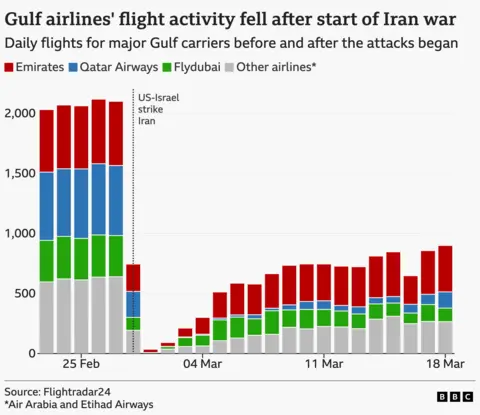
This sudden closure caught airlines and passengers off guard. Aircraft that had already departed were forced to return to their origin airports or divert to other locations outside the affected zone. The chart detailing daily flights by major Gulf airlines from late February to mid-March starkly illustrates this collapse: flights plummeted to near zero immediately after the attacks, recovering only gradually and remaining well below pre-conflict levels.
The scene in the gleaming, marble-floored halls of Dubai, Abu Dhabi, and Doha airports transformed from bustling efficiency to anxious uncertainty. Tens of thousands of passengers, many of whom were simply connecting, found themselves stranded, their onward journeys cancelled. "Many more passengers around the world were unable to travel on the services they had booked, because their flights were due to go via one of the Gulf hubs. They were left scrambling to find alternatives," the article notes.
The human element of this disruption was vividly captured by stories like that of Ian Scott, who was travelling from Melbourne to Venice via Doha. His flight from the Qatari capital was forced to turn back mid-air. He then spent several tense days sheltering in a hotel before undertaking a two-day desert drive to Oman to secure an onward flight. His conclusion, even once hostilities cease, is telling: he would avoid Gulf hubs due to "no faith" in the region’s long-term stability. Such sentiments, if widespread, pose a significant threat to the Gulf model’s core reliance on transit passengers.
Airlines scrambled to respond. Within days, Emirates and Etihad initiated limited services to repatriate stranded passengers, with Qatar Airways following suit. Governments, including the UK’s, chartered evacuation flights. However, the operational environment remains fraught. Cirium, an aviation data firm, reports over 30,000 services to the Middle East have been cancelled since the conflict began, highlighting the persistent instability and the challenge of restoring confidence.
The Economic Underpinnings and Wider Repercussions
Beyond the immediate travel disruption, the conflict strikes at the heart of the Gulf states’ economic diversification strategies. For decades, these nations have sought to lessen their reliance on hydrocarbon revenues by investing heavily in tourism, trade, and logistics, with aviation serving as a crucial catalyst. Dubai, in particular, has successfully cultivated an image as a global business and tourism destination, not just a transit point. This prosperity is intricately linked to the perception of stability and seamless connectivity.
Kristian Coates Ulrichsen, a Middle East expert at the Baker Institute in Texas, underscores this vulnerability. "Of course, the business model is going to be called into question the longer it goes on," he states. "If people don’t feel secure about travelling because they feel they’ll get stuck, or that at any time the airport might be closed because of a drone, even if it’s intercepted, that will do a lot of damage." Johannes Thomas, chief executive of Trivago, a travel specialist, echoes this sentiment, predicting it could take "maybe two to three years" for safety concerns to be fully overcome, suggesting a prolonged period of reduced tourism and business travel.
The impact on global supply chains, while not explicitly detailed in the original article, is also a critical consideration. Air freight, heavily reliant on passenger aircraft belly hold capacity, would also face disruptions, potentially increasing costs and lead times for high-value goods. The Gulf’s position as a logistics hub for East-West trade is thus equally exposed.
Reshaping Global Routes: The Future of Long-Haul Travel
The key question now is the long-term impact on the Gulf’s reputation and its unique aviation model. Andrew Charlton suggests that a swift resolution to the conflict might allow Gulf carriers to "flood the market with cheap airfares" and quickly regain lost ground. However, a prolonged conflict would compel passengers to "find alternate ways to fly," diverting traffic to rival hubs.
These alternatives primarily lie in Asia: Singapore Changi, Hong Kong International, Tokyo Narita and Haneda, and even Istanbul Airport, which has aggressively expanded its international reach, could emerge as beneficiaries. These hubs offer similar strategic positioning for connecting flights between Europe/North America and Asia/Oceania.
The long-term loss of capacity provided by Gulf airlines, which account for roughly 9.5% of global aviation capacity, would inevitably lead to higher prices. Charlton is unequivocal: "Did the Gulf carriers cause lower fares? Yes they did. Take Gulf carriers out of the equation, air fares are going to go up, as sure as eggs are eggs." This rise would stem from several factors: longer flight paths avoiding the Middle East (increasing fuel burn and crew costs), reduced competition, and potentially higher insurance premiums for airlines operating in or near unstable regions.
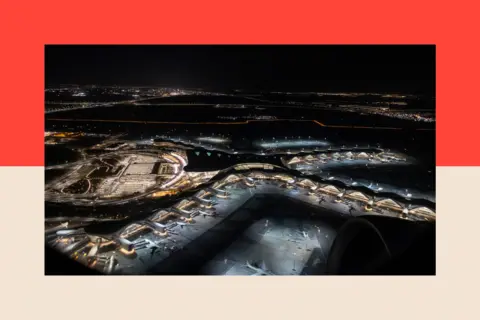
European carriers have already begun to adapt. British Airways has added extra services to Bangkok and Singapore, while Lufthansa and Air France-KLM have similarly boosted their Asia routes. However, Willie Walsh, Director General of the International Air Transport Association (IATA), cautions against overestimating their capacity to fill the void. Speaking in Paris, he stated, "there is no way the capacity provided by carriers in the Gulf can be replaced by European carriers." This highlights the unique scale and efficiency of the Gulf model, which would be difficult to replicate quickly.
Resilience or Reversal? Industry Perspectives
The Gulf aviation model has faced existential questions before, notably during the Covid-19 pandemic. Critics then argued that carriers reliant on long-haul transit traffic and large aircraft fleets lacked the agility to respond to global crises. Yet, the recovery was remarkably swift, with Emirates, Etihad, and Qatar Airways reporting healthy profits in subsequent years. "The aviation industry has seen Sars, it’s seen Covid, it’s seen geopolitical events in various parts of the world," notes John Grant. "It’s seen stock market crashes, and it bounces back." This historical resilience fuels optimism among some.
Former Etihad CEO James Hogan remains "very bullish" about the Gulf’s long-term prospects. "This is a major crisis, but it will be resolved at a point in time," he insists. "I’ve seen it over the years. Some people in the early days may be apprehensive, but travellers will come back."
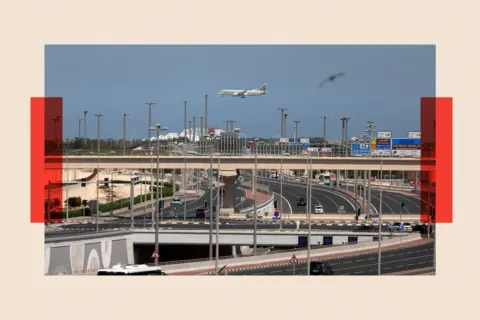
However, the nature of the current conflict – characterized by direct military actions and retaliatory strikes impacting civilian infrastructure and airspace – might present a different challenge. The "safety perception" in travellers’ minds, as highlighted by Trivago’s Johannes Thomas, could be a more enduring obstacle than previous health or economic crises. Restoring this sense of security is paramount, and it hinges on a lasting de-escalation of regional tensions.
Conclusion: A Crossroads for Global Aviation
The Middle East conflict has delivered a severe, unprecedented blow to the Gulf’s major carriers and their meticulously developed hub airports. The region, once synonymous with seamless global connectivity and luxurious transit, is now viewed with trepidation by many business and leisure travellers. The reputational damage, particularly concerning safety and reliability, is significant and will require considerable effort and sustained peace to overcome.
If the Gulf can swiftly resume its role as a stable and efficient junction connecting the world’s continents, the industry may yet navigate this turbulence and largely return to its established trajectory. However, should the conflict persist or reignite, forcing a more permanent re-evaluation of airspace safety and logistical feasibility, the implications for long-haul aviation could be profound and enduring. It could trigger a fundamental remapping of global flight paths, lead to sustained higher airfares, and significantly alter the economic fortunes of the Gulf states, marking a pivotal moment in the history of air travel. The world watches, waiting to see if this turbulence will be a temporary squall or a permanent shift in the skies above.

Related Posts

Zambia on Edge: Opposition Leader Arrested Amid Allegations of Insurrection Plot and Election Tensions
Rescuers search for survivors of powerful Indonesia earthquake

