

Artemis II Mission Set for Historic Lunar Flyby, Igniting Global Excitement on Florida’s Space Coast
Tonight, humanity takes another monumental leap towards deep space as NASA’s Artemis II mission prepares for its highly anticipated launch from the Kennedy Space Center. An estimated 400,000 people are expected to converge on Florida’s iconic Space Coast, transforming causeways, beaches, and motel balconies into prime viewing locations for this historic event. Four astronauts will blast off, aiming to orbit the Moon and potentially journey further from Earth than any human has ever ventured, marking a pivotal moment in the ambitious program to return humanity to its closest celestial neighbor.
The 10-day test flight, scheduled to launch between 18:24-20:24 local time (23:24-01:24 BST) on Wednesday, April 1, 2026, will not land on the lunar surface. Instead, it serves as a critical dress rehearsal, validating the Orion spacecraft’s systems and capabilities with a human crew aboard before future missions attempt a lunar landing. Despite not touching down, the crew is poised to witness breathtaking views of the lunar landscapes, some of which may have never been seen by human eyes from their unique trajectory.
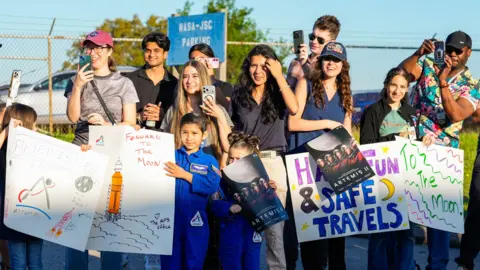
The palpable excitement on the ground underscores the universal appeal of space exploration. Eight-year-old Isiah, among the throngs of eager spectators, succinctly captured the sentiment: "People going up to the Moon is kind of cool." His youthful wonder is echoed by Amanda Garcia, who journeyed over 1,000 miles from New Mexico to witness the spectacle. "I’m pretty excited about it," she shared, anticipating "a great show" alongside countless others. This collective anticipation transforms the launch into a global celebration of human ingenuity and aspiration.
A New Era of Lunar Exploration: The Artemis Program
Artemis II is a cornerstone of NASA’s broader Artemis program, a visionary initiative designed not merely to revisit the Moon but to establish a sustainable human presence there. Unlike the Apollo missions of the 20th century, which focused on flags and footprints, Artemis aims to build a permanent lunar base, harness its natural resources, and, crucially, use it as a springboard for the ultimate journey to Mars. This long-term strategy involves international partners, commercial collaborators, and a new generation of spacecraft and infrastructure.
The program began with Artemis I, an uncrewed test flight that successfully orbited the Moon in late 2022. That mission rigorously tested the Space Launch System (SLS) rocket and the Orion capsule in deep space environments, gathering invaluable data on propulsion, navigation, and thermal protection. While largely successful, engineers identified issues with the Orion heat shield’s coating, which experienced unexpected charring and chunking during its fiery re-entry. The lessons learned from Artemis I have directly informed modifications and operational adjustments for Artemis II, making this crewed flight a crucial validation of these improvements.
The ultimate goal of the Artemis program includes the Gateway lunar orbital outpost, a small space station that will provide vital support for long-duration missions and serve as a staging point for lunar surface expeditions. Human Landing Systems (HLS), developed by commercial partners, will transport astronauts from Gateway to the lunar surface. Artemis II is the critical step that bridges the uncrewed test flights and the subsequent crewed lunar landings, proving the systems and procedures are safe for astronauts.
The Mission: Objectives and Trajectory
Artemis II is designed as a complex, multi-day shakedown cruise for the Orion spacecraft and its crew. Its primary objectives include:
- Testing Orion’s Life Support Systems: Ensuring the capsule can sustain a human crew for extended periods in deep space.
- Manual Flight Capabilities: Allowing the astronauts to manually control Orion, a vital skill for unforeseen contingencies.
- Communications and Navigation: Verifying robust communication links and precise navigation capabilities far from Earth.
- Thermal Protection System Validation: Critically, testing the modified heat shield during high-speed re-entry with a crew onboard.
The mission trajectory is meticulously planned. After launch, Orion will spend its first day in high Earth orbit, where the crew will perform initial systems checks, practice manual maneuvering, and thoroughly test the life support systems. On Day 2, a powerful trans-lunar injection (TLI) burn will propel the spacecraft out of Earth orbit and onto a free-return trajectory around the Moon. This specific trajectory is a safety measure; if no further burns are executed, the Moon’s gravity would naturally sling Orion back towards Earth, ensuring a return path even in the event of propulsion system failures. Small correction burns will fine-tune this course over the subsequent days.
One of the most anticipated moments will occur on Day 6, when Orion swings around the far side of the Moon. During this phase, the spacecraft will temporarily lose radio contact with Earth for approximately 40 minutes, a period of isolation where flight controllers will have no real-time information on the crew’s status. Orion will pass about 4,000–6,000 miles above the lunar surface. Depending on the precise trajectory, the mission could slightly exceed Apollo 13’s record distance of approximately 250,000 miles (400,000 km) from Earth, setting a new benchmark for human spaceflight. The crew will be afforded unparalleled views of the lunar farside, a region only observed directly by a handful of Apollo astronauts and robotic probes.
The Elite Crew: Pioneers of the Artemis Generation
The four individuals entrusted with this historic mission are a testament to international collaboration and extensive training. They have spent years preparing, honing their skills, and building an unbreakable bond as a team.
- Commander Reid Wiseman: A veteran NASA astronaut, Wiseman previously served on the International Space Station (ISS) for 165 days during Expedition 41 in 2014. His experience in orbital mechanics, spacecraft operations, and leadership makes him an ideal choice to command this complex mission.
- Pilot Victor Glover: Another seasoned NASA astronaut, Glover made history as the first African American to complete a long-duration mission on the ISS as part of Expedition 64. His background as a Naval aviator brings critical flight expertise to the Orion capsule.
- Mission Specialist Christina Koch: A highly accomplished NASA astronaut, Koch holds the record for the longest single spaceflight by a woman, spending 328 days on the ISS. Her extensive experience in spacewalks and systems operations is invaluable for the mission’s challenges.
- Mission Specialist Jeremy Hansen: Representing the Canadian Space Agency (CSA), Hansen is a fighter pilot turned astronaut, and Artemis II marks his inaugural trip into space. His selection underscores the international partnership integral to the Artemis program, and he will be the first Canadian to venture into deep space.
Commander Wiseman articulates the profound inspirational potential of their journey: "In our lifetime, we’ve looked at the Moon knowing that people had been there. And now in the Artemis generation, kids will walk out and look at the Moon going, we are there. We are there now, and we are going further into our solar system." This statement encapsulates the broader vision of Artemis: to ignite a new wave of passion for science, technology, engineering, and mathematics (STEM) among younger generations, fostering the explorers and innovators of tomorrow.

The Hardware: SLS and Orion
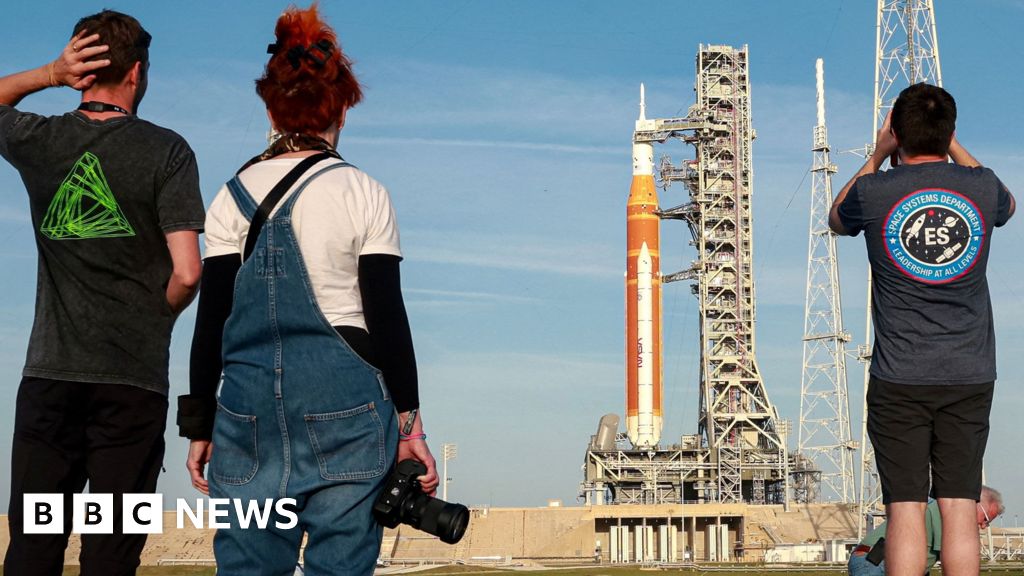
Standing majestically on Launch Pad 39B, the same historic stretch of concrete that witnessed the Apollo program’s lunar departures in 1969, is NASA’s Space Launch System (SLS) rocket. At 98 meters (321 feet) tall, this "white and orange giant" is the most powerful rocket ever developed by NASA, designed to lift unprecedented payloads to deep space. The SLS Block 1 configuration for Artemis II comprises a massive core stage, two five-segment solid rocket boosters (SRBs), and an Interim Cryogenic Propulsion Stage (ICPS) that provides the thrust for the trans-lunar injection. Its immense power is essential for accelerating the Orion capsule and its crew to velocities required to escape Earth’s gravity and travel to the Moon.
Perched atop the SLS is the Orion capsule, a spacecraft roughly the size of a small van. This compact living space will be home to the four astronauts for the next 10 days. Orion is a marvel of modern engineering, equipped with advanced life support systems, sophisticated avionics, and a robust heat shield. The European Service Module (ESM), provided by the European Space Agency (ESA), forms the backbone of Orion’s propulsion and power systems in space, further highlighting the international collaborative spirit of Artemis. This mission will be the first time the capsule is put through its paces with a human crew on board, testing every system under real-world deep-space conditions.
Re-entry: The Ultimate Test
The return journey will see Orion naturally pulled back towards Earth by the same free-return trajectory that sent it out. Small course adjustment burns will ensure the capsule hits Earth’s atmosphere at precisely the right angle. The mission culminates in the most brutal and critical phase: re-entry into Earth’s atmosphere. Traveling at speeds of approximately 25,000 mph (40,000 km/h), Orion’s heat shield will once again face temperatures hot enough to char rock, protecting the crew from the extreme friction and heat generated by atmospheric deceleration.
The re-entry profile for Artemis II incorporates a two-stage "skip" maneuver, a complex procedure where the capsule dips into the upper atmosphere, briefly climbs again, and then plunges back in for its final descent. This technique helps manage the immense heat and G-forces experienced by the crew while also enhancing splashdown accuracy. However, based on the findings from Artemis I, where chunks of the heat shield’s coating cracked and broke away, engineers have refined the angle and timing of this skip maneuver. The new modeling suggests that spending less time in the initial, gentler dip should reduce the heating and structural loads that contributed to the extra charring observed previously. This will be the first time this revised descent strategy is flown with a human crew, making its successful execution paramount to the mission’s overall success and the safety of future Artemis astronauts.
The Space Coast’s Economic and Cultural Boom
The excitement surrounding Artemis II extends far beyond the scientific community and space enthusiasts. Florida’s Space Coast is experiencing an unprecedented surge in tourism and economic activity. Local officials are projecting an economic impact of approximately $160 million (£121 million) from the "historic influx" of visitors. Bars advertise "moonshots," hotels issue warnings about extensive traffic delays to and from viewing spots, and local law enforcement implements comprehensive traffic plans to manage the anticipated crowds. The night sky will be a dazzling display, with the glow of floodlit launch towers competing with the vibrant lights of camper van barbecues and bustling highways.
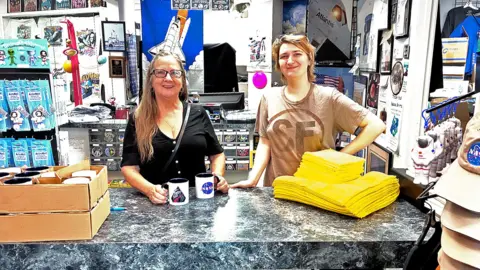
Brenda Mulberry, owner of Space Shirts on Merritt Island, has been selling NASA memorabilia for 40 years. Her shop, typically busy on regular launch days, is preparing for an unprecedented customer surge. "We’ve wanted to go back to the Moon since the ’70s. People are excited. People are beyond excited," she exclaimed, having stocked up for what she expects to be her biggest sales event ever. With a twinkle in her eye, she shared her ambitious dream: "I want to have the first T-shirt shop on the Moon. Because if you’ve been there, you get the T-shirt, right?" Her humorous aspiration perfectly encapsulates the long-term vision and popular enthusiasm for lunar settlement.
This economic and cultural phenomenon highlights the broad societal impact of space exploration. It generates jobs, stimulates local economies, and fosters a sense of collective pride and achievement. The imagery of families, young and old, gathering to witness the raw power of a rocket launch serves as a powerful reminder of humanity’s innate drive to explore and push boundaries.

Looking Ahead: The Path to Permanent Lunar Presence and Mars
If Artemis II successfully achieves all its objectives, it will pave the way for Artemis III, the mission slated to return humans to the lunar surface for the first time since 1972. This time, the goal is not just to plant flags but to establish a sustainable presence, enabling long-duration scientific research, resource extraction (like water ice from lunar poles), and technological development crucial for future deep-space missions. The lessons learned, the technologies developed, and the experiences gained from Artemis II are fundamental to realizing the vision of a permanent Moon base.
Ultimately, the Moon is envisioned as a critical stepping stone for humanity’s journey to Mars. Developing habitats, life support systems, and operational procedures on the Moon will provide invaluable experience and testbeds for the even greater challenges of a multi-year mission to the Red Planet. The Artemis program, therefore, is not just about returning to the Moon; it’s about expanding humanity’s reach across the solar system.
Tonight, as the Space Coast holds its breath, all attention will be fixed on Launch Pad 39B. The roar of the SLS rocket will signify more than just a launch; it will be the sound of human ambition, scientific endeavor, and a collective dream taking flight. And somewhere amidst the marsh grass and the launch pads, there will undoubtedly be someone proudly wearing one of Brenda Mulberry’s shirts, already envisioning the day when that familiar logo graces not just Florida cotton, but a photograph taken from humanity’s burgeoning outpost on the Moon. The Artemis generation is poised to turn dreams into reality, pushing the boundaries of what is possible and inspiring the world to look up and wonder.

Related Posts

Zambia on Edge: Opposition Leader Arrested Amid Allegations of Insurrection Plot and Election Tensions

Rescuers search for survivors of powerful Indonesia earthquake

