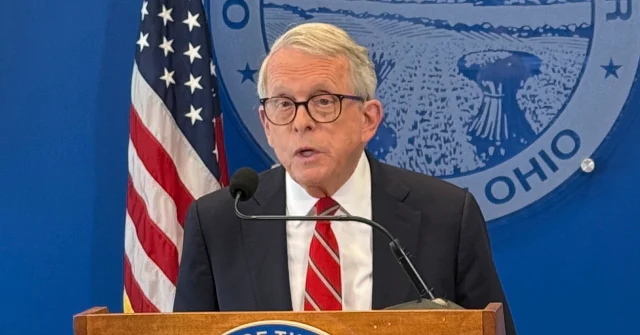
Ohio Gov. Mike DeWine: Americans Are ‘Other People’ in Migration Politics, ‘Haitians Came There to Work’
Ohio Governor Mike DeWine has ignited a significant debate after stating in a CBS interview that American citizens are "other people," while simultaneously commending Haitian migrants for their pivotal role in revitalizing Springfield, Ohio. The Governor’s remarks, which highlighted the economic contributions of the migrant population, have drawn sharp criticism from immigration experts and local advocacy groups who accuse him of prioritizing non-citizens over the welfare of native-born Americans.
Springfield’s Transformation and the Migrant Workforce
During the interview with CBS News’ Colombian-born migration reporter, Governor DeWine lauded the impact of Haitian migrants on Springfield, a city that has seen substantial demographic and economic shifts in recent years. "The Haitian migrants have helped Springfield really come back… The Haitians who are living there and employed there, they came there to work, and they came there because there were jobs that were not being filled by other people," DeWine stated, emphasizing the term "other people" to distinguish native-born Americans from the migrant workforce.
This statement frames a complex issue: the perceived labor shortages in certain sectors of the American economy and the role of immigrant populations in filling those gaps. Springfield, like many smaller American cities, has faced challenges related to an aging workforce, declining native-born populations, and a scarcity of individuals willing to take on certain labor-intensive or lower-wage jobs. The arrival of an estimated 20,000 non-citizen Haitian workers, renters, and consumers has undeniably injected new life into the local economy.
DeWine, a Republican who served as a conventional GOP Senator from 1995 to 2006, further elaborated on the migrants’ contributions. "If you talk to the employers in Springfield who are employing Haitians, they will tell you that these are people who have opened restaurants, they’ve opened other businesses, they’ve rehabbed houses, they’ve created jobs as well as filled jobs, and so to lose them and have them not be able to work anymore and possibly taken out of this country is frankly a blow to Springfield and it’s a blow to the state of Ohio." He also noted a broader trend, stating, "If you look at the growth we’ve had in Ohio — we’ve had some growth — 60 percent of that growth has come from immigrants."
Background: Haitian Migration to the U.S. and Springfield’s Context
The influx of Haitian migrants to the United States, and specifically to cities like Springfield, is rooted in a complex history of political instability, natural disasters, and economic hardship in Haiti. The devastating 2010 earthquake, followed by hurricanes, political turmoil, and widespread poverty, led to significant waves of emigration. Many Haitians sought Temporary Protected Status (TPS) in the U.S., a designation that allows eligible nationals from certain countries experiencing armed conflict, environmental disaster, or other extraordinary and temporary conditions to remain and work legally in the U.S. for a specified period.
While TPS has been a critical lifeline for many, its temporary nature and frequent debates over its renewal or termination create uncertainty for recipients and the communities they integrate into. The concentration of Haitian migrants in Springfield appears to be a result of various factors, including the availability of jobs, the presence of existing community networks, and the proactive recruitment efforts by local businesses facing labor shortages. Springfield’s economic landscape, once heavily reliant on manufacturing, has been diversifying, but many sectors still struggle to find a consistent workforce.
Expert Reactions: Defining a New Political Stance
The Governor’s explicit distinction between American citizens and "other people" has not gone unnoticed by immigration policy analysts. Jessica Vaughan, policy director at the Center for Immigration Studies, criticized DeWine’s perspective, stating, "He’s not talking about Americans at all. He’s trying to make the case for the employers of the Haitians who were imported into the state… so that those employers could avoid having to try to hire Americans, so that employers could bypass Americans and ignore Americans." Vaughan argues that politicians like DeWine often frame the issue as having "no consequences for Americans, and no effects on Americans."
Vaughan suggested a new term for such politicians: "Opportunity Zone Republicans." She elaborated, "He’s ignoring [Americans] as a variable in the calculations… Americans don’t enter the equation for him… [and] reporters let him get away with this." This term highlights a perceived focus on economic development zones and business interests, potentially at the expense of local citizens.
Joshua Lisec, an author who has documented the impact of migration on Springfield citizens, echoed this sentiment, suggesting "Economic zone [Republicans] is a pretty good descriptor." Lisec noted a growing local sentiment: "There’s a number of people who’ve said something to the effect of ‘America is not an economic zone, but our home.’" He described the local power brokers who profit from the migrant influx as "Elites" or the "Coalition of Haiti First," contrasting them with "Ohio First" locals who have begun wearing hats and T-shirts to express their priorities.
Kevin Lynn, founder of the U.S. Tech Workers group, which advocates against white-collar visa programs, offered another label: "Globalist Republicans." Lynn asserted, "All they care about is extraction, what they can take financially from America’s working classes. That’s their priorities." These expert perspectives collectively suggest a political trend where certain elected officials prioritize business demands for labor, often met by immigrant populations, over the potential impacts on the existing citizen workforce and community.
Economic Implications and Broader Context
DeWine’s statements come amidst a backdrop of significant economic policies in Ohio. On July 30, the Governor announced plans for another $1 billion tax rebate to Ohio businesses. If approved, this would bring the total amount paid to public and private employers during his administration to an astounding $10.2 billion, as reported by the Columbus Dispatch. This substantial financial support to businesses, coupled with the reliance on migrant labor, paints a picture of a state administration heavily focused on fostering a business-friendly environment, potentially influencing its stance on immigration.
The economic arguments for immigration often highlight increased labor supply, economic growth, and entrepreneurship. Immigrants are frequently noted for their higher rates of business formation and their willingness to fill jobs that native-born workers may shun. In Ohio, where manufacturing and agricultural sectors still play a significant role, the demand for labor can be acute. The 60% growth attributed to immigrants in Ohio underscores their quantitative contribution to the state’s population and workforce.
However, critics argue that such policies can depress wages for entry-level jobs, strain public services, and exacerbate housing shortages if not managed carefully. The rapid influx of a large population can place immense pressure on local infrastructure, schools, healthcare, and housing markets.
Community Tensions and Local Voices
While Governor DeWine praises the economic revitalization, voices from within the Springfield community reveal a more nuanced and often challenging reality. Local residents express concerns about the social and economic consequences of the rapid demographic shift, particularly regarding housing affordability.
Rev. Carl Ruby, a pro-migration advocate in Springfield, recently claimed that "Trump’s attack on TPS for Haitians is an attack on Springfield, Ohio’s entire community." This statement highlights the perceived integration of the Haitian community into the fabric of Springfield, suggesting that their removal would be detrimental.
However, many local Americans feel their concerns have been ignored. Bruce Clay, an advocate for Springfield’s homeless Americans, painted a grim picture of the housing market. "Our rents [are] better than double. It takes $1,030 to get in — plus first and last month’s rent — to get in what I call a dump, and I think it’s sad… You’ve got two and three, four people living in a house trying to make a living now," Clay reported to the Dayton Daily News. This suggests that while migrants are filling jobs, the increased demand for housing, without adequate supply, is pushing housing costs out of reach for many long-term residents, including those struggling with homelessness.
Local publisher Jack Windsor, speaking at a mid-July meeting of pro-America advocates in Springfield, lamented the lack of attention given to local voices. "For three years, people in this city have been telling their story at council podiums on the record… and for two years, the country talked about [you] instead of listening to you," Windsor stated, underscoring the frustration of residents who feel marginalized in the debate about their own community’s future. Governor DeWine notably did not attend this Springfield meeting.
The National Debate and Political Implications
The situation in Springfield reflects a microcosm of a broader national debate on immigration, labor, and community impact. Former President Trump’s push to deport Haitian migrants, particularly those whose TPS status may be challenged, has forced pro-migration media outlets to acknowledge and report on the concerns of the Americans who supported his policies. This suggests a growing awareness across the political spectrum of the tangible effects of immigration on local communities.
Jessica Vaughan further noted the disconnect between politicians and the populace. "DeWine is only looking at one side of the balance sheet," she said. "But Americans can see what is happening to their family members and their communities. There’s definitely a lot more of awareness of the scale — not only guest worker programs — but immigration more generally, and especially because of the experience of the last four years when we took in 9 million new illegal workers. That was a shock to the labor market that Americans understand, even if politicians don’t."
The use of terms like "other people" by a state’s highest official to refer to his own citizens can be politically perilous. It risks alienating a significant portion of the electorate who expect their elected representatives to prioritize their interests. The growing sentiment of "Ohio First" in Springfield is a direct response to a perceived "Haiti First" agenda, highlighting a cultural and economic clash that could have significant political ramifications in future elections.
As the debate continues, the challenge for policymakers will be to balance the economic benefits derived from immigrant labor with the social and economic welfare of existing citizens, ensuring that growth and revitalization do not come at the cost of community stability and equity for all residents. The dialogue in Springfield serves as a critical case study for understanding these complex dynamics in a nation grappling with its immigration policies and their profound local impacts.

Related Posts

Deadly Shooting Shocks Twin Falls, Idaho, Leaving Three Deceased and Multiple Injured in In-N-Out Restaurant Attack

Minnesota Science Teacher Sentenced for Back-Stepping Incident; License Revoked