
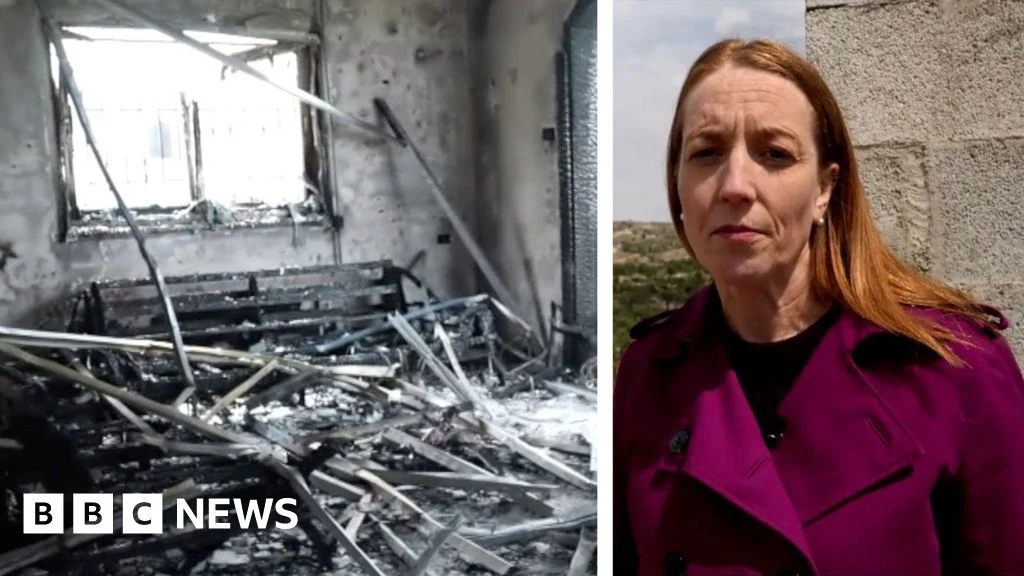
Inside the Palestinian home attacked by settlers
A wave of violent attacks by extremist Jewish settlers has swept across numerous Palestinian villages in the occupied West Bank, triggering widespread destruction and escalating an already volatile situation. The coordinated assaults began in the wake of the killing of an Israeli teenager on Saturday, reportedly after being hit by a vehicle driven by a Palestinian. This latest surge in settler violence, which has seen homes and vehicles torched, properties vandalized, and residents assaulted, marks a dangerous escalation in a region already grappling with unprecedented levels of conflict and tension. The United Nations reports that six Palestinians have been killed in the West Bank since March 1st, underscoring a stark increase in fatalities and highlighting the urgent need for de-escalation and protection for civilian populations.
The BBC’s Yolande Knell, reporting from Deir al-Hatab, bore witness to the devastating aftermath, where charred remains of homes and vehicles stood as grim testaments to the attacks. However, Deir al-Hatab is merely one of several communities targeted in what appears to be a coordinated campaign of retaliation. This pattern of reprisal attacks, often characterized by a lack of intervention from Israeli security forces, has long been a source of grave concern for human rights organizations and international bodies, further destabilizing a region where the fabric of daily life for Palestinians is increasingly frayed. The current situation unfolds against a backdrop of heightened regional instability, including recent military exchanges involving Israel and Iran, which while not directly linked to the West Bank violence, contribute to an environment ripe for escalation.
Escalation in the West Bank: A Timeline of Violence
The catalyst for the current wave of violence was the discovery of the body of Binyamin Achimeir, a 14-year-old Israeli settler, on Saturday, April 13. Achimeir had been reported missing the previous day after leaving the Malachei HaShalom outpost, an unauthorized settlement near the Palestinian village of al-Mughayyir, to tend to sheep. His disappearance prompted a large-scale search operation involving Israeli security forces and numerous settlers. The Israel Defense Forces (IDF) later confirmed his death, stating he had been murdered in a "terrorist attack," reportedly by being hit by a vehicle.
Within hours of the discovery, and even during the search operation, organized groups of settlers began launching violent reprisals against nearby Palestinian communities. The initial attacks on Saturday targeted al-Mughayyir, the village closest to where Achimeir’s body was found. Residents reported that large groups of settlers, some armed, stormed the village, setting fire to homes, vehicles, and agricultural land. Eyewitnesses described scenes of terror as settlers fired live ammunition, assaulted residents, and prevented firefighters from reaching burning properties. At least one Palestinian, Jihad Abu Alia, a 25-year-old resident, was killed in al-Mughayyir during these initial attacks, reportedly shot by settlers. Dozens more were injured, some seriously.
The violence did not abate on Saturday but intensified and spread throughout the weekend and into the following days. On Sunday, April 14, attacks were reported in several other Palestinian villages, including Duma, Beitin, and Aqraba. In these communities, settlers continued their rampage, destroying property, burning olive trees – a vital source of income for many Palestinian families – and physically assaulting residents. Videos circulated on social media showed settlers, often masked and armed, moving freely through villages, clashing with Palestinian residents, and setting fires. Israeli media reported that hundreds of settlers participated in these assaults, with some roadblocks set up by settlers themselves, preventing Palestinian movement.
By Monday, April 15, the scope of the destruction became clearer. Reports from Deir al-Hatab, as highlighted by the BBC, indicated significant damage, with homes and vehicles reduced to ashes. Further incidents were documented in Burqa, Qusra, and other villages across the Nablus and Ramallah governorates. The cumulative impact of these attacks has been devastating, displacing families, destroying livelihoods, and instilling a profound sense of fear and insecurity among Palestinian residents. The pattern observed is one of collective punishment, where entire communities are targeted in response to an act attributed to an individual.
The six Palestinian fatalities recorded by the UN since March 1st underscore a broader, alarming trend. These include not only Jihad Abu Alia from al-Mughayyir but also other individuals killed in separate incidents involving either Israeli security forces or settlers in the preceding weeks, signaling a continuous deterioration of security in the West Bank long before the latest settler attacks. This grim tally highlights a sustained period of lethal violence, making 2024 one of the deadliest years for Palestinians in the West Bank in recent memory.
Roots of the Conflict: Settler Violence in the West Bank
The recent spate of attacks is not an isolated phenomenon but rather a stark manifestation of a deeply entrenched and escalating problem of settler violence in the occupied West Bank. Israeli settlements, which house approximately 700,000 Israeli settlers, are considered illegal under international law, a position reaffirmed by numerous United Nations Security Council resolutions. Despite this, Israel maintains that the West Bank is disputed territory and continues to expand these settlements, often through the establishment of unauthorized outposts, like Malachei HaShalom, which are built without official Israeli government permits but frequently receive de facto support and infrastructure from the state.
The presence of settlements and outposts creates inherent friction points with Palestinian communities. Settlers, particularly those from extremist ideological backgrounds, often seek to expand their control over land, resources, and routes, leading to frequent clashes over access to agricultural land, water sources, and freedom of movement. Human rights organizations, both Israeli and international, have consistently documented a pattern of settler violence against Palestinians, which includes physical assaults, vandalism of property, destruction of olive groves, arson attacks on homes and mosques, and harassment. This violence is often accompanied by a perceived lack of effective law enforcement by Israeli authorities.
The issue of impunity for settler violence is a critical concern. Investigations by groups such as B’Tselem and Yesh Din frequently highlight a low rate of indictments and convictions for settler attacks, contributing to a sense that perpetrators can act without fear of serious legal repercussions. This perceived impunity, coupled with the protective presence of the Israeli military, emboldens extremist elements within the settler population. Critics argue that the Israeli military often acts to protect settlers, even when they are engaged in violent acts, rather than to protect Palestinian civilians from settler aggression.
The period since October 7, 2023, has seen an unprecedented surge in settler violence. According to data from the UN Office for the Coordination of Humanitarian Affairs (OCHA), settler-related incidents resulting in Palestinian casualties or property damage significantly increased in the months following the Hamas attacks on Israel. This increase is attributed to a combination of factors, including heightened tensions, a sense of collective grievance among some settlers, and the reduced presence of Israeli security forces in some areas, as many units were redeployed to the Gaza border or the northern front. The broader geopolitical climate, including the ongoing war in Gaza and recent military actions between Israel and Iran, further exacerbates an already fragile security environment, creating a fertile ground for extremist actions and a cycle of violence. While the killing of the Israeli teenager was the immediate trigger for the latest attacks, the underlying conditions for such widespread violence have been intensifying for months.
A Pattern of Escalation: Data and Trends
The data unequivocally illustrates a deepening crisis of settler violence in the West Bank. According to the UN Office for the Coordination of Humanitarian Affairs (OCHA), 2023 marked the highest number of settler attacks against Palestinians on record since OCHA began collecting such data in 2006. In the first nine months of 2023 alone, there were over 1,000 settler-related incidents that resulted in Palestinian casualties or property damage. This figure far surpassed previous annual totals and indicated a dramatic acceleration of violence. The trend has continued into 2024, with the recent wave of attacks further contributing to these alarming statistics.
Specifically, OCHA reported that in the six months following October 7, 2023, there were approximately 700 settler attacks against Palestinians in the West Bank. These incidents resulted in over 300 Palestinian casualties and significant damage to Palestinian property, including homes, vehicles, and agricultural infrastructure. The recent events add significantly to these figures, with preliminary reports indicating hundreds of homes damaged or destroyed, dozens of vehicles torched, and substantial agricultural land, including countless olive trees, devastated. The economic impact on already struggling Palestinian communities is profound, particularly for those reliant on agriculture.
Casualty figures for the West Bank paint an even grimmer picture. The UN reported that 2023 was the deadliest year on record for Palestinians in the West Bank, with over 300 killed, including more than 80 children. While the majority of these fatalities were at the hands of Israeli security forces, a significant number were attributed to settler violence. The six Palestinian deaths since March 1st, 2024, including the recent fatality in al-Mughayyir, contribute to a rising death toll that shows no signs of abating. For context, in the first three months of 2024, over 100 Palestinians have been killed in the West Bank, surpassing the number of fatalities in the same period in 2023.
Human rights organizations have consistently highlighted the systemic nature of the problem. B’Tselem, an Israeli human rights group, has repeatedly published reports detailing how settler violence often occurs with the passive or active assistance of Israeli soldiers, or with the soldiers failing to intervene to protect Palestinians. Their investigations often point to a "dual legal system" in the West Bank, where settlers enjoy significantly more protections and a higher degree of impunity than Palestinians, who are subject to military law. Yesh Din, another Israeli organization, reported that over 90% of investigations into settler violence against Palestinians are closed without an indictment. This lack of accountability perpetuates the cycle of violence and deepens Palestinian distrust in the Israeli justice system.
The destruction of agricultural assets, particularly olive trees, carries both economic and symbolic weight. Olive farming is a cornerstone of the Palestinian economy and culture, passed down through generations. The deliberate uprooting and burning of these trees, which can take decades to mature, represents a direct assault on Palestinian livelihoods and heritage. This systematic destruction, coupled with restrictions on movement and access to land, contributes to the ongoing humanitarian crisis in the West Bank and fuels resentment and despair.
Calls for Calm and Accountability
The widespread settler attacks have drawn sharp condemnation and calls for de-escalation from numerous international bodies and governments, though effective action remains elusive.
The Palestinian Authority (PA) swiftly condemned the attacks as "organized terrorism" perpetrated by "settler gangs" under the protection of the Israeli occupation forces. PA President Mahmoud Abbas called for urgent international intervention to provide protection for the Palestinian people and hold Israel accountable for the actions of its settlers. The PA’s Ministry of Foreign Affairs described the events as "ethnic cleansing" and a systematic campaign aimed at forcibly displacing Palestinians from their land. They have consistently called on the international community to recognize the State of Palestine and impose sanctions on illegal settlements and violent settlers.
Israeli authorities have issued mixed responses. Prime Minister Benjamin Netanyahu called for calm and urged citizens not to take the law into their own hands, stating that "these are not our ways." The Israel Defense Forces (IDF) also condemned the violence, stating that "the IDF and security forces are operating in Judea and Samaria [West Bank] to ensure security and prevent acts of terrorism, and will continue to do so." The IDF announced increased troop deployments to the West Bank to prevent further clashes and maintain order. However, critics, including human rights organizations, argue that these condemnations are often followed by insufficient action to prosecute settler perpetrators or prevent future attacks, highlighting a deep-seated issue of impunity. While some arrests of settlers involved in the violence were reported, the overall rate of accountability remains low.
The United Nations has expressed grave concern over the escalating violence. The UN Special Coordinator for the Middle East Peace Process, Tor Wennesland, condemned the killing of the Israeli teenager and the subsequent settler attacks, calling for an immediate end to all violence. He reiterated the UN’s call for all parties to respect international law, protect civilians, and hold perpetrators accountable. OCHA emphasized the humanitarian impact, urging for safe and unhindered access for humanitarian assistance and protection for affected communities. The UN Human Rights Office called for a thorough and transparent investigation into all incidents of violence and for accountability to be ensured, highlighting that the failure to do so only fuels further cycles of violence.
The United States has also weighed in, with the State Department issuing a statement condemning both the killing of the Israeli teenager and the subsequent extremist settler violence. They called for immediate de-escalation, urging Israel to ensure the protection of Palestinian civilians and to hold those responsible for the violence accountable. This stance, while echoing calls for calm, has been criticized by some for not being strong enough or for failing to exert sufficient pressure on Israel to curb settler aggression.
The European Union and several individual European nations have similarly condemned the attacks, reiterating their position on the illegality of settlements under international law and calling for an end to violence and a return to efforts towards a political solution. They have emphasized the importance of upholding human rights and ensuring accountability for all acts of violence.
Far-Reaching Consequences and Future Prospects
The current wave of settler violence carries far-reaching consequences that threaten to further destabilize the West Bank and undermine any prospects for a peaceful resolution to the Israeli-Palestinian conflict.
Firstly, the attacks exacerbate the cycle of violence. Retaliatory actions by settlers often provoke counter-responses from Palestinians, trapping both communities in a dangerous spiral. The lack of accountability for settler violence fuels Palestinian resentment and desperation, potentially leading to further acts of resistance or individual attacks, which in turn are used to justify further settler aggression or military operations. This cycle makes any de-escalation incredibly challenging.
Secondly, the humanitarian impact on Palestinian civilians is severe. Beyond the immediate casualties and destruction of property, the pervasive fear and insecurity have a profound psychological toll. Communities live under constant threat, their daily lives disrupted, and their economic stability shattered. Restrictions on movement, checkpoints, and settler intimidation hinder access to essential services, agricultural land, and markets, deepening an already precarious humanitarian situation. The destruction of olive groves and other agricultural assets directly impacts food security and livelihoods, pushing more families into poverty.
Thirdly, these events have significant political implications. The unchecked expansion of settlements and the violence perpetrated by extremist settlers are widely seen as major obstacles to the two-state solution, which envisions an independent Palestinian state alongside Israel. The international community, including the United States, largely views settlement expansion as eroding the viability of a future Palestinian state. The current violence further diminishes trust between Israelis and Palestinians, making any future negotiations or peace efforts incredibly difficult. It also strains Israel’s international standing, drawing criticism from allies and fueling calls for sanctions or other punitive measures.
Finally, the crisis of accountability undermines the rule of law and democratic principles. When perpetrators of violence are not brought to justice, it sends a dangerous message that certain groups are above the law. This erodes public confidence in institutions and contributes to a climate of lawlessness in the West Bank. For Palestinians, the perceived complicity or inaction of Israeli security forces reinforces the feeling of being unprotected and marginalized under military occupation.
In the immediate future, international pressure will likely intensify on Israel to curb settler violence and ensure accountability. However, with a right-wing government in Israel that includes ministers who openly support settlement expansion and express sympathy for settlers, significant policy shifts appear unlikely. The West Bank remains a tinderbox, and without a concerted effort from all parties and robust international intervention to protect civilians, enforce international law, and address the root causes of the conflict, the current escalation risks spiraling into even wider and more devastating conflict.

Related Posts
Zambia on Edge: Opposition Leader Arrested Amid Allegations of Insurrection Plot and Election Tensions
Rescuers search for survivors of powerful Indonesia earthquake

