Japan’s Kawasaki EC-2 Electronic Warfare Aircraft Completes Maiden Flight as Tokyo Bolsters Electromagnetic Domain Capabilities
The Japan Air Self-Defense Force (JASDF) reached a significant milestone in its modernization efforts on March 17, 2026, as its latest specialized electronic-warfare (EW) platform, the EC-2, successfully conducted its maiden flight. Taking off from Gifu Air Base, the modified aircraft represents a critical component of Japan’s broader strategy to secure superiority in the electromagnetic spectrum—a domain increasingly recognized by global military powers as the decisive frontier of modern conflict. The flight marks the beginning of an intensive testing phase aimed at meeting an operational induction deadline of March 2027.
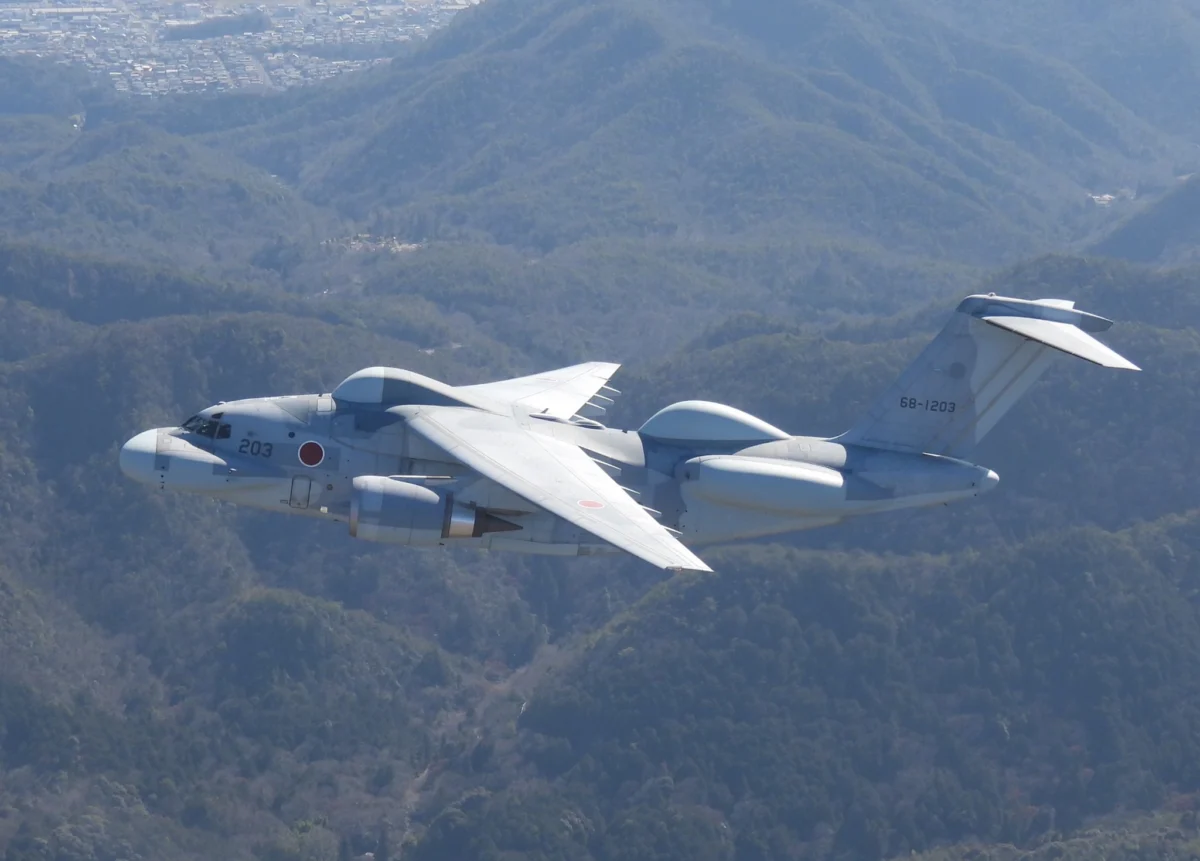
The EC-2 is a heavily modified derivative of the Kawasaki C-2 tactical transport aircraft, a twin-jet airlifter that has become the backbone of Japan’s logistical reach. By repurposing the C-2 platform for the standoff electronic warfare role, the Japan Ministry of Defense (ATLA – Acquisition, Technology & Logistics Agency) has leveraged the airframe’s significant payload capacity, long endurance, and high-altitude performance to house a suite of sophisticated, domestically developed jamming and intelligence systems.
Design and Development: Form Following Function
While the EC-2 has drawn attention from the global aviation community for its unconventional appearance—characterized by numerous "bumps," fairings, and a distinctive bulbous nose—every modification serves a specific technical purpose. The aircraft features a large, "platypus-like" radome on the nose, two tandem dorsal humps along the upper fuselage, and significant lateral fairings extending from the sides of the aircraft.
These protrusions are designed to house the massive antennas and sensitive sensor arrays required for standoff jamming. Electronic warfare aircraft require substantial internal volume for cooling systems and power generation to support high-output jamming transmitters, making the C-2 an ideal host compared to smaller business jets or fighter-derived platforms. The lateral fairings, in particular, allow for side-looking arrays that can scan and disrupt enemy frequencies while the aircraft patrols a safe distance from hostile airspace.
The transition from the original C-2 transport to the EC-2 configuration began with the first production C-2 airframe delivered to the JASDF. This choice reflects a pragmatic approach to procurement, utilizing a proven domestic airframe to minimize integration risks while maximizing the "sovereignty" of the onboard electronic systems.
The Technological Heart: Domestic Innovation in EW
The core of the EC-2’s mission capability lies in its integrated electronic warfare suite, much of which has been developed within Japan to ensure that the JASDF maintains a technological edge tailored to its specific regional threats. Central to this suite is the upgraded J/ALQ-5 jamming system.
Unlike previous generations of EW equipment, the systems aboard the EC-2 are designed for "standoff" operations. This allows the aircraft to operate from a position of relative safety—behind the front lines or outside the range of enemy surface-to-air missile (SAM) batteries—while effectively neutralizing or "blinding" enemy radar, communications, and data links. The aircraft’s specialized equipment includes:
- Electronic Countermeasures (ECM): Systems designed to deceive or disrupt enemy radar and radio signals.
- Electronic Support Measures (ESM): High-sensitivity receivers that detect, identify, and locate enemy electronic emissions.
- Satellite Communications (SATCOM): Advanced arrays that allow the EC-2 to act as a secure data relay hub in contested environments.
- Cross-Domain Integration: Hardware that allows the aircraft to feed real-time targeting and threat data to naval, ground, and other air assets.
Strategic Context: The Competitive Electromagnetic Environment
The development of the EC-2 is not an isolated procurement project but a direct response to the deteriorating security environment in the Indo-Pacific. Japan’s fiscal 2026 defense budget explicitly identifies the electromagnetic spectrum as a "frontline of offense and defense."
The rapid modernization of the People’s Liberation Army (PLA) of China has seen the introduction of specialized EW platforms such as the Y-9LG and the J-16D. Similarly, Russian activities in the Far East and North Korea’s advancing missile and radar capabilities have necessitated a robust Japanese response. Tokyo’s strategic planners have concluded that without the ability to suppress enemy air defenses and disrupt adversary command-and-control (C2) networks, traditional kinetic assets—like F-35 stealth fighters or Aegis-equipped destroyers—would face significantly higher risks.
"Securing superiority in the domain of electromagnetic spectrum is an urgent issue," the Ministry of Defense stated in its budget documentation. The EC-2 is intended to provide the "shield" and "cloak" under which the rest of the Self-Defense Forces can operate effectively.
Fleet Evolution and the Role of the Iruma Air Base
Upon completion of its flight test program and formal induction in 2027, the EC-2 will be assigned to the Electronic Warfare Operations Group stationed at Iruma Air Base, located in the Saitama Prefecture east of Tokyo. Iruma has long served as the hub for Japan’s signal intelligence (SIGINT) and EW operations.
The EC-2 arrives as a long-overdue replacement and expansion of Japan’s EW capabilities. For decades, the JASDF relied on a solitary EC-1 aircraft—a derivative of the older, smaller Kawasaki C-1 transport—which entered service in 1986. The EC-1 was officially retired last year, leaving a temporary gap that the EC-2 is designed to fill with vastly superior range and processing power.
While the JASDF currently operates 18 C-2 airframes in total, the fleet is being diversified into specialized roles:
- Transport: 16 aircraft remain in the standard tactical airlift configuration.
- RC-2: One airframe was converted into an electronic intelligence (ELINT) platform, which entered service in 2020.
- EC-2: The current EW conversion undergoing testing.
The Japanese defense acquisition directorate has indicated that the total number of EC-2s to be fielded is "currently under consideration," though previous requirements documents have suggested a target of at least four aircraft. Funding for the program remains robust, with 41.4 billion yen (approximately $262 million) allocated in the most recent budget to sustain development and conversion.
Broader Implications: The C-2 as a Multi-Mission Platform
The success of the EC-2 maiden flight also highlights the versatility of the Kawasaki C-2 airframe, which Japan is increasingly viewing as a modular "truck" for various high-end technologies. Beyond EW and SIGINT, the JASDF has recently explored the "Rapid Dragon" concept, an American-developed system for launching palletized munitions from cargo aircraft.
Testing has involved a C-2 aircraft dropping palletized long-range cruise missiles, such as the upgraded Type 12 Surface-to-Ship Missile (SSM). This capability would allow a transport aircraft to suddenly function as a heavy bomber or standoff missile carrier, providing Japan with a significant increase in its "counterstrike" capacity without the need for a dedicated bomber fleet.
While the EC-2 is optimized for the non-kinetic role of jamming and disruption, its commonality with the rest of the C-2 fleet simplifies maintenance and training at Iruma and other bases. The ability of the JASDF to field specialized variants like the RC-2 (Intelligence) and EC-2 (Attack/Jamming) alongside standard transports suggests a move toward a more integrated, "Cross-Domain" force structure.
Chronology of the EC-2 Program
The path to the March 17 maiden flight has been a multi-year endeavor:
- 2010: The original Kawasaki C-2 makes its first flight, beginning its journey as Japan’s primary tactical airlifter.
- 2018-2019: Conceptual work begins on a dedicated EW successor to the aging EC-1.
- 2020: The RC-2 ELINT variant is formally inducted, proving the feasibility of the C-2 airframe for high-end sensor integration.
- 2023: Significant funding is allocated in the defense budget for the EC-2 conversion, and the J/ALQ-5 system enters final development phases.
- 2025: Ground testing and taxi trials of the EC-2 prototype (converted from the first production C-2) commence at Gifu.
- March 17, 2026: Maiden flight successfully completed.
- 2026-2027: Scheduled flight testing, system calibration, and aircrew training.
- March 2027: Envisioned operational deployment to Iruma Air Base.
Conclusion: A Pivot Toward Electronic Dominance
The successful maiden flight of the EC-2 is a clear signal of Japan’s intent to maintain a credible deterrent in an era of high-tech warfare. By investing in standoff jamming capabilities, Tokyo is addressing a critical vulnerability in its defense posture: the risk of its sensors being overwhelmed or its communications being severed by a sophisticated adversary.
The EC-2 may not possess the sleek lines of a modern fighter, but its "bumpy" exterior houses the tools necessary to win the invisible battle of the airwaves. As the JASDF moves toward its 2027 operational goal, the EC-2 will likely become one of the most vital—if least seen—assets in Japan’s arsenal, ensuring that the country can operate freely in the increasingly crowded and contested skies of East Asia.

Related Posts
Pentagon Forges Landmark Seven-Year Agreements with Boeing and RTX to Accelerate Standard Missile-3 Production and Stabilize Defense Supply Chains
Boeing Unveils Ultra Low-Cost Seeker to Enhance Missile Inventory and Combat Cost Challenges in Modern Warfare