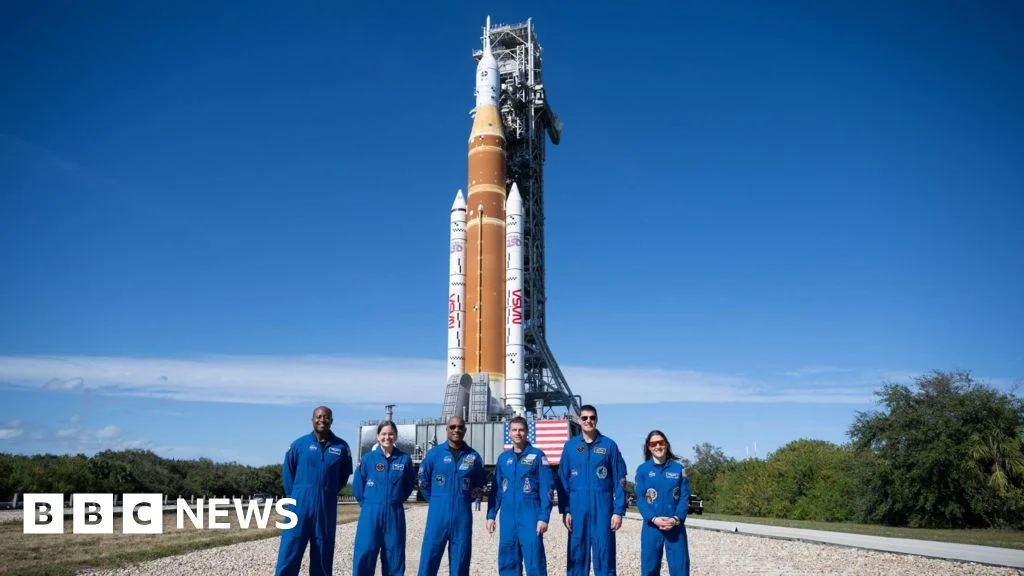
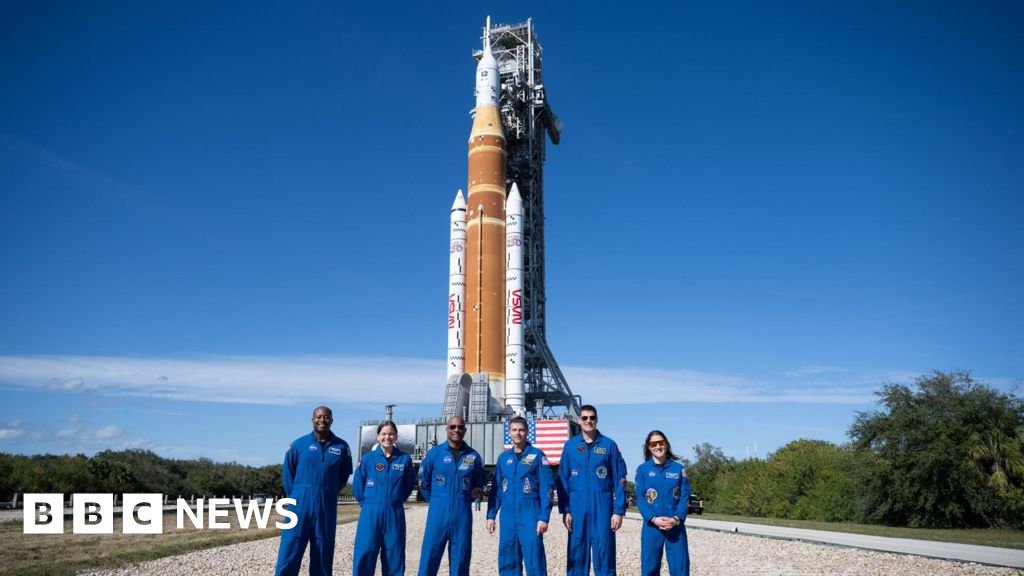
NASA’s Monumental Artemis II Mission Gears Up for Launch with Second Rollout of Giant Moon Rocket
NASA is once again moving its colossal Space Launch System (SLS) rocket and Orion spacecraft to the historic Launch Pad 39B at Florida’s Kennedy Space Center, marking a pivotal step towards the Artemis II mission. This endeavor aims to send a crew of four astronauts on a circumlunar journey, a feat of human spaceflight not undertaken in over half a century. The intricate process of transporting the 98-meter-tall (322-foot) rocket, taller than London’s Big Ben clock tower, signifies a renewed push after a technical issue with the rocket’s helium system necessitated an earlier return to the Vehicle Assembly Building (VAB) for repairs. Engineers are confident the issue has been resolved, and a series of final tests at the pad are expected to confirm the vehicle’s readiness for a launch window beginning in early April.
The Deliberate Journey to Launch Pad 39B
As night fell over Florida’s Space Coast, the towering SLS emerged majestically from the colossal VAB, one of the largest buildings in the world. Its slow, deliberate crawl towards the Atlantic coastline is a spectacle in itself, a testament to meticulous engineering and careful planning. The entire launch stack, including the SLS rocket, Orion spacecraft, and the Mobile Launcher platform, weighs approximately 5,000 tonnes (about 11 million pounds). This immense load is transported by Crawler-Transporter 2, a legendary vehicle specifically designed by NASA in 1965. This low-slung, tank-like behemoth, running on massive caterpillar tracks, was originally built to carry the Saturn V Moon rockets of the Apollo era and has since been upgraded to handle the even greater mass of the SLS.
The journey spans a distance of four miles (6.4 kilometers) and can take up to 12 hours, with the Crawler-Transporter 2 moving at a glacial pace of roughly 1 mile per hour (1.6 km/h). Its speed is intentionally reduced further on bends and as it ascends the gentle incline to the launch pad. This seemingly snail-like pace is a critical safety measure, likened by engineers to carrying a precious Ming vase. The slow, gentle motion minimizes stress and vibration on the multi-billion-dollar rocket and its intricate launch tower, safeguarding sensitive components. It also affords flight teams the maximum opportunity to monitor the "mobile skyscraper" for any unwelcome shifts or anomalies, ensuring its structural integrity throughout the complex transit. The VAB itself, a landmark of space exploration, stands 160 meters (525 feet) tall, providing ample space to assemble and service these towering rockets before their grand procession to the launch pad.
Addressing the Helium Anomaly: A Commitment to Safety
The decision to roll back the SLS to the VAB in March underscored NASA’s unwavering commitment to safety and mission success. During a critical fueling test, an interruption in the flow of helium to the rocket’s upper stage was detected. Helium plays a vital role in pressurizing propellant tanks, ensuring the correct fuel-to-oxidizer mixture reaches the engines and facilitating the safe draining of propellants if a launch abort is necessary. Any fault in this system could compromise the performance of the upper stage engine, a crucial component for the lunar trajectory, or present significant safety risks.
Rather than attempting to diagnose and repair the issue at the exposed launch pad, which would have offered limited access and potentially prolonged the delay, NASA managers opted for the prudent course of action: returning the entire vehicle to the controlled environment of the VAB. Inside the immense facility, specialized work platforms were raised around the upper stage, granting engineers full access to the helium circuit’s valves and intricate plumbing. Teams meticulously replaced suspect components and swapped out batteries in several critical systems. Following the repairs, exhaustive tests were conducted to confirm the fault had been cleared and that the helium system was functioning perfectly. This rigorous approach, prioritizing thoroughness over expediency, is a hallmark of NASA’s human spaceflight programs.
The Artemis II Mission: A Lunar Prelude
Artemis II is not just another space mission; it represents humanity’s return to the lunar vicinity with a crew after more than five decades. The mission’s primary objective is to test the critical systems of the Orion spacecraft with astronauts aboard in a deep-space environment, verifying its life support capabilities, communications, and navigation systems before a lunar landing. The ten-day mission will see the Orion spacecraft, propelled by the SLS, loop around the far side of the Moon, pushing further beyond Earth than any human has traveled before. This "test flight with crew" is a crucial bridge between the uncrewed Artemis I mission, which successfully demonstrated the integrated performance of the SLS and Orion in late 2022, and the future Artemis III mission, which aims to land astronauts on the lunar surface.
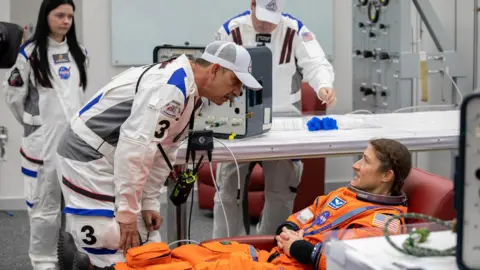
The crew for this historic mission comprises NASA astronauts Reid Wiseman (Commander), Victor Glover (Pilot), Christina Koch (Mission Specialist), and Canadian Space Agency astronaut Jeremy Hansen (Mission Specialist). Their inclusion marks a significant milestone, with Glover becoming the first African American to fly around the Moon and Hansen becoming the first Canadian to venture beyond Earth orbit. This international collaboration highlights the global nature of modern space exploration. The crew has already entered pre-flight quarantine, a standard procedure to ensure their health and minimize any risk of illness before launch, and will travel to Florida closer to the launch date to participate in final rehearsals, including suiting up and simulating the journey to the pad.
The Space Launch System and Orion: A New Era of Exploration
The Space Launch System (SLS) is NASA’s super heavy-lift expendable launch vehicle, designed to be the most powerful rocket ever built upon its debut. Standing at 98 meters (322 feet) in its initial Block 1 configuration, it generates 8.8 million pounds of thrust at launch, surpassing the Saturn V. Its core stage, similar in design to the Space Shuttle’s external tank, is powered by four RS-25 engines, augmented by two five-segment solid rocket boosters (SRBs). These SRBs, derived from Space Shuttle technology, provide over 75% of the rocket’s thrust during the first two minutes of flight. The upper stage, the Interim Cryogenic Propulsion Stage (ICPS), provides the necessary push to send Orion towards the Moon. The SLS represents a significant technological leap, integrating decades of shuttle and Apollo-era propulsion systems with advanced manufacturing and digital avionics.
Perched atop the SLS is the Orion Multi-Purpose Crew Vehicle (MPCV). Designed for deep-space missions, Orion can carry up to four astronauts and is equipped with advanced life support systems, robust thermal protection, and sophisticated navigation and communication capabilities. The European Service Module (ESM), provided by the European Space Agency (ESA), forms the backbone of Orion, supplying its propulsion, power, thermal control, and essential consumables like water and oxygen. Its advanced heat shield, a critical component for re-entry at lunar velocities (approximately 25,000 mph or 40,000 km/h), was successfully tested during Artemis I, enduring temperatures of nearly 2,760 degrees Celsius (5,000 degrees Fahrenheit). The successful integration and performance of these complex systems are paramount for the safety of the crew.
The Broader Artemis Vision: Gateway to Mars
The Artemis program is an ambitious, multi-phase initiative by NASA with international partners, aiming to return humans to the Moon sustainably and use lunar exploration as a stepping stone for future crewed missions to Mars. Artemis I, the uncrewed test flight of SLS and Orion in late 2022, validated the rocket’s performance and the spacecraft’s ability to withstand the harsh conditions of deep space and lunar re-entry. Artemis II, with its crewed circumlunar flight, builds directly on this success, adding the crucial human element to the testing regimen.
Looking ahead, Artemis III is slated for 2027 and aims to achieve the first human lunar landing since Apollo 17 in 1972, with the ambitious goal of putting the first woman and first person of color on the Moon. This mission will involve the Orion spacecraft docking with a human landing system (currently SpaceX’s Starship HLS) in lunar orbit. Subsequent missions, Artemis IV (planned for 2028) and beyond, envision the construction of the Lunar Gateway, a small space station orbiting the Moon that will serve as a staging point for lunar surface missions and a vital waypoint for deeper space travel. The program signifies a shift from the "flags and footsteps" approach of Apollo to a sustainable presence on and around the Moon, fostering scientific discovery, technological development, and preparing humanity for the ultimate journey to Mars.
Rigorous Testing and Final Preparations
Upon its arrival at Pad 39B, the SLS and Orion stack will undergo several days of intensive checks. Engineers will meticulously verify that the repairs carried out in the VAB have held up as intended and that no components have shifted or been compromised during the slow transit. The launch tower will be reconnected to the vehicle, and critical pressure tests will be performed on the helium system that caused the earlier issue. These tests are not merely routine; they are fundamental to confirming the integrity of the rocket’s plumbing and ensuring safe operations.
Controllers will also conduct comprehensive rehearsals of parts of the countdown sequence. These "wet dress rehearsals" typically involve sending commands through the same computers and networks that will be used on launch day, but without actually filling the propellant tanks with cryogenic fuel. This allows teams to practice critical procedures, identify any potential issues with software or hardware, and refine their operational readiness. Once these exhaustive tests are completed and all data reviewed, NASA’s mission management team will convene a few days before the earliest launch opportunity to give the final "Go/No-Go" decision for launch. This meticulous approach is standard for human-rated spacecraft, ensuring every possible contingency is considered and addressed.
Launch Windows and Global Anticipation
NASA is currently targeting 18:24 Eastern Daylight Time (23:24 in the UK) on April 1 for the first launch opportunity of Artemis II. This specific launch window is determined by a complex interplay of orbital mechanics, ensuring the correct trajectory for the lunar flyby and safe return to Earth, as well as favorable lighting conditions for photography and recovery operations. If the April 1 attempt is delayed, further launch windows are currently available on April 2, 3, 4, 5, and 6. Should these initial opportunities be missed, a final opportunity in April is set for the 30th. Each window requires specific alignment of Earth, Moon, and the launch site, making the launch period highly constrained.
The world watches with bated breath as NASA prepares for this landmark mission. The launch of Artemis II is more than just a technological display; it’s a profound statement about human ingenuity, collaboration, and our innate drive to explore. The mission carries the hopes of a new generation, inspiring future scientists, engineers, and astronauts to reach for the stars.
Implications for Deep Space Exploration
The success of Artemis II will have far-reaching implications for the future of deep space exploration. By demonstrating the SLS and Orion’s capability to safely transport and sustain a human crew beyond Earth orbit and around the Moon, it de-risks future, more complex missions. The experience gained from Artemis II in terms of operational procedures, crew training, and systems performance will be invaluable for planning the lunar landings of Artemis III and the eventual establishment of a sustained human presence on the Moon.
Furthermore, Artemis II is a critical stepping stone towards Mars. The technologies developed and refined for lunar missions, such as advanced life support, radiation shielding, long-duration power systems, and deep-space communication, are directly transferable to Mars-bound missions. The Moon serves as a proving ground, allowing engineers and astronauts to test concepts and hardware in a relatively close deep-space environment before committing to the much longer and more challenging journey to the Red Planet. The Artemis program, therefore, represents not just a return to the Moon, but a strategic and ambitious leap towards making humanity a multi-planetary species.

Related Posts

US Imposes Sweeping 50% Tariffs on Canadian Goods, Citing "Unequal Treatment" in Major Trade Escalation

The Silent Threat: How a Tick Bite Led to the World’s First Confirmed Fatal Mammalian Meat Allergy