Uganda’s oil ambitions under fire for relying on pessimistic IEA climate scenarios
The government of Uganda and its international partners are facing mounting criticism from environmental economists and climate scientists for basing the nation’s massive oil development strategy on the International Energy Agency’s (IEA) most pessimistic climate action scenarios. Critics argue that by aligning national economic policy with the IEA’s Stated Policies Scenario (STEPS)—which assumes that global climate targets will largely go unmet—Uganda is tethering its future to a "dying industry" and risking the creation of massive stranded assets. This controversy sits at the heart of the East African Crude Oil Pipeline (EACOP) project, a $10 billion venture that has become a global flashpoint for the tension between fossil fuel-led development and the urgent need for a global energy transition.

The Scenario Conflict: STEPS vs. Net Zero
The core of the disagreement lies in which version of the future the Ugandan government is preparing for. The International Energy Agency provides several pathways for the global energy system. The Net Zero Emissions by 2050 (NZE) scenario outlines what is required to limit global warming to 1.5°C, necessitating an immediate and drastic reduction in fossil fuel investment. Conversely, the Stated Policies Scenario (STEPS) reflects a world where current government policies and trends continue, leading to significantly higher fossil fuel demand and a projected temperature rise of roughly 2.4°C by the end of the century.
By referencing the STEPS model, Ugandan officials argue that global oil demand will remain robust enough through the 2040s to justify the development of the Lake Albert oil fields. However, climate advocates point out that if the world successfully moves toward the Paris Agreement goals, demand for oil will crater, potentially leaving Uganda with a 1,443-kilometer pipeline to nowhere and a mountain of debt. Relying on the "most pessimistic" scenario for climate action is, according to critics, a high-stakes gamble that assumes the rest of the world will fail to meet its environmental obligations.

Technical Scope and the Lake Albert Project
Uganda’s oil reserves were first confirmed in 2006 in the Albertine Graben, a region of immense biodiversity in the west of the country. The project is divided into two main upstream components: the Tilenga project, operated by TotalEnergies, and the Kingfisher project, operated by the China National Offshore Oil Corporation (CNOOC). Together, these fields are expected to produce approximately 230,000 barrels of oil per day at peak production.
Because the crude oil found in Uganda is highly viscous and "waxy," it cannot flow through a standard pipeline at ambient temperatures. This necessitates the construction of the East African Crude Oil Pipeline (EACOP), which will be the world’s longest electrically heated pipeline. Running from Hoima in Uganda to the port of Tanga in Tanzania, the pipeline must be kept at a constant temperature of 50°C (122°F). This requirement significantly increases the project’s carbon footprint, as the heating process itself requires a constant and massive supply of energy, further complicating the project’s climate credentials.

A Chronology of Uganda’s Oil Journey
The path to "first oil" has been fraught with delays, shifting timelines, and intensifying international scrutiny.
- 2006: Exploration teams from Tullow Oil and Hardman Resources confirm commercially viable oil deposits under Lake Albert.
- 2010–2012: Major players Total (now TotalEnergies) and CNOOC enter the Ugandan market, acquiring interests from Tullow Oil.
- 2013: The Ugandan government issues the first production licenses, marking the formal shift from exploration to development.
- 2017: Uganda and Tanzania sign the Inter-Governmental Agreement (IGA) for the EACOP, selecting the southern route to the Tanga port over a northern route through Kenya.
- 2021: The Final Investment Decision (FID) is delayed several times due to tax disputes and environmental concerns but is eventually signaled as imminent by the project partners.
- 2022: The European Parliament passes a resolution calling for the delay of the project, citing human rights violations and environmental risks.
- 2023–2024: Construction begins on the Kingfisher and Tilenga sites, while the EACOP enters the land acquisition and pipe-laying preparation phases.
- 2025–2026: Revised target dates for "first oil" production, though many analysts remain skeptical of this timeline.
Supporting Data and Economic Projections
The Ugandan government, led by the Petroleum Authority of Uganda (PAU), estimates that the oil sector will contribute significantly to the national economy. Official projections suggest that at its peak, the oil industry could contribute up to 30% of Uganda’s GDP and generate between $1.5 billion and $2 billion in annual revenue.

However, these figures are increasingly scrutinized. A report by the Climate Policy Initiative (CPI) suggested that the value of Uganda’s oil reserves has fallen by more than 70% since 2013 when adjusted for the global energy transition. If the world adheres to the NZE scenario, the "break-even" price for Ugandan oil—estimated to be between $40 and $50 per barrel—may become difficult to maintain as global prices fluctuate and cheaper producers in the Middle East dominate a shrinking market.
Furthermore, the project’s financing has become a battleground. To date, over 25 major international banks and 23 insurance companies have publicly stated they will not support the EACOP, citing its incompatibility with their climate commitments. This has forced Uganda and its partners to seek alternative funding sources, primarily from Chinese and Middle Eastern financial institutions, often at higher interest rates.

Official Responses and the "Right to Develop"
President Yoweri Museveni has been a vocal defender of the project, frequently characterizing Western opposition as "economic racism" and "hypocrisy." The Ugandan government argues that the Global North, having built its wealth on centuries of fossil fuel consumption, is now attempting to "kick away the ladder" for African nations.
"Our oil is for our development," Museveni stated during a recent energy summit. "We cannot be told to remain in poverty to save a climate that others destroyed. We will develop our resources responsibly, but we will develop them."

TotalEnergies has also defended its involvement, asserting that the Tilenga and EACOP projects are "low-cost and low-carbon" compared to other global oil projects. The company claims it is implementing rigorous environmental safeguards, including biodiversity offset programs and the use of solar power to provide a portion of the pipeline’s heating needs. However, environmental groups like 350.org and StopEACOP argue that these measures are "greenwashing" and do not account for the massive Scope 3 emissions—the emissions generated when the oil is eventually burned by consumers.
Environmental and Social Impacts
The human and ecological cost of the project has been a primary driver of the criticism. The pipeline route crosses several critical ecosystems, including the Lake Victoria basin, which provides water for over 40 million people. A leak in this region could have catastrophic implications for food security and regional stability.

Moreover, the Tilenga project involves drilling inside the Murchison Falls National Park, Uganda’s oldest and largest protected area. While TotalEnergies claims the footprint of the drilling sites is minimal, conservationists argue that the noise, dust, and presence of thousands of workers will permanently disrupt the migratory patterns of elephants and other endangered species.
On the social front, the project has displaced or affected the land of more than 100,000 people across Uganda and Tanzania. While the companies involved claim that compensation has been fair and that new housing has been provided, human rights organizations have documented numerous cases of "delayed and inadequate" compensation, leaving many farmers without a livelihood for years while they wait for their new land.

Broader Implications and Analysis
The debate over Uganda’s oil ambitions is a microcosm of the broader global struggle over the "just transition." It raises a fundamental question: Should a developing nation be allowed to exploit its natural resources even if those resources contribute to a global crisis?
From a financial perspective, the reliance on the IEA’s STEPS scenario suggests a dangerous lack of "climate transition risk" planning. If Uganda invests billions into oil infrastructure while the rest of the world pivots to electric vehicles and renewable energy, the country could face a "debt trap." The infrastructure is being built with borrowed money that must be repaid with oil revenues. If those revenues fail to materialize due to low global demand, the Ugandan taxpayer will be left to foot the bill.

Furthermore, the project sets a precedent for other African nations with recently discovered fossil fuel deposits, such as Mozambique (gas), Senegal (oil), and Namibia (oil). If Uganda succeeds, it may embolden a new wave of fossil fuel development across the continent. If it fails, it could serve as a cautionary tale of how the "resource curse" can be exacerbated by a rapidly changing global climate policy.
As construction continues and the 2026 production target approaches, the eyes of the world remain on the Albertine Graben. The outcome will not only determine Uganda’s economic trajectory for the next thirty years but will also serve as a definitive test of whether the global community’s commitment to the Paris Agreement is strong enough to reshape the development strategies of emerging economies. For now, Uganda remains committed to its path, betting that the world’s thirst for oil will outlast the world’s resolve to save the climate.

Related Posts
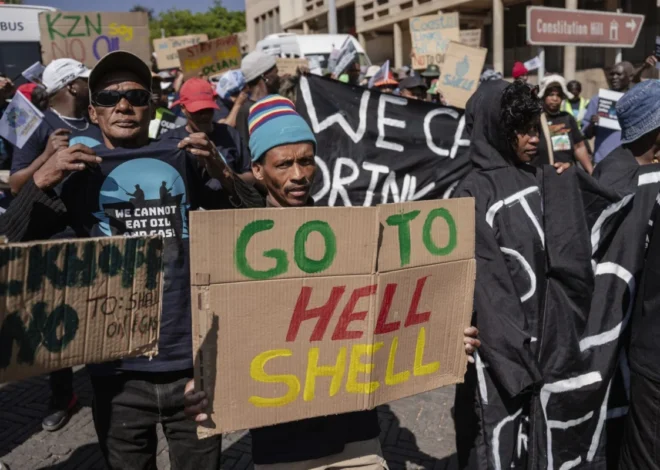
Constitutional Court of South Africa Bars Shell Oil Exploration in Landmark Victory for Environmental and Community Rights
The Battle for Saldanha Bay: South Africa’s Ambitious Ocean Economy Strategy Faces Legal and Environmental Reckoning