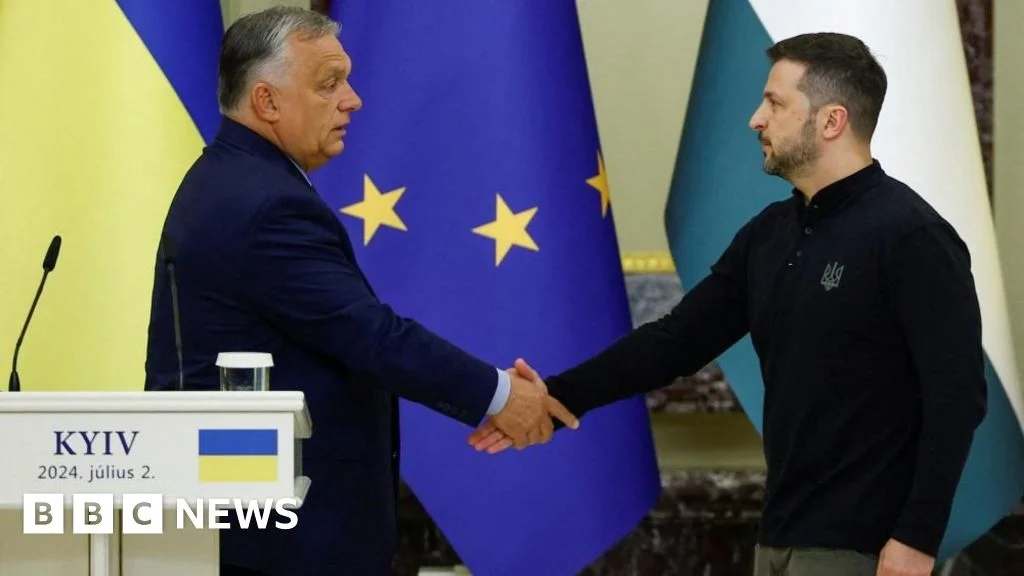
Hungary’s Political Landscape Erupts Amidst Claims of Ukrainian Interference and Russian Disinformation Ahead of Pivotal Elections
Hungary is currently engulfed in a storm of political contention, just weeks before its parliamentary elections on April 12, as the ruling Fidesz party, led by Prime Minister Viktor Orbán, levels explosive accusations against war-torn Ukraine. The Hungarian government alleges that Kyiv is actively attempting to prevent Orbán and Fidesz from securing another term, going as far as preparing physical violence against the prime minister and his family, and orchestrating attacks or sabotage on critical energy infrastructure. These claims have ignited a furious diplomatic and informational battle, with Ukraine vehemently denying the allegations and accusing Budapest of manufacturing a "hate campaign" to manipulate voters. Complicating this already volatile situation, reports suggest that Russia is also covertly involved, allegedly launching a disinformation campaign to bolster Orbán’s position and undermine the surging opposition.
Escalating Accusations and the Battle for Narrative Control
The Hungarian government’s narrative, amplified through state-controlled media, paints Ukraine as an aggressive external force actively seeking to destabilize Hungary and influence its democratic process. Ministers have repeatedly claimed that Ukraine "will stop at nothing" to see Orbán’s defeat, suggesting a direct and dangerous interference in Hungarian sovereignty. These accusations, unprecedented in their severity during peacetime, form a central pillar of Fidesz’s re-election campaign, which has increasingly focused on national security and the perceived threats emanating from the ongoing conflict in Ukraine. The claims of potential physical violence against the prime minister and his family, alongside threats to vital energy installations, are designed to evoke a sense of existential peril among the Hungarian populace.
In stark contrast, the Ukrainian government has dismissed these allegations as baseless and politically motivated. Kyiv asserts that Hungary is intentionally fabricating a campaign of fear and hatred against Ukraine to rally domestic support for Fidesz. Ukrainian officials argue that Orbán’s government is exploiting the war to divert attention from internal issues and to demonize a neighboring country fighting for its survival. This war of words highlights the deeply strained relationship between the two nations, which has been exacerbated by Hungary’s often critical stance on sanctions against Russia and its perceived reluctance to provide substantial aid to Ukraine.
The Shadow of Russian Influence and Electoral Dynamics
Adding another layer of complexity to the Hungarian political drama is the alleged involvement of Russia. A report by the Financial Times on Wednesday revealed that the Social Design Agency, a media consultancy firm with known links to the Kremlin, is reportedly orchestrating a massive disinformation campaign within Hungary. The objective of this campaign, according to the report, is twofold: to bolster the electoral prospects of Viktor Orbán and his Fidesz party, and simultaneously to discredit the emergent opposition, particularly the Tisza Party and its charismatic leader, Peter Magyar. This revelation underscores the broader geopolitical chessboard on which Hungarian domestic politics is being played, suggesting external actors are actively seeking to shape the outcome of the upcoming elections.
With just 30 days remaining until the parliamentary election on April 12, the intensity of this "anti-Ukraine hysteria" has led some political analysts to believe that Prime Minister Orbán is showing signs of panic. Recent polling data indicates a significant shift in public sentiment, with Fidesz reportedly trailing the Tisza Party by 39% to 50% in the latest surveys. Such a deficit, if accurate, would mark a dramatic departure from Fidesz’s dominant electoral performance over the past decade. This potential vulnerability, after four consecutive electoral victories, could explain the heightened rhetoric and dramatic allegations.
However, other observers offer a different interpretation. They contend that Orbán, a seasoned political strategist, deeply understands his electorate. His long track record suggests a calculated approach to political messaging, often leveraging nationalist sentiment and perceived external threats. In this view, the current campaign is not a sign of panic but a deliberate strategy to convince Hungarian voters that the nation faces mortal danger, thereby galvanizing support for Fidesz as the only party capable of ensuring stability and security. If successful, this strategy could secure Orbán a remarkable fifth consecutive victory, a feat that would solidify his position as one of Europe’s longest-serving leaders.
The Druzhba Pipeline: A Tangible Flashpoint
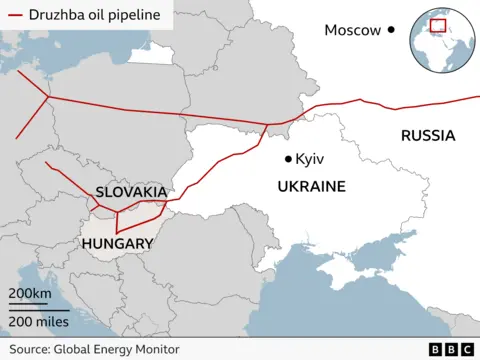
At the heart of the immediate dispute between Budapest and Kyiv lies the disruption of the Druzhba (Friendship) pipeline, a critical artery for Russian oil supplies to Hungary and Hungarian-run Slovak refineries. This pipeline, a legacy of the Soviet era, represents a significant point of energy dependence for Hungary, which has historically resisted efforts to diversify its energy sources away from Russia.
Timeline of the Druzhba Dispute:
- January 27: Oil deliveries through the southern leg of the Druzhba pipeline abruptly ceased. The disruption followed a Russian drone strike that caused a fire at the Brody oil hub in western Ukraine. Brody is a key junction for the pipeline system, and the incident immediately raised concerns about energy security in Central Europe.
- Late January – Early March: No oil arrived in Hungary via the pipeline, leading to growing anxieties about potential fuel shortages and economic impact. Hungarian officials began to vocalize concerns, initially framing it as a technical issue.
- Early March: Prime Minister Orbán escalated the rhetoric, publicly presenting satellite images that, according to him, demonstrated the pipeline itself was physically intact. Based on this, he and his ministers directly accused Ukraine of deliberately delaying repairs to harm Orbán’s re-election chances by creating an artificial fuel shortage in Hungary. This accusation moved the issue from a technical problem to a politically charged act of interference.
- Response from Security Analysts: András Rácz, a security analyst at the German Council on Foreign Relations, countered the Hungarian government’s claims. He stated that the Orbán government was "not telling the full truth" about the absence of technical obstacles. Rácz explained that during the January 27 Russian attack, an oil tank at Brody, containing 75 million liters of crude oil, was severely damaged. To prevent an environmental catastrophe and salvage the crude, the oil was pumped into the pipeline for storage. The presence of this stored oil, coupled with other technical damage resulting from both the initial and a subsequent Russian attack, prevents the restoration of regular supply. Ukraine has estimated that full repairs could take approximately six weeks. This technical explanation directly contradicts Hungary’s narrative of deliberate political obstruction.
Campaign Tactics and Public Anxiety
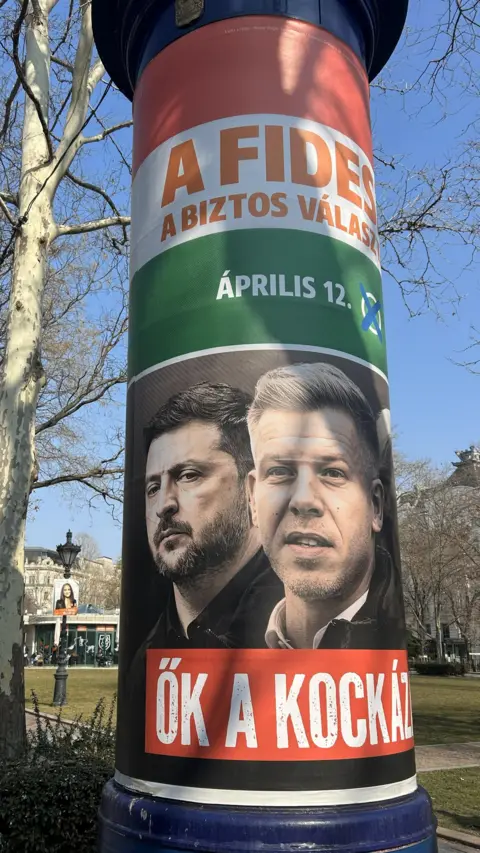
Beyond the pipeline dispute, the "Ukraine hysteria" in Hungary manifests in various forms across the country’s public and media landscape. Giant billboards and city lights posters, strategically placed in urban centers and along major roadways, dominate the visual environment. Many of these depict Ukrainian President Volodymyr Zelensky in an unflattering light, often shown "begging" for money from EU chiefs, a visual designed to evoke resentment and suggest that Hungarian taxpayers are being unduly burdened by Ukraine.
Another prevalent theme involves juxtaposing Zelensky with Peter Magyar, the leader of the opposition Tisza Party. These posters accuse Tisza of planning to drag Hungary into the Ukraine war by aligning with what Fidesz labels "the pro-war lobby" in Brussels. Magyar vehemently denies these allegations, asserting at his daily rallies that Tisza is "the real party of peace." The Fidesz campaign slogan, visible on posters, explicitly states: "Fidesz is the certain choice: They [Zelensky and Magyar] are the risk."
Prime Minister Orbán and his ministers have also embarked on a nationwide tour, addressing what they brand as "anti-war" assemblies of Fidesz supporters. These events serve as platforms to reinforce the government’s narrative of safeguarding Hungary from external threats and maintaining peace, implicitly positioning Fidesz as the only party capable of doing so.
Perhaps the most shocking campaign material is an artificial intelligence (AI) produced video disseminated by Fidesz. The video chillingly depicts a little girl asking her weeping mother when her father will return, followed by a cut to a firing squad preparing to execute her blindfolded father. The video explicitly suggests that such a fate awaits Hungarians if they vote for Tisza, a potent and disturbing attempt to instill fear. Despite reader complaints regarding its violation of rules on political content and violence, Facebook reportedly rejected these complaints.
In an unusual move for peacetime, the Hungarian army has been deployed to patrol key energy installations across the country. According to the Fidesz narrative, this deployment is intended "to reassure" the public. However, the Tisza opposition argues it is designed "to frighten" them, reinforcing the government’s message of imminent danger. In the eastern city of Debrecen, Defence Minister Kristof Szalay-Bobrovniczky warned that the city could be a target for "hybrid operations" such as sabotage. This pronouncement led to public concerns, with Tamas Polgar Toth, a journalist at the independent Debreciner news portal, reporting that "many people contact us, asking why, if the danger of attack is real, the government does not provide information about air-raid shelters." The Fidesz mayor of Debrecen, Laszlo Papp, later indicated that this was being considered, further highlighting the public anxiety generated by the government’s rhetoric. The dominant pro-government media, acting as a powerful echo-chamber, consistently amplifies these government messages, shaping public perception and reinforcing the narrative of external threats.
Financial and Diplomatic Fallout
The tensions have also manifested in significant financial and diplomatic disputes. On February 21, Prime Minister Orbán utilized Hungary’s veto power within the European Union, blocking the delivery of a crucial EU loan package to Ukraine. Orbán explicitly linked the release of the funds to the restoration of oil flow through the Druzhba pipeline, asserting that Hungary would not approve the loan until its energy security concerns were addressed. This move drew criticism from other EU member states, who viewed it as holding Ukraine hostage amidst its struggle against Russian aggression. In response, Ukraine was forced to secure a €1.5 billion loan from the International Monetary Fund (IMF) to bridge the financial gap until the dispute with Hungary could be resolved.
The diplomatic standoff further intensified on March 4, when Ukrainian President Volodymyr Zelensky made a contentious statement that appeared to exacerbate the already strained relations. While not explicitly naming Orbán, Zelensky warned, "We hope that no-one in the European Union will block the €90 billion (£78bn) [of EU aid, currently vetoed by Hungary]. Otherwise we will give that person’s address to our armed forces so they can call on him and speak to him in their own language." This veiled threat, perceived by many as a direct challenge to Hungary’s prime minister, drew swift condemnation from Budapest.
On March 6, Prime Minister Orbán publicly reacted to Zelensky’s remarks, stating on state radio, "They want to get rid of us, with threats if possible, because if nice words don’t work, then with threats and blackmail." This exchange underscored the deep animosity and lack of trust between the two leaders, highlighting the personal dimension of the broader geopolitical dispute.
Further compounding the tensions, on March 5, two vehicles belonging to the Ukrainian state savings bank, Oschadbank, were seized while crossing Hungarian territory. The operation involved TEK anti-terror troops, a highly unusual deployment for what appeared to be a financial dispute. The independent HVG weekly subsequently depicted the TEK troops on its front cover as Viktor Orbán’s "private army" moving gold bars around the symbol of the Tisza party, implying political motivations behind the seizure. Pro-government media outlets quickly alleged that one of the lawyers representing the Ukrainian bank in its efforts to recover the money and vehicles was an ardent Tisza supporter, attempting to link the opposition party to illicit activities. In response to the incident, the Hungarian government issued a decree on Monday, ordering prosecutors to investigate "whether Hungarian criminal organisations, terrorist organisations or political organisations present in Hungary may have benefited from the transported assets," further politicizing the incident.
A Mission Without Official Status
In a final development, on Wednesday, a so-called fact-finding mission established by the Hungarian government entered Ukraine by car. Deputy Energy Minister Gábor Czepek announced their objective in a Facebook post: "Our job is to assess the status of the pipeline and create conditions for its restart." However, Ukraine quickly dismissed the mission, stating that the group was being treated merely as tourists. A statement from Ukraine’s foreign ministry clarified, "This group of individuals holds no official status, nor do they have any scheduled official meetings; therefore, it is fundamentally incorrect to refer to them as a delegation." This rejection highlights Ukraine’s skepticism regarding Hungary’s intentions and its refusal to grant official recognition to a mission perceived as politically motivated.
Broader Implications and Regional Instability
The current political and diplomatic turmoil in Hungary carries significant implications, both domestically and internationally. Domestically, the intense rhetoric and alleged disinformation campaigns threaten the integrity of the upcoming elections, raising concerns about voter manipulation and the health of Hungary’s democratic institutions. The Fidesz strategy, if successful, could solidify an authoritarian-leaning government, further distancing Hungary from mainstream European liberal democratic values.
On the international stage, Hungary’s confrontational stance towards Ukraine and its perceived alignment with Russia continue to strain relations within the European Union and NATO. Hungary’s repeated use of its veto power to block aid and sanctions undermines EU unity and complicates efforts to present a united front against Russian aggression. This ongoing friction impacts not only Ukraine’s ability to receive vital support but also raises questions about Hungary’s long-term geopolitical commitments. The accusations of Ukrainian interference and the deployment of the army for "reassurance" also risk creating a climate of regional instability, particularly given the ongoing war on Ukraine’s eastern flank. The entire situation underscores the profound challenges facing Central and Eastern Europe as the continent grapples with external threats and internal political divisions, with the outcome of Hungary’s April 12 election poised to shape the region’s trajectory for years to come.

Related Posts
Pentagon Forges Landmark Seven-Year Agreements with Boeing and RTX to Accelerate Standard Missile-3 Production and Stabilize Defense Supply Chains
Boeing Unveils Ultra Low-Cost Seeker to Enhance Missile Inventory and Combat Cost Challenges in Modern Warfare