US Navy Strengthens Blockade of Iran as USS Spruance Intercepts Cargo Vessel in the Strait of Hormuz
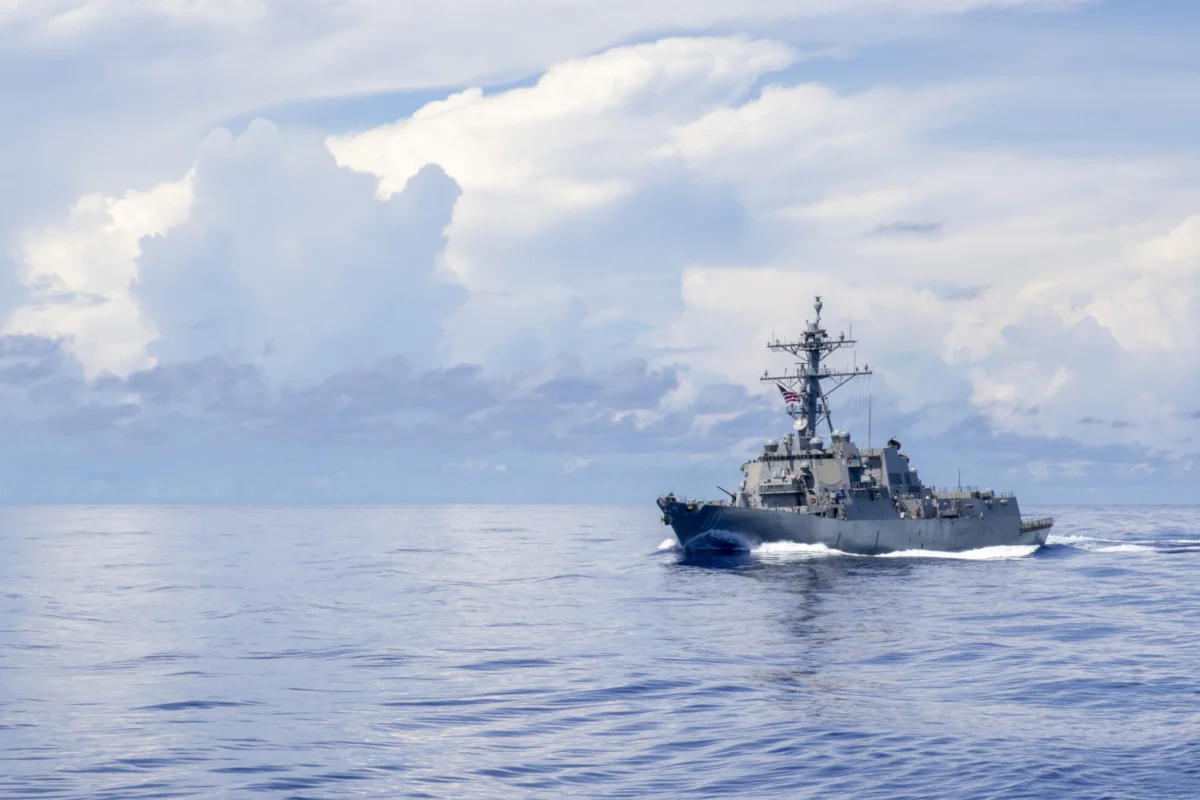
The United States Navy successfully intercepted and redirected an Iranian-flagged cargo vessel on Tuesday after the ship attempted to bypass an active maritime blockade in the Persian Gulf. According to statements released by U.S. Central Command (CENTCOM), the Arleigh Burke-class guided-missile destroyer USS Spruance (DDG 111) identified the vessel as it departed from the port of Bandar Abbas. The cargo ship reportedly attempted to evade detection by navigating closely along the Iranian coastline after exiting the strategic Strait of Hormuz. However, the USS Spruance maneuvered to intercept the vessel, forcing it to reverse course and return to Iranian waters.
This encounter marks a significant escalation in the enforcement of a massive naval operation that began on Monday. CENTCOM officials confirmed via social media that the blockade has been absolute in its initial phase, stating that ten vessels have been successfully turned away since the operation’s inception, with zero ships managing to break through the American perimeter. The blockade represents one of the most significant mobilizations of U.S. naval power in the region in decades, signaling a "maximum pressure" posture following the collapse of high-stakes diplomatic negotiations.
Strategic Scope of the Naval Blockade
The current blockade is an immense military undertaking, involving approximately 10,000 personnel across various branches of the U.S. Armed Forces. The maritime component is anchored by over a dozen warships, including the USS Spruance and the America-class amphibious assault ship USS Tripoli (LHA 7). The USS Tripoli, which functions as a "lightning carrier," provides a mobile platform for F-35B Lightning II stealth fighters, significantly enhancing the U.S. military’s ability to project air power and conduct surveillance over the narrow waters of the Gulf.
In addition to the surface fleet, the operation is supported by more than 100 aircraft, including fighter jets, maritime patrol aircraft, and unmanned aerial vehicles (UAVs). These assets provide a continuous "unblinking eye" over the Strait of Hormuz, ensuring that any movement from Iranian ports is detected in real-time. CENTCOM has clarified that while the blockade specifically targets vessels transiting to and from Iranian ports, the Strait remains open to international shipping that is not visiting Iran. This distinction is intended to mitigate some of the global economic fallout, though insurance rates for maritime transit in the region have already begun to climb.
The Collapse of the Islamabad Peace Talks
The decision to implement a full-scale blockade follows the failure of critical peace talks held in Islamabad, Pakistan, on April 11 and 12. The American delegation was led by Vice President JD Vance, accompanied by special envoys Steve Witkoff and Jared Kushner. The talks were intended to find a diplomatic resolution to the long-standing impasse regarding Iran’s nuclear program and its regional activities.
According to Vice President Vance, the negotiations reached a terminal stalemate when the Iranian delegation refused two primary American demands: the physical removal of all enriched uranium from Iranian territory and a verified commitment to permanently dismantle their nuclear enrichment infrastructure. "The security of the United States and our allies is non-negotiable," Vance stated following the talks. "Without a commitment to denuclearization, the Iranian regime cannot expect access to global markets."
The failure of these talks prompted President Donald Trump to announce the blockade via social media on April 13. The President’s directive to "seal off" the Strait of Hormuz to Iranian traffic was presented as a direct consequence of the regime’s perceived intransigence in Pakistan. This move effectively transitioned the U.S. strategy from economic sanctions to a direct military containment of Iranian trade.
Chronology of Escalation: April 2026
The rapid escalation of tensions follows a timeline that began with a tentative pause in hostilities earlier this month:
- April 7: A two-week ceasefire between the United States and Iran officially goes into effect, intended to provide a stable environment for diplomatic dialogue.
- April 11–12: High-level negotiations take place in Islamabad. Vice President JD Vance and special envoys meet with Iranian officials. The talks conclude without an agreement.
- April 13: President Trump announces on social media that the U.S. military will initiate a blockade of Iranian ports, citing the failed talks and the continued threat of Iran’s nuclear program.
- April 14: The blockade officially commences. U.S. naval assets, including the USS Spruance and USS Tripoli, take up positions in the Arabian Sea and the Gulf of Oman.
- April 15: CENTCOM reports that ten vessels have been turned back. The USS Spruance intercepts an Iranian-flagged cargo ship attempting to flee Bandar Abbas, marking the first major maritime encounter of the operation.
Tactical Capabilities and the Role of the USS Spruance
The USS Spruance, the vessel at the center of Tuesday’s interception, is an Arleigh Burke-class destroyer equipped with the Aegis Combat System. This system allows the ship to track and engage multiple air, surface, and subsurface threats simultaneously. Its presence in the Strait of Hormuz is a clear indicator of the U.S. Navy’s intent to maintain a high-readiness posture.
The destroyer’s ability to conduct "visit, board, search, and seizure" (VBSS) operations, combined with its advanced radar and sensor suites, makes it an ideal platform for enforcing a blockade. By redirecting the Iranian cargo vessel without the use of kinetic force, the Spruance demonstrated the "show of force" tactics that the U.S. Navy is currently employing to maintain the blockade while avoiding a direct military clash that could end the current ceasefire prematurely.
The Role of the USS Tripoli and Air Superiority
While the destroyers manage the surface-level interceptions, the USS Tripoli provides the necessary air cover to deter Iranian naval or air interference. As an amphibious assault ship configured for aviation-heavy operations, the Tripoli carries a contingent of Marine Fighter Attack Squadron (VMFA) aircraft. These F-35Bs provide a fifth-generation capability that far outclasses the aging fleet of the Islamic Republic of Iran Air Force.
The air component of the blockade also includes P-8A Poseidon maritime patrol aircraft and various surveillance drones. These assets allow the U.S. to monitor not just the shipping lanes, but also the movements of the Islamic Revolutionary Guard Corps Navy (IRGCN) fast-attack craft, which have historically been used to harass international shipping in the Strait.
Legal and Economic Implications
The implementation of a blockade is traditionally considered an act of war under international law. However, the Trump administration has framed the current operation as a "maritime enforcement action" necessary for national security. The legal justification rests on the premise that Iran’s nuclear enrichment activities pose an imminent threat that overrides standard maritime commerce protections.
Economically, the blockade of a major oil-producing nation and the restriction of traffic in the Strait of Hormuz—through which roughly 20% to 30% of the world’s total oil consumption passes—has sent shockwaves through global energy markets. While the U.S. has stated that non-Iranian traffic is permitted, the increased military presence and the risk of miscalculation have led many commercial shipping firms to reroute vessels or seek additional security guarantees.
Market analysts suggest that if the blockade continues beyond the current two-week ceasefire period, global oil prices could see a significant "war premium" added to every barrel. Furthermore, the insurance industry’s "War Risk" premiums for the Persian Gulf have reportedly tripled since Monday, adding substantial costs to the global supply chain.
International Reactions and Geopolitical Fallout
The international community remains deeply divided over the U.S. blockade. Close allies, including Israel and certain Gulf cooperation states, have signaled quiet support for the move, viewing it as a necessary step to curb Iranian influence and nuclear ambitions. Conversely, traditional adversaries and some European partners have expressed concern over the potential for a wider regional conflict.
China, a major purchaser of Iranian oil, has issued a formal protest, calling the blockade a violation of the principle of "freedom of navigation." A spokesperson for the Chinese Foreign Ministry stated that "unilateral actions that disrupt international shipping lanes are detrimental to global stability and economic recovery."
Russia has also criticized the move, with the Kremlin warning that the blockade could lead to an "uncontrollable escalation" in an already volatile region. Within the United States, members of Congress have requested a formal briefing on the operation’s long-term objectives and the legal framework under which the 10,000 troops are being deployed.
Future Outlook: The Fragility of the Ceasefire
The current situation is complicated by the existence of the two-week ceasefire that began on April 7. While the blockade is a form of military pressure, the U.S. has thus far avoided direct combat engagements with Iranian military forces. However, the ceasefire is set to expire in less than a week.
Military experts suggest that the coming days will be a "test of nerves" for both Washington and Tehran. If Iran continues to attempt to break the blockade using its own naval assets, or if it utilizes proxy forces to strike at U.S. ships, the ceasefire could collapse entirely.
The U.S. Navy’s success in turning back ten ships without firing a shot is a temporary tactical victory. The strategic question remains whether this level of pressure will force Iran back to the negotiating table with a renewed willingness to concede on its nuclear program, or if it will lead to a broader maritime conflict in one of the world’s most vital waterways. As the USS Spruance and the rest of the fleet maintain their stations, the eyes of the world remain fixed on the narrow corridor of the Strait of Hormuz.

Related Posts
Pentagon Forges Landmark Seven-Year Agreements with Boeing and RTX to Accelerate Standard Missile-3 Production and Stabilize Defense Supply Chains
Boeing Unveils Ultra Low-Cost Seeker to Enhance Missile Inventory and Combat Cost Challenges in Modern Warfare