Tanzanian Security Forces Accused of Lethal Crackdown on Bystanders Following Disputed 2025 General Elections
The Tanzanian government’s response to the 2025 general elections has come under intense international scrutiny following a comprehensive report by Human Rights Watch (HRW) documenting widespread abuses by security forces. The report, released today in Nairobi, details a "brazen crackdown" that resulted in the deaths and injuries of dozens of individuals who were not participating in the demonstrations. While the government has established a commission of inquiry to investigate the violence, rights groups argue that the scale of the violations—including extrajudicial killings, arbitrary detentions, and the use of lethal force against bystanders—demands immediate accountability and systemic reform.
According to HRW’s documentation, at least 31 people who were not participating in protests were killed by security forces during the post-election period. The organization also received credible information regarding an additional 19 such deaths and suggests that the total death toll across the country likely reaches into the hundreds. The violence was not limited to the commercial capital, Dar es Salaam, but extended to several administrative regions, including Mwanza, Arusha, Geita, Ruvuma, and the Zanzibar archipelago.
The Context of the 2025 General Election
The 2025 elections were preceded by a period of intensifying political repression. In the months leading up to the October polls, the administration of President Samia Suluhu Hassan was accused of rolling back the democratic openings that had briefly characterized the early years of her presidency. A pivotal moment occurred on April 9, 2025, when police arrested Tundu Lissu, the chairman of the main opposition party, Chama cha Demokrasia na Maendeleo (Chadema). Lissu was charged with treason and the dissemination of "false information" following a rally where he criticized the government’s refusal to implement electoral reforms.
Following Lissu’s arrest, the Independent National Electoral Commission (INEC) disqualified Chadema from the elections, citing a failure to sign a government-mandated code of conduct. This disqualification, combined with the abduction and extrajudicial killing of at least ten government critics in late 2024, created a volatile environment. Opposition activists and civil society groups called for nationwide protests on election day, October 29, 2025, to demand transparency and the restoration of political rights.
Chronology of the Crackdown
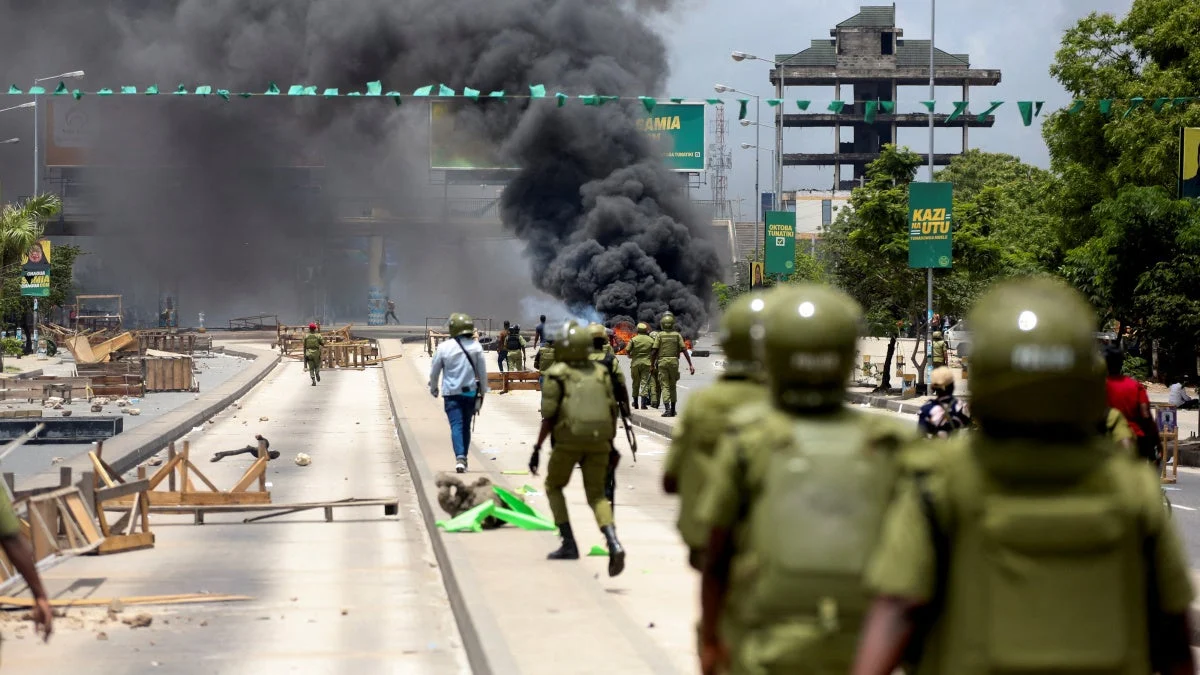
The unrest began in earnest on the morning of October 29. In Dar es Salaam, protesters blocked major arterial roads, including Mandela and Bagamoyo roads, using burning tires and debris. By early afternoon, the government responded by imposing nationwide internet restrictions, severely hampering communication and the documentation of events in real-time.
At 5:00 PM on election day, Police Inspector General Camillus Wambura announced an immediate and indefinite lockdown in Dar es Salaam. Residents were ordered to stay indoors, and only security personnel were permitted on the streets. This lockdown was later expanded nationwide. Despite these orders, protests continued into October 30 in several cities and at the Namanga border crossing with Kenya.
The enforcement of the lockdown was characterized by the indiscriminate use of live ammunition and tear gas. Witnesses reported that military and police units established roadblocks, in some instances preventing the wounded from reaching hospitals, which directly contributed to the loss of life. By November 1, the Election Commission declared President Hassan the winner. She was sworn in for a second term on November 3, shortly before the government announced a "gradual resumption" of normal activities and the restoration of internet services.
Regional Findings: Mwanza and the Buhongwa Market Massacre
The northern city of Mwanza witnessed some of the most severe violence. On the morning of October 30, police officers moved to enforce the lockdown at a market in the Buhongwa neighborhood. Witnesses told HRW that many vendors and shoppers were unaware that the lockdown had been extended to Mwanza, or were in the process of packing their goods when police arrived.
Around 8:00 AM, approximately 20 officers began beating people with sticks. When the crowd did not disperse quickly enough, the officers reportedly transitioned to using live ammunition, firing directly into the groups of vendors. Documented fatalities at the Buhongwa market included a motorcycle taxi driver, a shoe salesman, a tailor, and a traditional medicine vendor. In total, at least seven people were killed and 50 injured in this single incident.
The violence in Mwanza escalated the following evening. At the Mjimwema center, police officers allegedly opened fire on a group of people watching a football match at a local restaurant. According to survivors, officers ordered patrons to lie face down on the ground before shooting them. HRW identified 14 deaths from this incident, corroborated by video evidence showing bodies arranged in the street and inside the establishment. Subsequent forensic analysis by international media outlets suggested the ammunition used was consistent with Kalashnikov-style assault rifles, which are standard issue for Tanzanian police.
The Situation in Arusha and Dar es Salaam
In Arusha, the crackdown targeted neighborhoods such as Mianzini and Sakina. Witnesses described a chaotic scene where police fired into crowds protesting the rising cost of living. One witness documented the death of a pregnant woman who was shot in the back while returning from a market. Another account detailed the death of a man shot while leaving a mosque. The morgue at Mount Meru Hospital was reportedly so overwhelmed with bodies that families struggled for days to identify and recover their relatives.
The violence extended to the Namanga border, where Tanzanian police fired across the frontier into Kenyan territory. A 32-year-old man eating at a restaurant on the Kenyan side of the border was severely injured when a bullet struck him in the face. Kenyan authorities eventually transported him to Nairobi for treatment, as his family feared he would be arrested if they sought medical aid within Tanzania.
In Dar es Salaam, the HRW report highlights the case of Peter Elibariki Makundi, a lawyer who was shot and killed while returning home from shopping. Other victims included a motorcycle taxi driver who was arrested while transporting a customer, severely beaten, and charged with treason. He was only released in late December after a presidential directive ordered the review of hundreds of similar cases.
Mass Arrests and Legal Violations
The government’s response included the detention of over 2,000 individuals. Many, including children, were held on charges of destroying government property or treason—a capital offense in Tanzania. HRW emphasizes that these arbitrary arrests and the use of treason charges to suppress dissent violate both Tanzanian law and international human rights standards.
The African Charter on Human and Peoples’ Rights, which Tanzania has ratified, strictly prohibits the excessive use of force and guarantees the right to a remedy for victims of human rights violations. Furthermore, the UN Basic Principles on the Use of Force and Firearms dictate that security forces must use non-violent means whenever possible and that the intentional lethal use of firearms is only permissible when strictly unavoidable to protect life. The evidence gathered by HRW suggests that Tanzanian security forces routinely ignored these principles during the 2025 election cycle.
Official Responses and the Commission of Inquiry
Under mounting international pressure, the Office of the President established an "independent commission" on November 18, 2025. Composed of former officials and retired civil servants, the commission is tasked with investigating the "breach of peace" during the election period. However, the commission’s mandate remains opaque, and it is currently unclear if its scope includes the investigation of deaths and injuries of non-protesters or the legality of the mass arrests.
Human Rights Watch reached out to both the Tanzania Police Force and the Commission of Inquiry in March 2026 to share its findings and request a formal response. As of this publication, no response has been received. The commission is scheduled to conclude its findings by April 3, 2026.
Analysis of Implications and International Reaction
The events of late 2025 have significantly damaged Tanzania’s long-standing reputation as an "island of peace" in a volatile region. The use of the military to enforce a domestic lockdown and the targeting of civilians indicate a shift toward more militarized governance.
"The Tanzanian authorities should recognize that impunity for rights abuses encourages further political violence," said Oryem Nyeko, senior Africa researcher at Human Rights Watch. "The commission of inquiry should deliver justice for the victims and accountability to ensure that such violations do not happen again."
Developmental partners and neighboring governments are being urged to call for a thorough and transparent investigation. There are also calls for the international community to provide direct support to Tanzanian civil society organizations, which remain the primary actors documenting violations despite the risk of state retaliation.
The long-term impact on Tanzanian society is profound. Many of the survivors interviewed by HRW reported permanent disabilities that prevent them from returning to work, plunging their families into poverty. The psychological toll on communities that witnessed indiscriminate shootings in marketplaces and restaurants has created a climate of fear that may take years to dissipate. As the Commission of Inquiry nears its deadline, the eyes of the international community remain fixed on Tanzania to see if the government will choose the path of accountability or continue a trajectory of repression.

Related Posts
Bangladesh: First Enforced Disappearance Case Since July 2024 Uprising
Crackdown on Artistic Dissent in Morocco: The Arrest of Mehdi Black Wind and the Shrinking Space for Freedom of Expression